

The Further Mis-Adventures Of Cliff Booth Doubles Down On A Once Upon A Time In Hollywood Controversy
Warning: This article contains spoilers for "The Further Mis-Adventures of Cliff Booth."
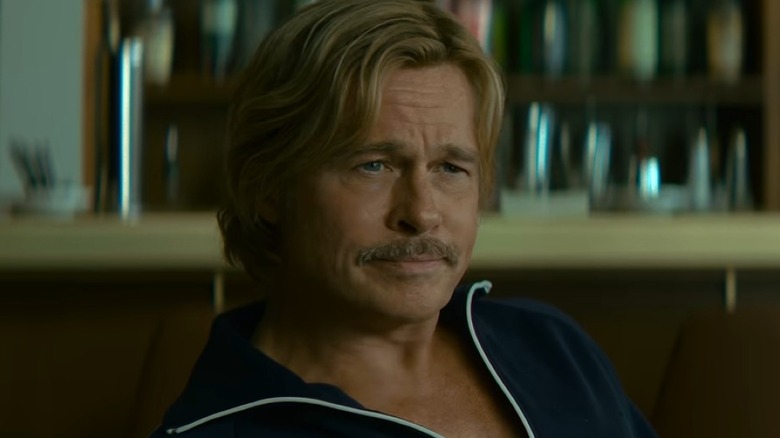
It simply wouldn't be a Quentin Tarantino movie if it didn't double down on itself. After wowing audiences everywhere in 2019 with "Once Upon a Time in Hollywood," the quirky and uber-talented filmmaker returned to the scene of the crime (so to speak) once more with his long-awaited sequel/spin-off film, "The Further Mis-Adventures of Cliff Booth." This time, the buddy comedy act with Leonardo DiCaprio's Rick Dalton and Brad Pitt's Cliff has been dropped, focusing solely on the latter as the stuntman embarks on his latest round of mischief. Though Tarantino stepped aside from his directing duties to make room for David Fincher, well, let's just say that the script is as purely QT as it gets.
That quickly becomes evident as we're dropped back into this alternate-history world of 1970s Los Angeles, and there's one recurring gag that references a certain controversy from before. You see, despite so much acclaim from critics and fans alike, "Once Upon a Time" drew the ire of many with its irreverent treatment of martial arts legend Bruce Lee, portrayed by Mike Moh in the film. Even Lee's family weighed in on the matter, objecting to how easily Cliff puts the arrogant Lee in his place during a fight scene on the set of a film. Not surprisingly, "Cliff Booth" returns to this fraught topic on several occasions, and it certainly feels like a meta-textual jab at the real-world backlash from before.
Was this in poor taste, or is Tarantino merely poking fun with a self-deprecating running joke? Moviegoers will undoubtedly have strong takes on either side. Here's where we land on our second go-around with this little debate.
To his credit, Quentin Tarantino doesn't shy away from the Bruce Lee controversy in Cliff Booth
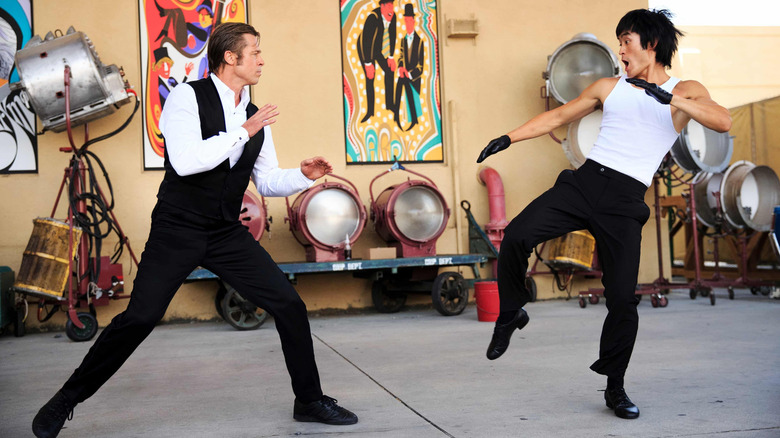
You know, there's something to be said for addressing an uncomfortable matter head-on instead of dancing around it — or even ignoring it altogether. Quentin Tarantino has never been one to shy away from a fight, a trait he happens to share with washed-up stuntman Cliff Booth. As a master cinephile, a brilliant bartender, a hit with the ladies, and a ruthless killer all in one, the power fantasy of it all isn't exactly hard to see in "The Further Mis-Adventures of Cliff Booth." Perhaps that's what made the Bruce Lee moment in "Once Upon a Time in Hollywood" stand out all the more (a fight that almost ended very differently). It's one thing for Cliff to be the coolest person alive in his world, and quite another for him to intrude rudely upon our own.
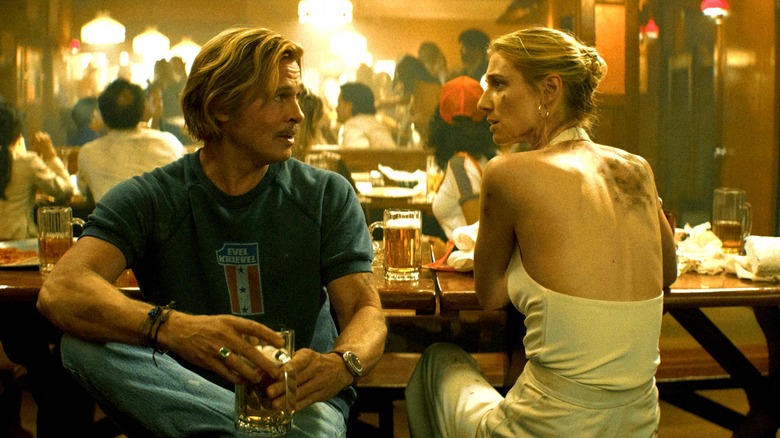
So how does "Cliff Booth" address this elephant in the room? Although the incident is brought up on a number of occasions in passing, Yahya Abdul-Mateen II's buzzy actor Rodrick "Hot Rod" Harrison is positively fixated on it once he meets Cliff — a fact that also seems to catch the eye of talent manager Karen Crosby (Elizabeth Debicki). Intriguingly, Cliff himself almost seems embarrassed by the attention, perhaps self-reflexively brushing it off as the brash actions of a young man. Maybe, like Tarantino himself, he's a little older and a little wiser and less apt to repeat the same mistakes.
Less generously, the fact that this fight is emphasized so much in "Cliff Booth" could make the exact opposite point. It's treated almost like a legend or a myth in this world, giving Cliff a dangerous sense of aura and mystique that belies his charming appearance.
The Further Mis-Adventures of Cliff Booth is about how we try to define our own stories
Either way, this is just one ingredient tossed into a much larger stew. "The Further Mis-Adventures of Cliff Booth" may struggle to reach the transcendent heights of "Once Upon a Time in Hollywood," but isn't that part of its point, too? "What is Cliff Booth without Rick Dalton?" Quentin Tarantino's script seems to be asking. Not dissimilarly, is a Tarantino movie with David Fincher at the wheel really a Tarantino movie anymore? Who can say how much ownership any of us have over our own art — or our lives in general?
Perhaps that's why "Cliff Booth" feels so much colder and mean-spirited than its predecessor. Although both films build to violent climaxes, the one in "Hollywood" is shot to be much more over-the-top and darkly funny than the one here. Before, Rick Dalton and Cliff were fighting to preserve a very specific way of life — one that the Manson family threatened to overturn. Here, Cliff very easily could've avoided the bloodshed with killers Eddie (Matt Groove) and Fernando Verdusco (JB Tadena), but he pursues this anyway out of ... ego? Principle? A sense of right and wrong? Cliff is a man of both simplicity and contradictions, so perhaps it's only fitting that the filmmaking style reflects this through Fincher's very different approach, as well.
That's where the repeated jabs about the Bruce Lee fight come in, as a moment that Cliff has no choice but to own. "Cliff Booth" is a movie about our attempts to define our own stories — whether it be himself, the troublemaking TV star Charlie Peters (Scott Caan), or Karen. And maybe Bruce Lee, too.
"The Further Mis-Adventures of Cliff Booth" is now playing in limited theaters.