

VisionQuest's Finale Finally Pays Off A Story Marvel Started In Avengers: Age Of Ultron
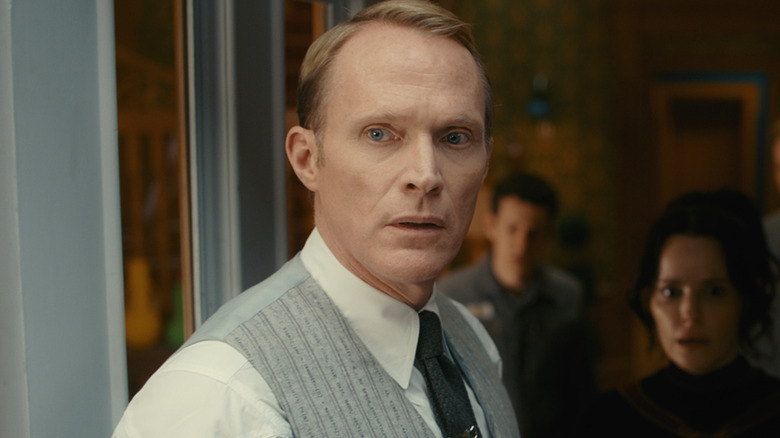
What is grief if not spoilers persevering? This article discusses major plot details from the season finale of "VisionQuest."
An argument could be made that the "VisionQuest" finale was a confrontation over a decade in the making. Clearly, the well-received Disney+ series has marketed itself as a "WandaVision" sequel and a trilogy-capper to the story continued in "Agatha All Along." But there's no way around its biggest and most pressing concern: providing a fitting epilogue to the 2015 blockbuster "Avengers: Age of Ultron." In an inspired choice, "VisionQuest" showrunner Terry Matalas understood there was still plenty of unfinished business between James Spader's megalomaniac robot Ultron and Paul Bettany's synthezoid Vision, which finally pays off spectacularly in the eighth and final episode of the show.
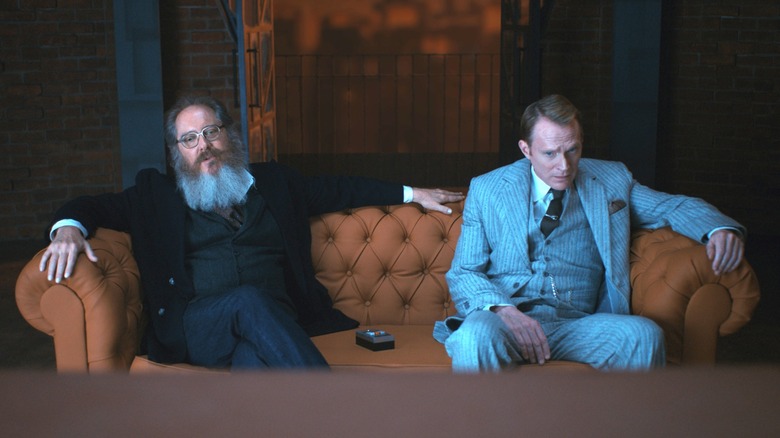
Once Vision and Jocasta (T'Nia Miller) realize that the mysterious Client dogging their steps is actually Virgil Horton (also played by Spader), the descendant of Phineas Horton (aka the mind behind the Synthetic Man, as portrayed by Bettany), this sets up the finale's most compelling battle. No, it's not Horton's toxic, twisted love for Dr. Jo Carrington and his desire to inhabit Vision's body so they may live forever together. It's the apparent murder of Ultron's lover Jocasta, setting off Ultron's malevolence towards humanity and one last showdown with Vision.
This is precisely the kind of potential that shared universes were meant to fully realize — not cameos and references for the sake of it or disposable narratives to throw on in the background as white noise, but as meaningful additions to ongoing arcs for viewers willing to take the time to explore them. That may go down as the greatest accomplishment of "VisionQuest" in its finale, delivering the perfect button on the Ultron saga that "Age of Ultron" simply couldn't pull off.
VisionQuest gives us the Vision vs Ultron fight that Avengers: Age of Ultron couldn't fully deliver
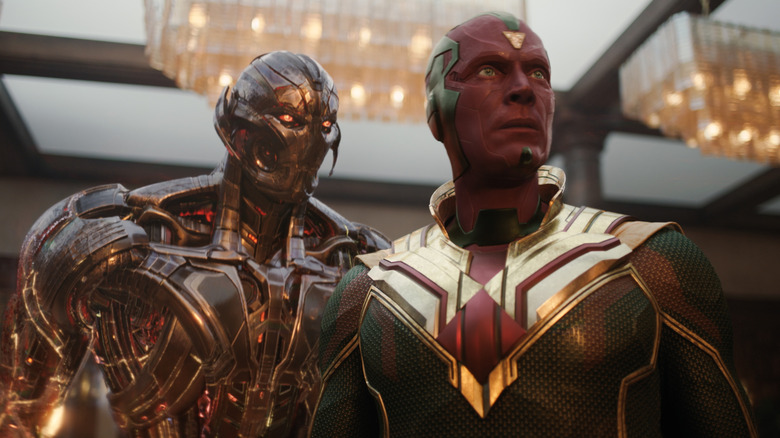
Amazing what eight hours of storytelling can do that studio-meddled blockbusters never could, eh? In spite of its obvious shortcomings and compromises, we here at /Film are long-suffering defenders of "Avengers: Age of Ultron." Arguably the last time the Marvel Cinematic Universe was able to be as weird and messy and introspective as the comics themselves, the movie still managed to find moments of quiet poignancy amid all the mind-numbing spectacle. To no surprise, that's something showrunner Terry Matalas and his writers have carried over into "VisionQuest," and nowhere is that more confidently on display than in the finale.
We're not only talking about the moment when a dying Jocasta merges Ultron with the horde of killer nanobots and allows him to regain his physical form, fighting Vision in a well-staged battle that ought to be many a nerd's dream come to life. What puts the finale over the top is when it somehow combines the best of "Age of Ultron" with "WandaVision." Vision traps Ultron inside a sitcom-set mindscape where the two artificial beings can hash out their differences without throwing hands and trading particle beams at each other. If previous episodes filled in some Ultron-centric plot holes, then this one brings us back to their best moment of all — when, in the midst of Sokovia's destruction, the two land in an idyllic forest to talk about humanity's doomed fate, the grace found in their failings, and the fact that nothing beautiful is meant to last forever.
Here, the big climactic fight becomes a treatise on Ultron's all-consuming grief, his unresolved malevolence towards human beings, and, deep down, his debilitating fear of being alone.
The VIsionQuest finale suggests that Ultron can be redeemed
If we let "Avengers: Age of Ultron" have the final word on the murderous, genocidal robot, then Ultron's arc is conclusively a tragic one. Designed to save humanity, he instead opts to facilitate our wholesale destruction and finally achieve "peace in our time." He does learn to become surprisingly more human over the course of the film, but his last act is a refusal to grant humankind the benefit of the doubt — and he pays for that with his life (unless, of course, you subscribed to certain fan-theories about his survival).
To the credit of "VisionQuest," this season-long epilogue suggests there's more to his emotional journey than a single movie could ever explore. The finale digs even deeper to prove this, completing Ultron's transformation into something much more human by giving him someone to love. Despite the changes made to the comics' origins, the Ultron/Jocasta romance is a defining moment in Ultron's portrayal in the MCU. Finally, he can understand Vision's own progression to becoming an individual in his own right, along with all the joy and loss and humanity that comes with it.
That's probably why, even after he retreats back to his old ways and attempts to cause our extinction again, "VisionQuest" posits that Ultron isn't beyond redemption. Sure, it isn't until he's confronted with his own mortality that he finally decides to spare the world's population. But even that is as human as it gets. Vision helps him come to terms with what life has to offer. And when we leave him, eager to appreciate human art and perhaps even rebuild Jocasta, it's a perfect period to the end of his sentence ... or, perhaps, an ellipsis.
"VisionQuest" is now streaming on Disney+ in its entirety.