

The Office's Downfall Can Be Traced Back To One Moment
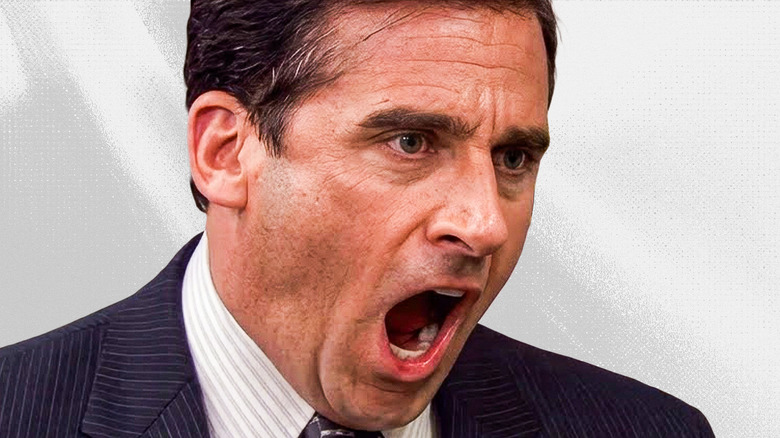
In 2005, two TV shows premiered as mid-season replacements, which isn't usually a great sign for said series' potential longevity. One was "Grey's Anatomy" on ABC, which became one of the longest-running TV shows in history. The other? "The Office," an adaptation of Ricky Gervais' British series of the same name that became one of the biggest hits in the entire history of NBC.
With Steve Carell leading the way as the well-meaning but unbelievably buffoonish Michael Scott (the regional manager of the Scranton branch of paper company Dunder-Mifflin), the American version of "The Office" made it past a somewhat rocky first season and became a small-screen staple, launching the careers of Carell and co-stars like John Krasinski, B.J. Novak, and Mindy Kaling. (It also, arguably, led to an uptick in small-screen mockumentaries like its successors "Modern Family," "Parks and Recreation," and "Abbott Elementary.") After running for nine massively successful seasons, "The Office" wrapped up its run in 2013 with a finale that actually stuck the landing ... but the road to the finish was rough.
You can argue all you want about how to pinpoint the downfall of "The Office," but I won't entertain any debate. The answer is that "The Office" hit a major point of no return in Season 7 when Carell left the show, which led to Michael Scott moving away from Scranton and decamping to Colorado. Despite its best efforts to continue relatively uninterrupted, the series just didn't functionally work without Michael Scott.
The Office never recovers from Steve Carell's departure
It's perfectly understandable that Steve Carell wanted to leave "The Office" behind after spending so long playing one character. (He's a pretty talented guy, after all.) Still, the show should have just ... ended. Even the lead-up to Michael's exit was, all things considered, sort of bleak. This is conjecture on my part, but it really felt like, in Season 6 episodes like "Scott's Tots" and "Koi Pond," the show was leaning into Michael's worst impulses and making him straight-up unlikable instead of silly but well-meaning.
The reason for Michael's departure, however, is undeniably sweet. After human resources representative Holly Flax (Amy Ryan) makes her debut appearance in the Season 4 finale "Goodbye Toby," she and Michael ultimately fall in love before she gets moved back to her original Dunder-Mifflin branch in Nashua due to higher-ups fretting about the pair's relationship. Then, in Season 7, she returns to Scranton, and while Holly and Michael have been broken up for some time when she finds herself back in northeastern Pennsylvania, they get back together ... but their happy ending is threatened when family troubles mean that Holly needs to move back to Colorado.
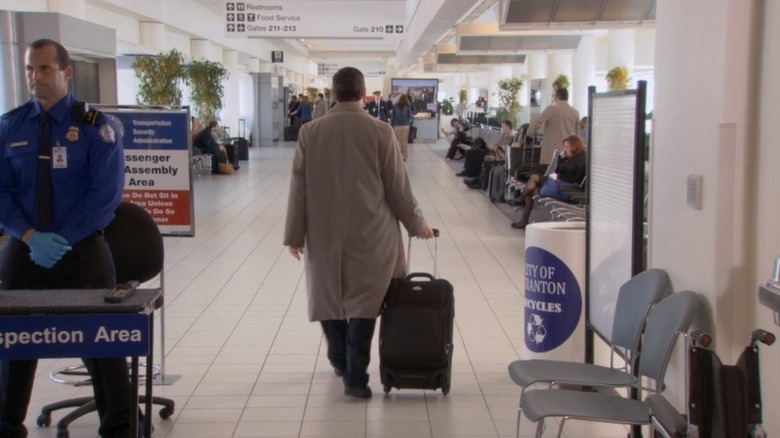
Thankfully, by this point in the series, Michael is back to being essentially likable again, so he does the right thing: He proposes to Holly and tells his colleagues he's moving with her. His final episode, "Goodbye Michael," is incredibly moving, especially the moment where Pam Beesly-Halpert (Jenna Fischer) says goodbye to Michael in the airport. Yet, the show loses its footing forever as he departs, and it never recovers. Why? Well, the string of potential replacements for Michael is lackluster at best and egregiously unfunny at worst.
None of the other bosses on The Office ever worked as well as Michael Scott
One of the many crimes committed in the final two seasons of "The Office" is that the show managed to make English treasure and comedy legend Catherine Tate actively exhausting, but I'm getting ahead of myself. First, "The Office" pulls out the stops by bringing in Steve Carell's "Anchorman" cohort Will Ferrell (the proverbial comedic big gun) as Deangelo Vickers, a deeply confusing and unfunny new manager who's written off after getting a brain injury during a pickup basketball game. From there, Creed Bratton's erratic "Creed Bratton" briefly becomes the manager (and it goes just as well as any "Office" fan would expect), and while James Spader's unfathomably bizarre Robert California has his moments as one of Creed's successors, he doesn't work, either.
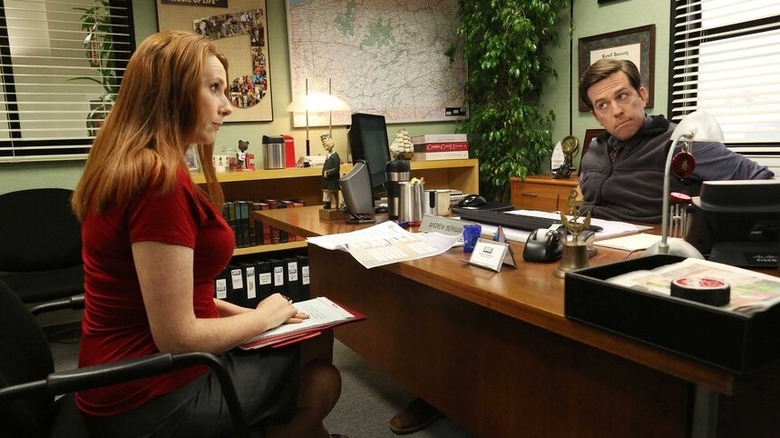
Ultimately, Tate's Nellie Bertram and Ed Helms' Andy Bernard are the people who run the Scranton branch most consistently in Michael's absence, and not only are they both terrible at the job, neither of them recreates the magic that only Carell could bring to the series. Instead, Tate's Nellie is, at varying times, exceedingly ridiculous or shrewd (it depends on the episode you're watching), whereas Andy is so expendable that "The Office" briefly writes him off. (This was done to free up Helms to go film "The Hangover Part III" at the time.) Moreover, everyone eventually gets simplified to the point of parody (i.e. Flanderized, to use a popular "Simpsons"-inspired term), so much so that Andy, himself an Ivy League graduate, becomes borderline illiterate. Put simply, it's a mess.
Yes, "The Office" has a great series finale, but the journey to getting there was rough without Michael Scott. Decide for yourself: The show is currently streaming on Peacock.