

Star Trek's Brent Spiner Won't Take Credit For Data's Most Important Contribution [Exclusive]
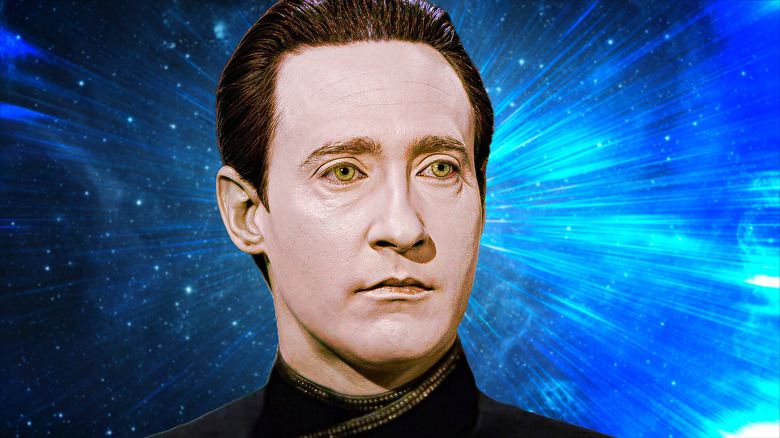
While the "Blade Runner" franchise gets all the credit for its themes about becoming "more human than human," "Star Trek" has always been on the bleeding edge of this classic sci-fi concern. Spock, of course, symbolizes the franchise's most enduring attempt to reflect our own intrinsic foibles and eccentricities throughout "The Original Series" and beyond. But coming in a close second place would have to be Brent Spiner's Data, the lovable android who's devoted much of his programming to the pursuit of making sense of his flesh-and-blood crewmates.
The legacy of Data extends far beyond the mediums of film and television, however. Countless fans have come to view the scene-stealer of "The Next Generation" as an avatar for basic human rights, coexistence, and, most intriguingly of all, neurodivergence. It's easy to see why. As someone on the outside looking in at an entire world of emotions and feelings — which he logically intuits, but struggles to regulate and understand — Data's journey has struck a chord with anyone who's gone through similar experiences in life.
It wouldn't be a big leap to say that Data helped the general public better understand the tricky topic of mental health, and particularly neurodivergence ... but don't expect Spiner himself to take credit for that. At this year's New York Comic Con, I spoke with the "Trek" veteran about his character's contribution to pop culture and society's wider acceptance of those whose brains process reality differently than others. According to Spiner:
"Well, I wouldn't be so arrogant as to say I had anything to do with the acceptance of neurodivergence, or anything else for that matter. It was a role. A really sweet, good role, and I'm glad if it did have that effect, but I know it wasn't intentional."
Why Brent Spiner sees his performance as Data as an 'unknowing conduit' for Star Trek fans

Even if Gene Roddenberry and the writers of "The Next Generation" didn't necessarily approach Data with the intention of making neurodivergence normalized or more mainstream, the effects of both the character and Brent Spiner's performance are impossible to debate. This concept was even made literal during the various movies, as Data (somewhat controversially) installed an emotion chip that gave him access to all the feelings he had spent years longing for throughout the series.
Even in the decades since, as "Star Trek" celebrates its 60th anniversary in 2026, that aspect continues to be meaningful to entire generations of Trekkies. And, as is usually the case, fans have never hesitated to share that love with the actor. Brent Spiner went on to tell me:
"I've met a lot of kids who were autistic or had Asperger's and have told me, 'Oh, you helped me so much when I was young, because I couldn't relate to the human experience, and there was Data going through the same thing.' And I had nothing to do with that, except that I was there, and I'm glad I was. I was just an unknowing conduit for people just to feel better about themselves. And that's all I — that makes me really happy."
There's clearly a direct line extending from Spock to Data to even characters like Robert Picardo's Doctor in "Voyager." Six decades on, it's comforting to know that "Star Trek" continues to make room for the full spectrum of the human experience. You can see Spiner and several cast members talk about that and more in the new documentary "The Sixty-Year Mission: How Star Trek Changed Television and the World," now playing in Regal theaters.