

The Twilight Zone Creator Rod Serling Worked On A Survival Series That Could Have Been Legendary
We may receive a commission on purchases made from links.
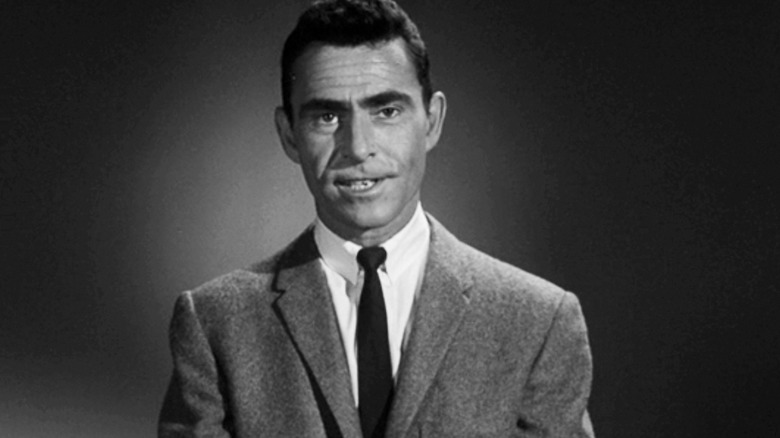
According to Rod Serling "The Twilight Zone" is not a sci-fi series. But it doesn't really matter what you call it. The show remains the greatest TV anthology series of all time, and if it was the only thing Serling ever did he'd still be a legend. After the show was canceled in 1964, however, Serling maintained his prolific output, which at one point saw him write the pilot for a series called "The New People," which was both ahead of its time and viewed with a certain disdain by the creator himself.
After "The Twilight Zone" Serling created the short-lived Western series "The Loner," in which he tried to hook audiences by bringing his socially conscious sensibility to the small screen Oater. It didn't quite work out, and Serling moved on. Before creating his second most-famous show "Night Gallery," he penned a few TV movies, after which he lent his talents to a new show created by Aaron Spelling and Lawrence Gordon.
"The New People" began airing on ABC in 1969 and followed a group of college students who became stranded on an island in the South Pacific. But this was nothing like the adventures of Gilligan and his castaways, who that same decade had found themselves similarly stranded in the South Pacific (though Serling seemed to see a connection between the two shows). "The New People" explored what the younger generation of the era might do given the chance to run society without having to worry about older generations and established customs. It was an attempt to attract younger viewers but it didn't last long enough to attract much of an audience at all, even with Serling writing the pilot episode.
Rod Serling's The New People pilot followed students stranded in the South Pacific
"The Twilight Zone" was kicked off the air by forgotten 1960s sitcom "Fair Exchange," in a development that was, ironically, anything but. Still, Rod Serling pushed ahead. As his daughter, Anne Serling, wrote in "As I Knew Him: My Dad, Rod Serling," "The cancellation of 'The Twilight Zone' has not slowed him at all. Producer Aaron Spelling wants him to write a pilot for a series called 'The New People.'"
Spelling and producer Lawrence Gordon, who later went on to produce "Predator" and the first two "Die Hard" movies, had indeed come up with a premise and enlisted Serling help bring it to life. He obliged, though judging by his and others' comments he seemed to have regretted it. Not that he should have. The show was ahead of its time in many ways, with Anne Serling noting in her memoir, "The show, some think, is the inspiration for J.J. Abrams' 'Lost.'"
Serling delivered his script and the show went into production, debuting alongside three other new series on ABC in February 1969, one of which was a now forgotten show that ultimately gave us "Happy Days:" "Love, American Style." "The New People" however, didn't last long enough to do much of anything. Serling's pilot sees a group of college students on a goodwill tour of South East Asia suddenly become stranded on a deserted island when their plane goes down. The surviving students eventually discover that they've landed on Bomano, which the Atomic Energy Commission (AEC) intended to use as a testing site for nuclear weapons. As such, the island comes complete with its own deserted town, filled with food and supplies. It's up to the young survivors to establish their own society.
Even Rod Serling wasn't a fan of The New People
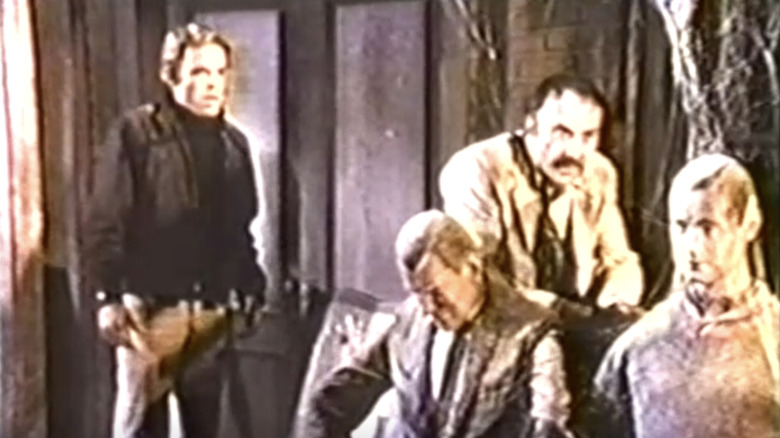
The pilot episode of "The New People" contains much of the social commentary Rod Serling was known for, but it wasn't quite as cleverly managed as in the "Twilight Zone" years. The first episode sees a racist student scupper the group's chances of being rescued simply to keep a Black student stranded on the island. The only surviving adult of the crash, Mr. Hannichek (Richard Kiley), then does what he can to prevent the other students from killing the racist, before succumbing to a wound he sustained in the crash. The surviving students are then left to establish the kind of society they had been calling for at home via their radical ideology.
Critics were split on the program, but more interesting was Rod Serling's take. Serling had already delivered a candid opinion on "Star Trek" but was seemingly willing to hold himself to account, too. In "As I Knew Him," Anne Serling writes, "My dad sends over his script but later comments that while its "sub-'Lord of the Flies' theme may work for television, it doesn't work for him." Elsewhere, in "Serling: The Rise and Twilight of Television's Last Angry Man," author Gordon F. Sander quotes the writer as having told journalist Cecil Smith, "That's Aaron Spelling's show. I have nothing to do with it. The show is somewhere between 'Gilligan's Island' and San Francisco State. It may work, but not with me."
It didn't work. "The New People" was cancelled after 17 episodes and, according to Sander, was "predictably combative and talky" demonstrating "how out of touch [Serling] had become with the younger generation." Still, "The New People" had a premise that could have resulted in a better show, given time.