

The Uprising Review: Andrew Garfield's Robin Hood Origin (Sort Of) Is A Dull, Dreary Disappointment
There might not be a single piece of recognizable IP that Hollywood is more eager to push than Robin Hood. On paper, it's easy to see why. As a legend of folklore and fables, the role naturally lends itself to any movie star stepping into the famous woodland archer's shoes and reinterpreting the character as a filmmaker sees fit. Given the whole "Steal from the rich, give to the poor" of it all, there's no real risk of this ever feeling untimely or out of date. And, in an era where audience familiarity is the most valuable commodity to studios ... well, who the heck doesn't know Robin Hood?
None of this, however, has managed to bring this public domain figure any closer to becoming a bankable draw at the box office — or, as this latest effort shows, a particularly interesting subject for any adaptation to tackle, either. With the lone exception of Michael Sarnoski's revisionist "The Death of Robin Hood," no installment released in the last decade (or three) has managed to feel all that worthwhile. At this point, it's fair to wonder if it's high time to call an end to this whole experiment and hang up the hood for good.
Into this most inauspicious of landscapes steps writer/director Paul Greengrass with "The Uprising," which doesn't exactly do much to dissuade anyone of that notion. Apparently, the brilliant and not-at-all confusing idea this time around was to attempt a Robin Hood movie that's not actually a Robin Hood movie at all. To paraphrase Chris Evans' infamous "Lightyear" tweet, this is a story about the man who allegedly inspired the Robin Hood myth. If that sounds like an awkward and oddly ham-fisted approach, that's nothing compared to how dull and dreary this disappointment proves to be.
Paul Greengrass' handheld, shaky-cam aesthetic is a terrible fit for The Uprising
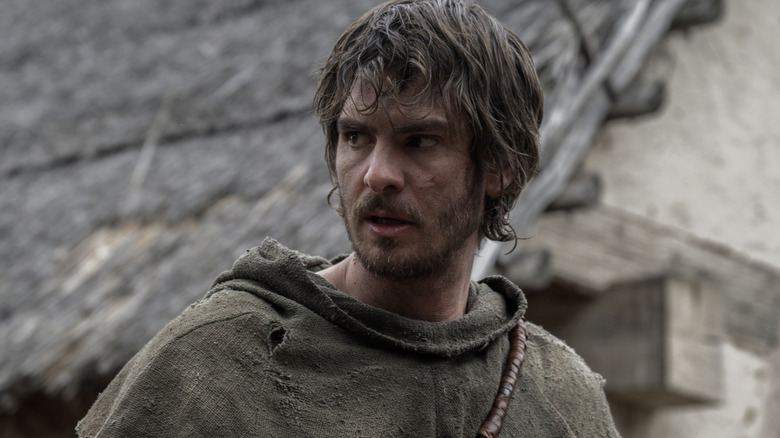
After a series of title cards establishing the 1381 setting as England's remaining population struggles to recover from the devastating plague, we meet Andrew Garfield as our latest twist on the Robin Hood hero, known only as "Ploughman." ("I am what I do," he states early on.) He works his field, wordlessly grieves the deaths of his wife and two children, and ... yeah, that's pretty much all we ever get to know about him. This broken land is ruled in name only by the hopelessly overmatched and unconvincing boy king Richard II, portrayed by the similarly overmatched and unconvincing Woody Norman (a far cry from his tremendous work opposite Joaquin Phoenix in Mike Mills' "C'mon C'mon"). When the crown pushes the peasants to the breaking point, our Ploughman finally snaps and inadvertently kicks off a revolution.
The only problem? All of this goes down in the first 10 minutes, essentially skipping the first act altogether in as baffling a screenwriting faux pas as I've ever seen. There's something fundamentally amiss about "The Uprising" — a feeling that only grows as the overlong 127-minute runtime plods on.
It's unmistakable how mismatched Paul Greengrass is with this material. The "Bourne" director's trademark handheld style is back in full force here, but every instance of abrupt digital zoom-ins and manufactured chaos is completely at odds with an historical period piece. The action (what little there is) is never in focus. Garfield and his co-stars are hardly ever given the chance to actually command the screen, as cinematographer Pål Ulvik Rokseth instead opts to shoot walk-and-talk moments almost entirely from the back of his cast's heads. It only gets worse from there.
The Uprising is filled with cardboard-cutout 'characters,' a bore of a plot, and no sense of scale
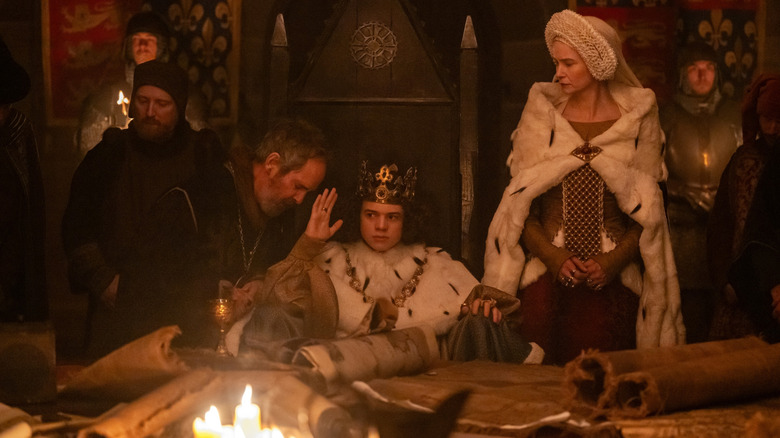
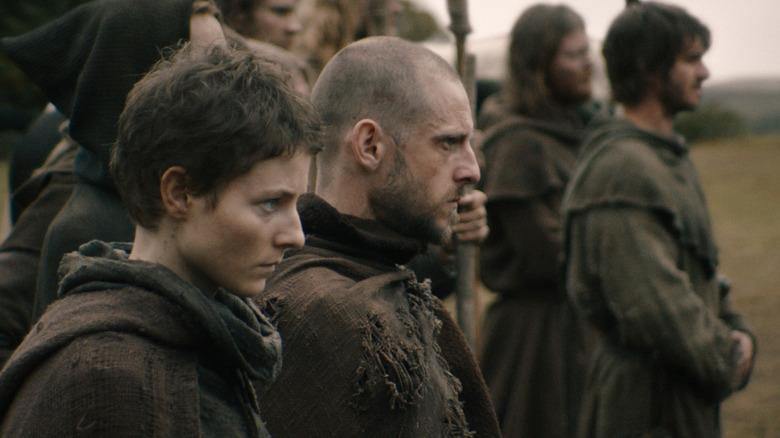
As bad as it is that form and function are waging bloody war with one another in "The Uprising," the journey that Paul Greengrass' half-baked script takes its sorry excuse for "characters" on is even more concerning. When Ploughman joins his fellow peasants from Essex all the way to London to petition the king with their demands, they meet allies like Jamie Bell's "heretical" friar John Ball, Cosmo Jarvis' soldier/rebel leader Wat Tyler, and Thomasin McKenzie's nun Alyce — each one even more one-dimensional than the last. As we're shown a mind-numbing amount of times, the mousy King Richard II is merely a pawn to the preening, scheming, mustache-twirling members of his council (made up of Stephen Dillane, Tom Hollander, and Stanley Townsend). Not even the great Katherine Waterston is given anything to do as the king's mother, known only as The Countess, other than stand around disapprovingly.
When both halves of the plot collide, it's less an inevitable clash and more like a shrug. A series of riots and marches and confrontations across the countryside as the balance of power tips precariously shouldn't ever feel as perfunctory as it does here. Once again, much of that comes back to the decision to take an epic drama aspiring to the heights of "Spartacus" or "Gladiator" and shoot it as if it were a low-budget documentary. A recent success like "The Odyssey" points to how extreme close-ups of its cast's faces can add intimacy without sacrificing the scale. "The Uprising," unfortunately, makes the exact opposite point. When the whole movie is filmed so suffocatingly small, not even armies of grubby-looking extras or stunning, on-location shooting can make the stakes and tension feel real.
The Uprising has nothing to say about the Peasants' Revolt or Robin Hood
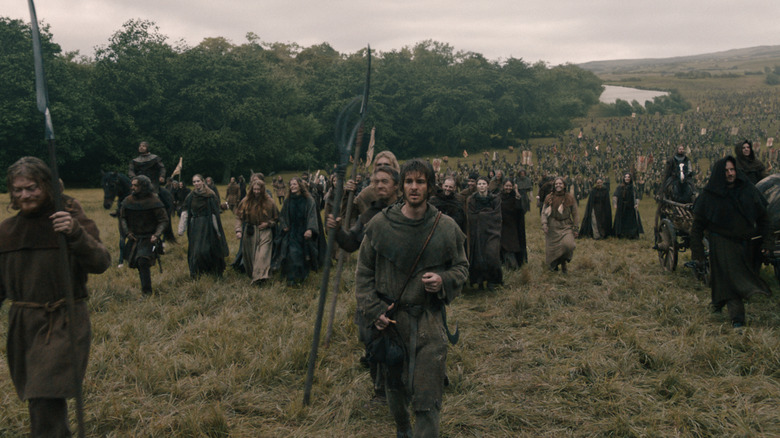
For a story ostensibly about the real-world circumstances behind the Peasants' Revolt of 1381 (and, judging by that bizarre marketing saga, Robin Hood himself), "The Uprising" is shockingly incurious about the "how" or "why" behind any of it. There's some vague lip-service paid to removing the "poison of wealth" from ruling elites and the Black Death coming as "punishment for the crimes of the rich," but anyone looking for some substantial ideology — or even a pretense of one — is bound to be disappointed. The dramatic, truly realm-shaking events of this rebellion (credited for ushering in the end of England's system of serfs and fiefdoms) is as cinematic as it gets. Too bad "The Uprising" only has the imagination to capture this in hazy, washed-out colors at night or under overcast skies.
At the risk of criticizing a movie for what it isn't, a politically-driven, "Game of Thrones"- or "Succession"-like exploration of the backstabbing, courtly intrigue in Canterbury would've been a vastly more intriguing option. Or, what if this had taken an incisive look at the true cost of revolutions and the struggles of uniting a populace under one goal? Even an explicit Robin Hood origin story would've brought something to the table, as opposed to merely gesturing at one on the margins. Anything would've improved on a feature mostly content to draw hackneyed, "The Flemings are stealing our jobs!" parallels or culminate in a head-scratching bait and switch.
Every so often, you can just sense when a movie is scrambling for a reason to exist. Forget Robin Hood. "The Uprising" ultimately has nothing interesting to say — about anything, really.
/Film Rating: 4 out of 10
"The Uprising" arrives in theaters on September 11, 2026.