

Hope Review: Na Hong-Jin's Alien Invasion Epic Needs To Be Seen To Be Believed

"Hope" is unlike any other movie you'll see this year — or any year, for that matter. The South Korean blockbuster, reportedly the most expensive production in the country's cinematic history, doesn't attempt to merely live up to its own lofty expectations; it's set on shattering them completely. Ten long years after director Na Hong-Jin unleashed his last feature upon us (the unsettling horror film "The Wailing"), nobody could've expected the complete 180 he'd take with his long-awaited follow up. But the bulk of the novelty comes from how refreshingly idiosyncratic this genre-defying epic is. Just when you think you've got a handle on the specific storytelling mode and tone this is going for, Na's script pulls the rug out from under you and hits you in the face with something else entirely.
"Hope" might as well be several wildly different movies in one. The opening 45 minutes or so confidently lays out the sleepy coastal village of Hope Harbor (set so close to the DMZ that we see multiple "Report spies" signs ominously scattered about), the trio of main protagonists we'll end up following, and the unseen monster stalking them all through the narrow streets and alleyways. Next comes the disaster flick, a relentless stretch of action that eschews silly trivia like "plot" or "story structure" in favor of sensory overload during one thrilling, claustrophobic set piece after another. Afterwards, that's when things get weird, building to a crescendo of some of the goofiest, most audacious sci-fi nerdery you'll ever see outside James Cameron's "Avatar."
It's truly not overselling this experience to say that, for better and worse, the final result is far more memorable than any mainstream movie of the pandemic era.
Hope takes an unconventional approach to the blockbuster formula
Following its Cannes premiere earlier this year, "Hope" justifies most of the festival hype by taking a thinking person's approach to a creature feature. Where American cinema has spent decades trying (and mostly failing) to chase the mix of restraint and spectacle in "Jaws" and "Jurassic Park," here comes an alien invasion movie that fully understands what you don't see is oftentimes more frightening than what you do ... in the early going, at least. Na Hong-Jin's barebones approach to narrative will inevitably rankle viewers used to Hollywood's spoon-feeding tendencies. But, then again, it'd be a mistake to expect something conventional and straightforward from an artist who has so often prioritized atmosphere, mood, and feeling.
The same certainly holds true here. That outright rejection of all the familiar blockbuster tropes is evident as soon as we meet local sheriff Bum-seok, a small-town cop defined almost entirely by how ineffectual he really is at his job. As with everyone else we meet, there's no tragic backstory or clichéd family drama to make us invested in this figure — who, on the face of it, is as unlikeable as it gets. Instead, star Hwang Jung-min is mostly tasked with playing various shades of irritation, helplessness, and pure, eye-popping terror (along with enough foul-mouthed rage to make sailors blush). "Hope" knows exactly what kind of movie it is and, more importantly, what it isn't.
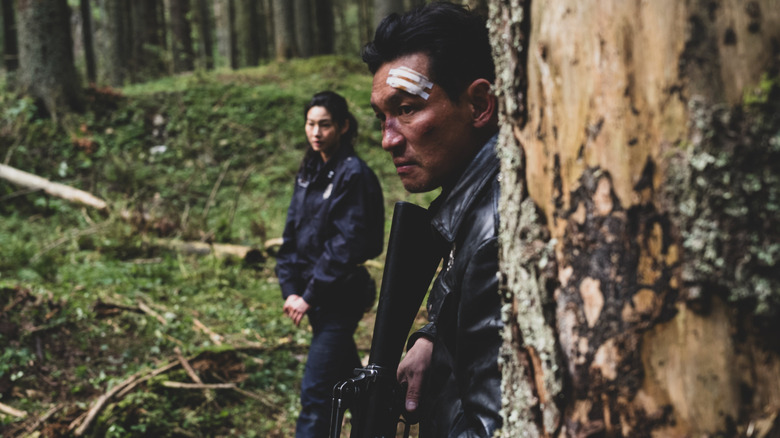
When Bum-seok and hunting-enthusiast cousin Sung Ki (Zo In-sung) come upon a dead cow slaughtered by some beast and left for dead in the middle of a country road, the film splits into a dual-perspective thriller: one following Bum-seok's nightmarish journey into a town ravaged by the predator, and the other with Sung Ki's gun-toting hunters wandering a forest.
Hope kicks off with the best, boldest, and most intense first act of any blockbuster in 2026
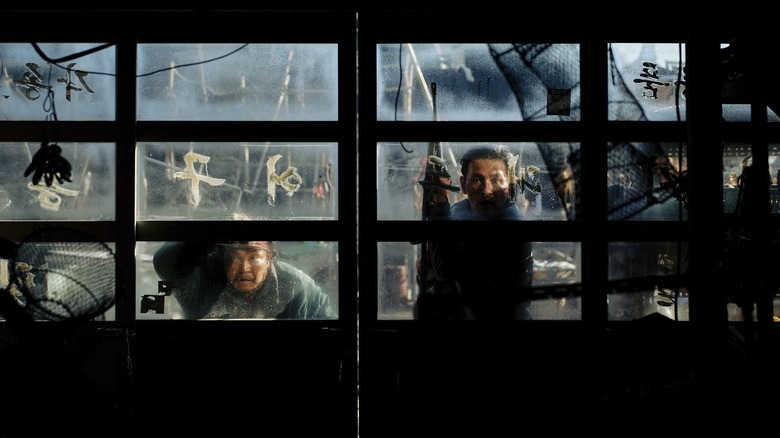
At the risk of overstating matters, all the action that unfolds from Bum-seok's hellish descent into Hope Harbor in pursuit of an otherworldly monster feels downright transcendent. Not since "Prometheus" or perhaps "A Quiet Place: Day One" has a blockbuster so convincingly captured the existential horror of humans pitted against an unstoppable force of nature (extraterrestrial though it may be). Writer/director Na Hong-jin seems to take genuine glee in keeping this monster hidden from us for as long as he possibly can. And when the film isn't cutting to stunning establishing shots of South Korean landscapes, further underlining the idea of humanity encroaching on a natural world that we don't know or understand, accomplished cinematographer Hong Kyung-pyo ("Snowpiercer," "Burning," and "Parasite") keeps the ever-moving camera at an almost suffocating proximity to Bum-seok.
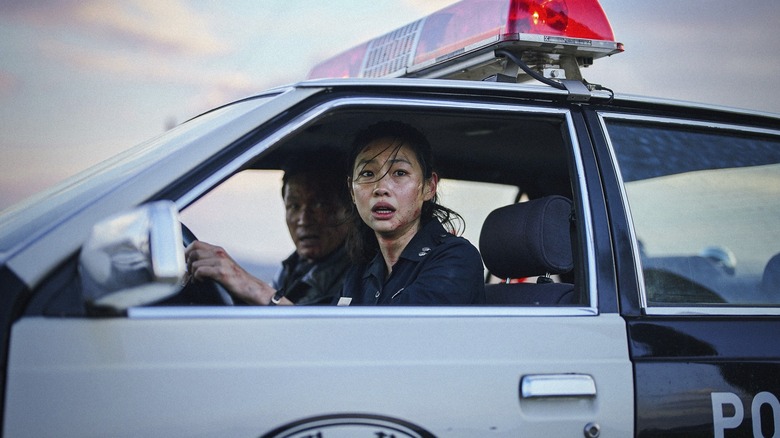
Not coincidentally, this is where all the artistry of "Hope" shines through the brightest. The almost deafening sound design is cranked up to 11 and works hand-in-hand with composer Michael Abels' brassy, orchestral score — a seamless collaboration that builds up to the unforgettable moment when everything drops out and Bum-seok catches his first glimpse of exactly what he's up against. Thrilling car chases in the streets, gunfire and explosions going off all around the actors, and even the hero-worthy introduction of Hoyeon as fellow cop Sung-ae all come together to make this war-torn opening act better than the entirety of most films I've seen this year.
Still, if it feels like this is leading to a massively deflating "But," that's because it is. In stark contrast to such a bold and intense first act, what comes next brings "Hope" crashing back down to Earth.
Hope overstays its welcome and takes a few big swings too many
It's this extended look at the potential of what "Hope" could've been overall that makes the latter half of the film feel that much more disappointing. It all starts to go downhill when Na Hong-jin has no choice but to let the other shoe drop and reveal the alien threat at the center of the story. The gooey, budget-breaking visual effects work does it no favors, but the decision to show it so prominently from that point forward (and often in broad daylight) lets almost all the air out of the balloon. Other than an inspired set piece here or there, this taut thriller soon transitions into a much less compelling sci-fi romp.
To talk in-depth about where the blockbuster goes from here would be treading into spoiler territory but, make no mistake, the 157-minute runtime is the biggest culprit behind what goes wrong. Individual scenes stretch out too long, unnecessary subplots pile up at an alarming rate, and even the film's subversive streak comes undone by a finale anticlimactically teeing up a sequel. It's a sour note to end on, but one that can't completely undo what came before.
At the very least, one can't fault "Hope" for its ambition. When it all goes south, it's not out of obligation to studio notes or a capitulation to media-illiterate general audiences. Every aspect of what follows is just as risky and boundary-pushing as the first half — it's simply one or two (okay, more like four or five) big swings too many. To both its credit and its detriment, "Hope" deserves credit for aiming high ... even if it can't stick the landing.
/Film Rating: 6.5 out of 10
"Hope" releases in U.S. theaters on September 9, 2026.