

It Ends Director Alex Ullom On Why Liminal Horror Is So Popular [Exclusive]

If you've been paying any sort of attention to horror movies this year, you're aware that there's a major new subgenre emerging involving liminal horror. We've certainly been watching this emergence closely here at /Film, and it's exciting to see it begin to hit the mainstream with success stories like "Backrooms" and "Exit 8." To be fair, the aesthetic isn't entirely new, as it has roots in surrealism, dream logic, rubber reality, and other horror subgenres. Yet the way its expression has coalesced is intriguing, especially coming from young filmmakers. Even in movies that aren't solely liminal horror, like this year's "undertone" and "Obsession," there are elements of the trend that can be seen.
This week, Neon is releasing "It Ends," the debut film from 20-something writer/director Alexander Ullom, and it's the latest entry in the liminal horror subgenre. The movie is a fascinating, thoughtful, and unique ride, one that falls a little more on the "liminal" side of liminal horror. It follows four young friends who, while reuniting after college, find themselves trapped on a seemingly endless forest road. It's as good an allegory as any for the feelings of aimlessness, despair, uncertainty, and self-reliance that we can all encounter in life, especially as a young adult. With the film, Ullom is not just responding to elements of his own life, but also to the general issues and cultural stagnation that we're all currently going through.
During a recent chat I had with the filmmaker, Ullom explained how he felt that this uncertain destination (or total lack thereof) is what's fueling the popularity of liminal horror right now. He also revealed that, like the horror luminaries of old, there are overlapping friendships between this new generation of storytellers.
It Ends filmmaker Alex Ullom explains what's behind the interest in liminal spaces
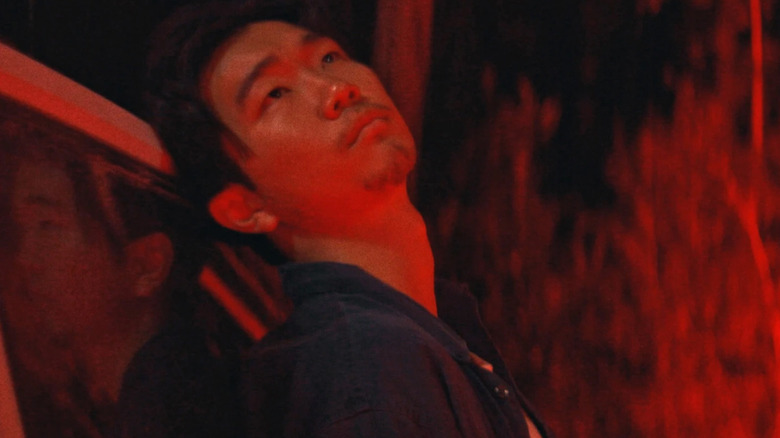
One of the most intriguing elements of "It Ends" lies in how the protagonists, stuck in the same car with the same objects and people on an endless road, eventually run out of things to consume. It's simultaneously a metaphor for disengagement through familiarity as well as the stagnation of pop culture in general. When I asked Alex Ullom about this, he explained why that lack of new culture, especially in Hollywood, is what makes liminal spaces such a draw:
"I think everything's suffering from that. I think that's why there's a draw to liminal spaces in my generation specifically, is that there's not really a destination anymore for us. Structurally, it's not going to be the tentpoles of things that used to unite young people, whether it was a nuclear family or housing or religion, et cetera. [They] don't exist, and we've been given directions to a destination that doesn't exist anymore. And I think that if liminal spaces are transitionary spaces, there's almost a comfort now in transitionary spaces because it's like, 'Well, I don't know what the alternative would be.' It feels like we're on the precipice of something else. I see culture downtrodden from more structural, economic issues that are plateauing things, less so that it's a symptom of itself, I guess."
Ullom's answer is a great encapsulation of why liminal horror is emerging in a big way right now. For the last couple decades, tech corporations and the like have sold people on the promise of endless possibility and potential while simultaneously removing so many paths to that success. How can we celebrate or be content when we can't look away from the endless road ahead of us?
Alex Ullom and Kane Parsons have a kinship personally and artistically
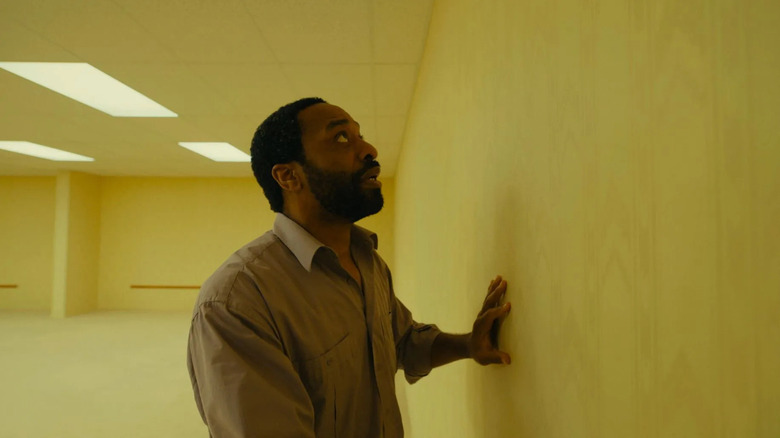
The kinship between many of these liminal space horror movies isn't just a cultural or generational one — at least not in the case of "It Ends" and "Backrooms." As a matter of fact, when I asked whether he was intentionally looking to make a liminal horror movie, Alex Ullom told me that he and "Backrooms" creator/director Kane Parsons have a real-life friendship that reflects their shared artistic interests:
"Kane's a good friend of mine, and we realized that we were both in some of [these] very similar internet threads when this stuff was starting to pop off. So I definitely was always drawn to it. It just ended up being a really good vehicle for story. It's a pun, I guess."
The relationship between Ullom and Parsons is reminiscent of how so many filmmakers of the past found affinity with each other through their cultural and generational similarities, from the "Movie Brat" directors Francis Ford Coppola, Steven Spielberg, Martin Scorsese, Brian De Palma, and George Lucas to horror filmmakers like George A. Romero, Stephen King, Dario Argento, and John Carpenter. If the liminal horror movement continues to be championed by the likes of Ullom, Parsons, and their contemporaries, then it's a good bet we'll be seeing more and more liminal horror movies until the wheels fall off. (I like puns too, Alex!)
"It Ends" is in theaters now.