

Producer J.J. Abrams Explains How The End Of Oak Street Got Away With Securing A PG-13 Rating [Exclusive]

When it comes to cinema history, the old adage of "the more things change, the more they stay the same" holds true. Take, for instance, the Motion Picture Association. When the MPA (then called the MPAA) established the film rating system in the late 1960s, it was intended to allow American filmmakers more freedom of expression while providing the public with a general guideline as to the content of a given movie. Of course, as soon as you give people (and particularly creative people) a set of rules, they start looking for ways to bend them. The initial ratings system consisted of G, M, R, and X, which after three years changed to G, GP, R, and X, before finally landing on G, PG, R, and X. That last configuration lasted until 1984, when the Steven Spielberg productions "Gremlins" and "Indiana Jones and the Temple of Doom" exposed a necessity for a rating in between PG and R. Thus, the PG-13 was born.
Over 40 years later, PG-13 has become so ubiquitous that it's become the standard rating for most all-ages, wide appeal movies. This means that filmmakers enjoy testing its boundaries, too. This month's "The End of Oak Street" is a movie that deliberately harkens back to the heyday of Spielberg's cinematic output, including those aforementioned ratings breakers. As such, the film contains some harrowing, even shocking moments that folks may not be expecting in a PG-13 summer release. This is by design, of course. During a recent chat I had with writer/director David Robert Mitchell and producer J.J. Abrams, the latter explained to me how the film's ratings journey was surprisingly smooth. Yet, as Abrams confessed, things did get a little bumpy along that road for a minute.
Everyone was on board with David Robert Mitchell's vision from the beginning

When it was first announced that David Robert Mitchell would be making a dinosaur sci-fi adventure movie, fans of his films were perplexed as much as they were delighted. Would the director who delivered some surprisingly gnarly gore in "It Follows" and some creepy salaciousness in "Under the Silver Lake" have trouble adjusting his sensibilities? Of course, the answer turned out to be "no," which shouldn't come as a surprise to fans of other indie horror heroes-turned-blockbuster filmmakers like Sam Raimi and Peter Jackson. As with "Spider-Man" and "The Lord of the Rings" trilogy, Mitchell had an edgy, yet all-ages appropriate, vision for "The End of Oak Street" that was apparent from the script, as J.J. Abrams explained:
"The script that David sent us was pretty close to what the movie ended up being. I mean, there's some exceptions here and there, but the vision was super clear and it was on the page. And obviously being a fan of David's and knowing that sensibility, it was such an interesting lens to see the subject matter through. And I was so excited to see that. But everyone sort of was on board from the beginning with the level of intensity, the balance of sweetness and love and humor with terror, and these action sequences and suspense sequences."
Of course, it's one thing to be PG-13 on the page, while it's quite another to deliver that on screen. After all, the MPA loves to ratchet up a film's rating for reasons of "intensity" and the like!
J.J. Abrams felt 'happy and lucky' for The End of Oak Street to get a PG-13
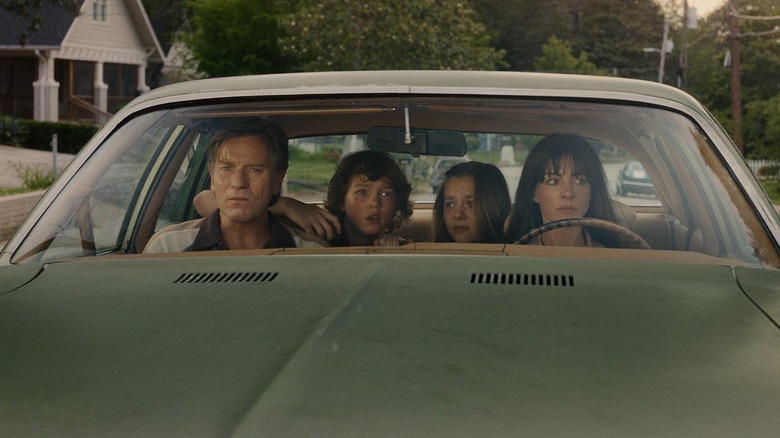
So while the script for "The End of Oak Street" seemed to promise a rating lower than R, it wasn't certain until the final cut of the movie was delivered. J.J. Abrams recalled the feeling he had when the final decision from the MPA was made:
"...the truth is, even though [the film] is, I think, a very balanced and really fun rollercoaster ride, we didn't know, was it going to be difficult with the rating? And we were, I think, happy and lucky to get the PG-13. So it never really felt like we had to fight."
However, Abrams alluded to folks who did indeed have some worries over certain moments in the film. While I won't spoil what these might be, you can probably guess at least one of them after watching the movie:
"There were little things where some people who shall remain nameless might have had an issue with this sequence or that sequence. But at the end of the day, even those people came to see that it was worthwhile and what we were doing felt like it should be in the movie, and ultimately was."
To follow on from Abrams' thoughts, "The End of Oak Street" may be a boundary-pushing film, but it's also one which wholly earns its boldness. David Robert Mitchell is a consummate filmmaker in that way, understanding that provocation and bending rules for their own sake isn't as valuable as making the movie work as a complete experience. It's a big part of why the film isn't lazy homage, and why it deserves to be mentioned in the same breath as Steven Spielberg's '80s productions, even if it doesn't break the ratings system.
"The End of Oak Street" is now in theaters nationwide.