

House Of The Dragon Season 3 Finale Scene Opens Up A Game Of Thrones Plot Hole
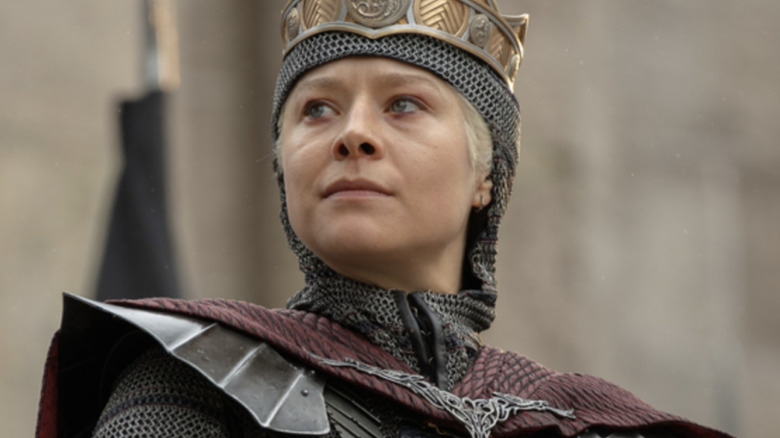
This is the song of ice and spoilers. Major plot details for the "House of the Dragon" Season 3 finale follow.
What's in a prophecy? Both "Game of Thrones" and now "House of the Dragon" have shown how buying into one's own hype and justifying actions in the name of destiny can lead to some truly dark places. George R.R. Martin has underlined much the same point in his "A Song of Ice and Fire" series, repeatedly treating such things like something out of Greek tragedy. The more characters try to fulfill (or avoid) their fates, the likelier the exact opposite of what they intend comes to pass.
The most important of these prophecies — and the most misunderstood — would have to be the fabled Prince That Was Promised, introduced in "Game of Thrones" and again brought back in "House of the Dragon." As young Rhaenyra (then played by "Supergirl" star Milly Alcock) learns, each Targaryen ruler learns of this story at an appointed time and eventually passes it down to their heir. As Aegon the Conqueror apparently foresaw a century earlier when he decided to unite the Seven Kingdoms, a mysterious wintry threat out of the north is fated to sweep across the land and, as Aegon interpreted it, only a Targaryen sitting on the Iron Throne could thwart it.
But here's the rub: That has always been a tightly-guarded secret. This preserves the narrative of Targaryen supremacy, of course, but it also fills an important plot function. By the events of "Game of Thrones," nobody cares about the White Walker danger ... because nobody knows they exist. In the Season 3 finale of "House of the Dragon," Rhaenyra (Emma D'Arcy) blurts this out to an entire mob of smallfolk, creating a bizarre plot hole in the process.
Why the heck does Rhaenyra tell King's Landing about the Prince That Was Promised?
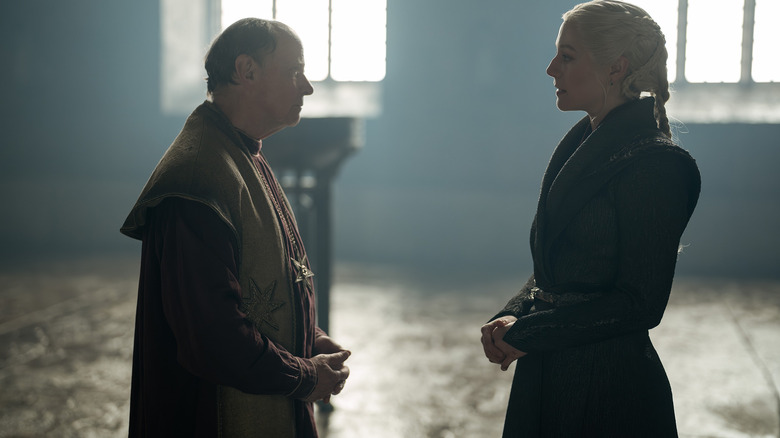
Rhaenyra has had a terrible, horrible, no good, very bad week on "House of the Dragon" lately, so she can be forgiven for not entirely acting out of a sense of logic and reason ... but what she does in the Season 3 finale may have just opened up a world of trouble. Rattled by the news that the deposed (and declared dead) King Aegon II (Tom Glynn-Carney) is actually very much alive along with his dragon Sunfyre, Rhaenyra begins a slow but steady march towards her own undoing. In fear and anger, she gives her husband Daemon (Matt Smith) the go-ahead to attack Tumbleton, despite her previous hesitations in having her own subjects caught in the crossfire. Then she continues her cruel treatment of poor Helaena (Phia Saban), inadvertently driving her to take her own life. The cherry on top, however, comes when she impulsively marches on the Grand Sept, orders the killing of Simon Chandler's High Septon (there goes our theory about him playing the role of the Shepherd from the book), and addresses the smallfolk gathered nearby.
Nothing could possibly go wrong with telling a bunch of confused peasants about mythic prophecies and the end of the world, right? In a sequence that not-so-subtly depicts Rhaenyra as somewhat of a raving lunatic, she launches into a speech about how the Targaryens are destined to rule Westeros while the Hightowers are pretenders to the crown (never mind that her recently-resurrected rival Aegon is also a Targaryen). To prove this, she foolishly reveals the Song of Ice and Fire prophecy and twists it as "proof" that she specifically was meant to rule.
The only problem is that this raises all sorts of questions.
How does Rhaenyra's actions in the House of the Dragon Season 3 finale set up Season 4?
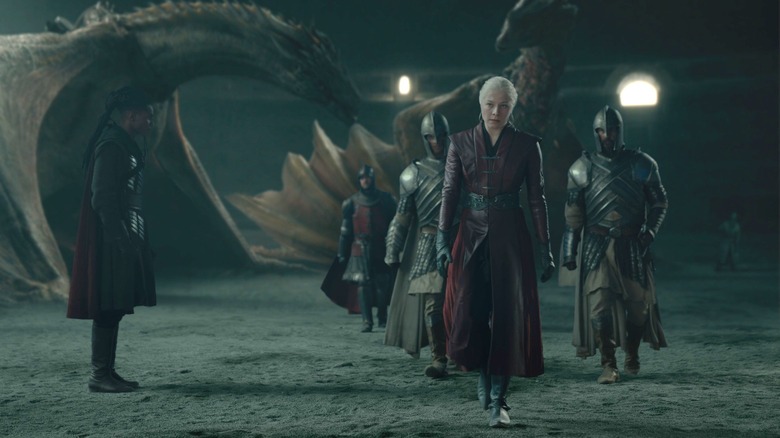
That's one way to let the cat out of the bag. For diehard fans, it was already controversial enough that "House of the Dragon" introduced the retcon that Aegon the Conqueror invaded Westeros and subjugated its people thanks to grand visions of prophecy, not personal ambition (although, according to co-creator Ryan Condal, this came straight from George R.R. Martin himself). Now, a bunch of King's Landing residents have just heard their Queen rant and rave in public about some mysterious enemy descending upon them from the north, destined to be spread around town in no time at all. How this jives with the status quo of "Game of Thrones" (and, to a lesser extent, "A Knight of the Seven Kingdoms") will likely go unaddressed. But perhaps that's not as important as how this scene sets up what's to come in Season 4.
Are we watching the downfall of Rhaenyra play out in front of us in real time? The Season 3 finale sure seems like it's trying extra hard to beat this drum, showing the ruler at her lowest possible moment — overwhelmed and paranoid and panicky, all at once. Dismissing her once-trusted advisor Mysaria (Sonoya Mizuno) speaks volumes and can't possibly suggest anything good to come for Team Black, as does her heartless treatment of Helaena that now adds even more blood on her hands. When news of the disaster at Tumbleton comes back to court, along with the betrayal of Ulf the White (Tom Bennett), her grip on the throne will be this close to slipping entirely.
Season 4 still has lots of ground to cover, but don't expect a happy ending here for anyone in "House of the Dragon."