

How The Avatar Aang: The Last Airbender Movie Sets Up The Legend Of Korra
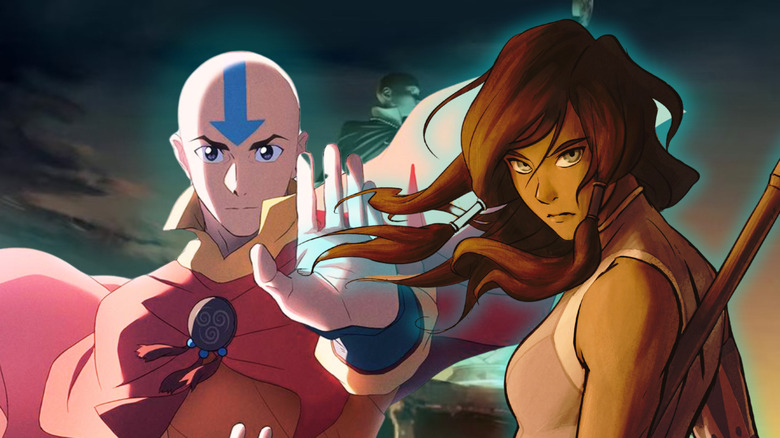
This article contains spoilers for "Avatar Aang: The Last Airbender."
"Avatar Aang: The Last Airbender" lives up to its title. The much-beloved animated series was truthfully an ensemble; scarred Fire Nation Prince Zuko's (Dante Basco) journey to redemption was as much a backbone as Aang's (Zach Tyler Eisen) heroic journey. But this movie? Aang (Eric Nam) is absolutely the main character; sorry, Zuko (Steven Yeun) or Toph (Dionne Quan) fans, maybe next time.
Set about a decade after the original "Last Airbender" series, Aang still hasn't quite settled into a world where he's, well, the last Airbender. As if to catch up new viewers, the movie opens with a flashback to Aang's childhood in the Southern Air Temple. This, in turn, gives way to a nightmare about the Fire Nation's genocide of the Air Nomads, a calamity Aang escaped by running away from his duties as the Avatar and getting himself cryogenically frozen.
The narrative thrust of the movie is Aang discovering another, much more ancient Airbender named Tagah (Dave Bautista) who long ago was frozen like him. Tagah leads Team Avatar to discover a magical staff that he claims can create new Airbenders, but his intentions may be more sinister than he claims.
"Avatar" fans have seen an evil Airbender before, though. In the "Last Airbender" sequel series "The Legend of Korra" Book 3, the main villain was Zaheer (Henry Rollins), an airbending anarchist who revered the Air Nomads' teachings on earthly detachment.
Set 70 years after "The Last Airbender," this sequel starred Avatar Korra (Janet Varney), who had to live in the world that Aang had built and fill the big shoes he left. While this movie is set early in that 70-year gap, it still starts to build a bridge between the series.
Avatar Aang features the early days of Republic City and the Air Acolytes
"Long ago, the Four Nations lived in harmony. Then everything changed when the Fire Nation attacked," declares Katara (Mae Whitman) in the opening narration of every "Last Airbender" episode. What "Legend of Korra" and "Avatar" sequel comics hammer in is that the Four Nations living in "harmony" were also living separately. After 100 years of war, the old, segregated world couldn't be rebuilt. So, Aang and Zuko transformed the Fire Nation's colonies in the Earth Kingdom into a new, culturally integrated United Republic of Nations.
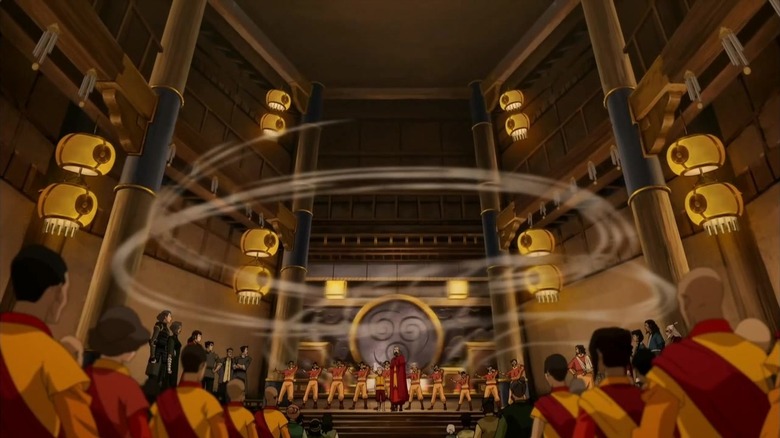
"Avatar Aang" takes place primarily in the new nation's capital, Republic City. Aang's angst is amplified because the city he's built is home to every culture ... except his. By the end of the film, he's remedied that. While he can't bring back airbending, he can continue to pass on the Air Nomad culture. He has a new Air Temple built on an island in the Republic City harbor, and recruits new "Air Acolytes" to carry on the Air Nomad ways.
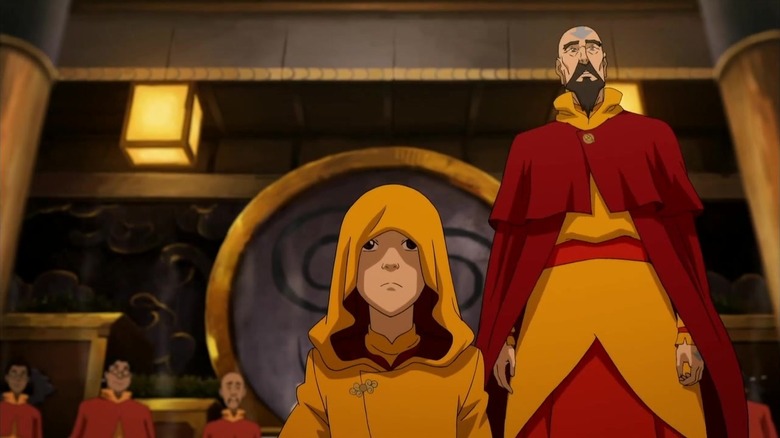
This will all be familiar to "Legend of Korra" fans. Republic City and Air Temple Island are major locations in "Korra." During that show, the island temple is the home of Tenzin (J.K. Simmons), Aang and Katara's son, his family, and the Air Acolytes.
Moreover, the film ends with Aang, Team Avatar, and the Air Acolytes discovering a herd of sky bison at a hidden air temple. In "Last Airbender," Aang's pet Appa was assumed to be the last sky bison, but "Korra" showed many more bison still alive; they were an endangered species, not extinct. This ending finally answers that hanging question of where all the new sky bison came from.
Avatar Aang's staff MacGuffin hints at the eventual rebirth of Airbending
The staff Tagah seeks in "Avatar Aang" was created by Sonam (Frieda Pinto), the Avatar of his era (5,000 years ago). The Airbenders were the least numerous of the bending tribes, but Sonam relied on them in her mission of maintaining balance. So, she communed with the Spirit World, learned how to make nonbenders into benders, and elevated many nonbender Air Nomads (including Tagah).
Tagah is traumatized by seeing his brothers-in-arms slaughtered by an earthbending army and further incensed when he learns about the Fire Nation's genocide of the Air Nomads. He wants to use the staff to create more Airbenders and build an "Air Empire." When he attacks Republic City, Aang defeats him and takes Sonam's Staff — but echoing the advice of Avatar Xian's spirit (He Huy Quan), he decides the staff is too much power for one individual to have and so destroys it.
Aang sacrificing his chance to bring back airbending leads to him embracing the Air Acolytes as the next best thing. But "Avatar" fans know the birth of airbending is nigh, even if Aang won't live to see it.
During "Legend of Korra" Book 1, Tenzin and his three children are the only airbenders left. But at the end of Book 2, "Korra" reconnects the physical and Spirit worlds permanently. As a result of that and an earlier alignment of the planets ("Harmonic Convergence"), people across the world suddenly become Airbenders, like the universe itself correcting an imbalance and the last scar of Fire Lord Sozin's war.
Sonam's staff in "Avatar Aang" reinforces what "Legend of Korra" showed: that spiritual power can awaken bending, and it would be the key to restoring airbending. In "Avatar Aang," Tagah briefly does just that.
The Denied in Avatar Aang foreshadow the Equalists
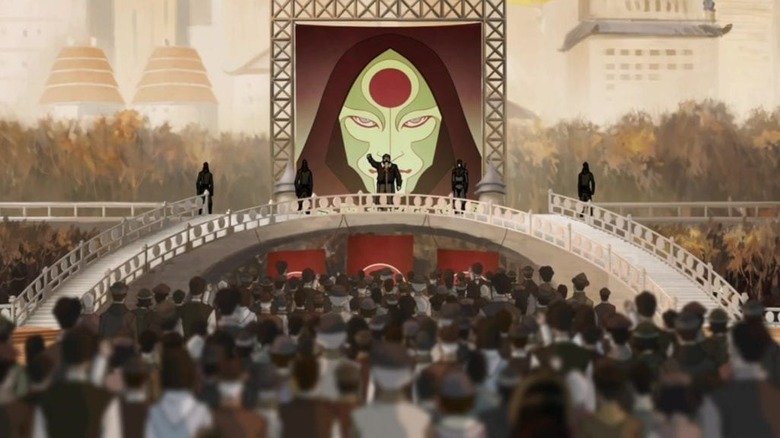
Besides Tagah, the antagonists of "Avatar Aang" are a group called the Denied. True to their name, they're nonbenders who believe the innate power imbalance between benders and nonbenders has led to an unequal society. "If we want anything to change, we need what the benders have — power," the Denied's leader declares. In the third act, Tagah uses Sonam's staff to make the Denied into Airbenders, though the power fades when Aang destroys the staff.
The Denied's rhetoric and grievances foreshadow the villains in "The Legend of Korra" Book 1: The Equalists, named for the inequality created by bending. While the Denied want to gain the power of bending themselves, the Equalists wanted to destroy bending altogether. The Equalists suggest the Denied's defeat didn't quell the social tensions that produced them — and neither, really, did Korra.
The political themes in "Legend of Korra" don't hold up to time or scrutiny. The show settles for making the Equalists pure villains, barely bothering to dig into any legitimate inequality in Republic City or explore the unique social stratification bending creates. (In the "Avatar" world, a select minority essentially have superpowers, but bending can't be redistributed like social power in the real world.)
The Equalists collapse not because Korra proves their point wrong or offers another solution, but because their leader Amon (Steve Blum) is revealed to be a bender himself. Come Book 2, the Equalists are no more and apparently the social inequality has been addressed ... because Republic City's new president is a nonbender.
"Avatar Aang" likewise glosses over any inequality. The Denied vaguely allude to past trauma, with their leader asking her followers how many people died because Aang was missing for 100 years, but the movie doesn't pause to dig into that.