

How Christopher Nolan's The Odyssey Changes The Iconic Cyclops Showdown
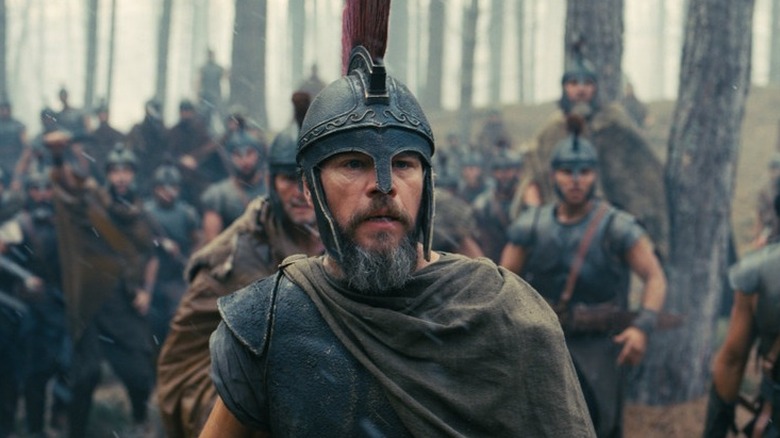
Spoilers for "The Odyssey" follow.
Christopher Nolan hadn't tread into the high fantasy genre territory before making "The Odyssey." If anything, it seems contrary to Nolan's whole ethos of a filmmaker of wrapping his head around a story's technical detail. Nolan's "Dark Knight" trilogy was all about bringing Batman down into the real world, while his feuding magician movie "The Prestige" explores in depth the practical mechanics behind stage magic tricks.
But in a tale like "The Odyssey," you can't hide from the fantastical. For his part, Nolan doesn't, at least not totally. The Gods are offscreen presences in the film, besides Odysseus (Matt Damon) seeing brief visions of Athena (Zendaya), and that may disappoint fans of the original "Odyssey" poem. But the monsters that Odysseus and his crew encounter, like the enormous, man-eating Cyclops (Bill Irwin), undeniably exist as flesh and blood.
In Homer's original "The Odyssey," Odysseus converses with the Cyclops (named Polyphemus) while he is its captive. Possibly the most famous moment in the whole sequence is when Odysseus, ever the trickster, tells the monster his name is "Nobody." After Odysseus and his men blind the sleeping Polyphemus, the monster screams that "Nobody" is attacking him, something the other Cyclopes misinterpret him entirely.
Interviewed on "The Daily Show with Jon Stewart," Nolan explained why he cut this moment from the movie. "It's a pun. Puns in translation are tough," he said. "I tried. It was not possible to work it in." What's the pun, you ask? In the original Greek, Odysseus tells the Cyclops his name is "Outis," which both sounds like a diminutive form of "Odysseus" and is a Greek word meaning "Nobody." This pun doesn't carry over into English, hence the Cyclops looking like an even greater fool for falling for the "nobody" name trick.
The Cyclops sequence in Christopher Nolan's The Odyssey is broadly faithful
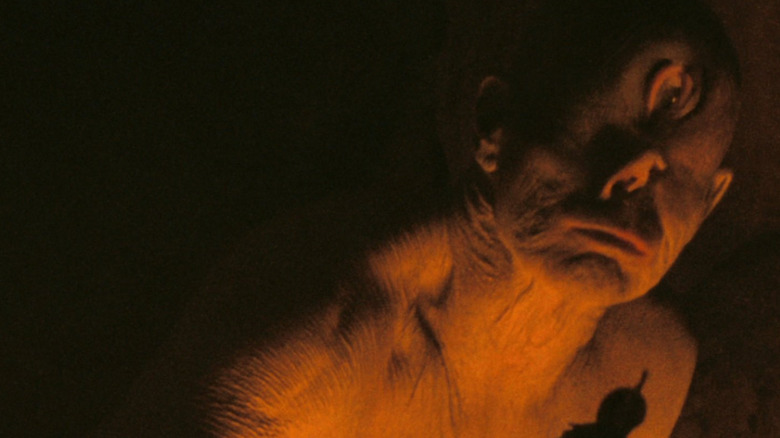
The essential beats of the Cyclops sequence in Nolan's "The Odyssey" match up with Homer's original epic. Odysseus and his men come ashore to the Cyclops' island, and follow the sheep to his cave home. The Cyclops begins eating Odysseus' crew, a couple at a time, and they can't escape or kill the monster while it sleeps because it blocks the exit of the cave with an enormous rock. After blinding the Cyclops, they slip out of the cave alongside the sheep, wool along their armor fooling the Cyclops' sense of touch. However, this episode dooms most of them because it angers the Cyclops' father: Poseidon, god of the sea, who you need on your side while sailing.
In Nolan's "The Odyssey," the Cyclops is mostly silent, a choice that serves to make it eerier. When it does speak a prayer to its father after its blinding, there's a bizarre echo to its mostly unintelligible voice. Odysseus explains why it doesn't talk to his men with an analogy: Would they converse with ants? Besides, without the "nobody" sequence, there's little narrative reason for it to talk and plenty of atmosphere to preserve by keeping it silent. (No "nobody" also means we see no other Cyclopes on the island.)
In both versions of the story, Odysseus makes a final, fatal mistake. In the original poem, Odysseus cries out from his ship to the Cyclops, telling it his true name and how he fooled it, so Polyphemus then knows to ask his father to curse Odysseus of Ithaca. In the movie, Damon's Odysseus vengefully shoots the sleeping Cyclops with an arrow after he escapes its cave, prompting it to chase after his men and kill a few more of them.
How Christopher Nolan brought The Odyssey's Cyclops to life
Ancient Greek myths are full of stories about giant cannibals devouring men, and the concept has persisted as a recurring horror across cultures. Arguably the most singularly horrific image of this is Francisco Goya's 19th century painting "Saturn Devouring His Son," something Nolan had in mind as a visual reference for his Cyclops.
"[Goya's painting] was very much the inspiration," the filmmaker told the LA Times. "We had it up on the wall. Whenever we brought in a new technology that was the first thing we showed them." Nolan added that the Cyclops was portrayed with a mix of "puppetry, animatronics, [and] robotics," but also Bill Irwin's own physical presence. On "Oppenheimer," Nolan set the challenge for himself of portraying a nuclear explosion without any CGI, and he took the same approach to the Cyclops.
Besides Goya, Nolan told the LA Times that he looked to another filmmaker much more experienced in portraying fantastical monsters: "I was very inspired by Guillermo del Toro. What I learned from him is that a monster is not a monster. You have to approach them the way you approach any other character." Indeed, the Cyclops devouring Odysseus' men calls to mind the eyeless Pale Man from del Toro's "Pan's Labyrinth," which grabs and then devours fairies headfirst. The Pale Man is the rare monster del Toro does not extend sympathy towards; nor does Nolan to the Cyclops.
"The Odyssey" is now playing in theaters.