

Where Was The Good, The Bad And The Ugly Filmed? Every Major Location Explained
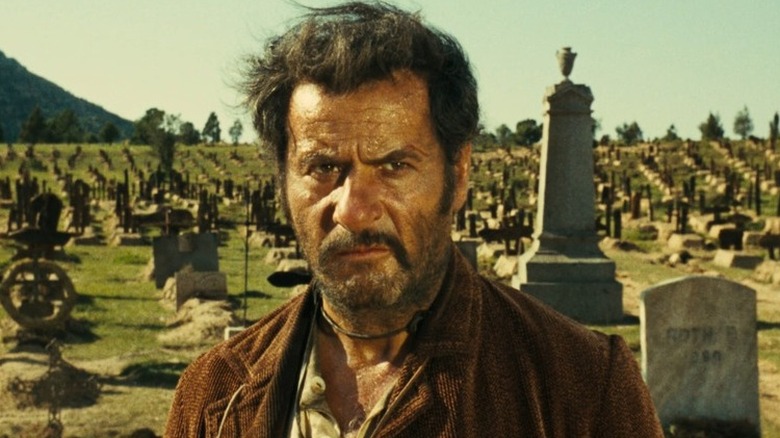
What more can be said about Sergio Leone's "The Good, The Bad, and the Ugly"? It's the third and most famous Western Leone made with Clint Eastwood as the lead gunslinger, retroactively known as "The Dollars Trilogy" or "The Man With No Name Trilogy." Clocking in just under three hours long, "The Good, The Bad, and the Ugly" is a true Western epic. Six decades on, it's also still just as thrilling and fine-tuned as it was when it first shot into cinemas — no-one shoots and cuts close-ups and gun-fights onscreen like Leone did.
"The Good, The Bad, and the Ugly" is set during the U.S. Civil War, but its three leads are mercenary criminals: Blondie (Eastwood), Angel Eyes (Lee Van Cleef) and Tuco Ramirez (Eli Wallach), all searching for buried gold. That quest takes them across the New Mexico territory. However, while an American film in the setting, "The Good, The Bad, and the Ugly" was shot in Europe. (You can tell from the dubbing; the English dialogue rarely maps onto the European actors' mouth movements, even if that hardly diminishes the film.)
It's a Spaghetti Western, the nickname for Westerns shot in Europe (specifically Italy and Spain) rather than Hollywood, and one of the very best Spaghetti Westerns at that. If the untamed plains and searing deserts of "The Good, The Bad, and the Ugly" weren't actually shot on the American frontier, where was the movie filmed?
The Good, the Bad, and the Ugly was primarily shot throughout Spain
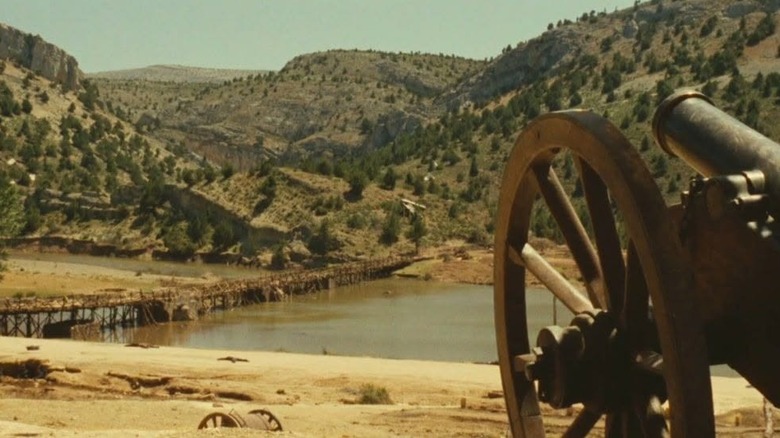
The primary filming locations for "The Good, the Bad, and the Ugly" were located in Spain, with different setpieces being filmed all across the country, from the northern Burgos province to southern provinces such as Granada and Almeria.
For instance, the famous scene where Blondie and Tuco rig a bridge over a river with dynamite and blow it up (an explosive sequence that had to be shot twice) was filmed in the Almeria province, including in the Cabo de Gata-Níjar Natural Park. (The Cabo de Gata desert is among the most filmed locations in Europe.)
The scene where Tuco escapes a train while handcuffed to a union officer, then lays the chain on rail tracks to be crushed by an oncoming train, was filmed at and near the Calahorra Station, located in the eponymous city in the province of La Rioja.
Like many other Spaghetti Westerns, much of "The Good, the Bad, and the Ugly" was filmed in the Tabernas Desert, located in Almeria. Leone had previously shot scenes from "A Fistful of Dollars" and "A Few Dollars More" there, and it was a favored filming location for Spaghetti Westerns due to its close resemblance to the real American West.
Blondie and Tuco's first scene in The Good, the Bad, and the Ugly was shot in Rome
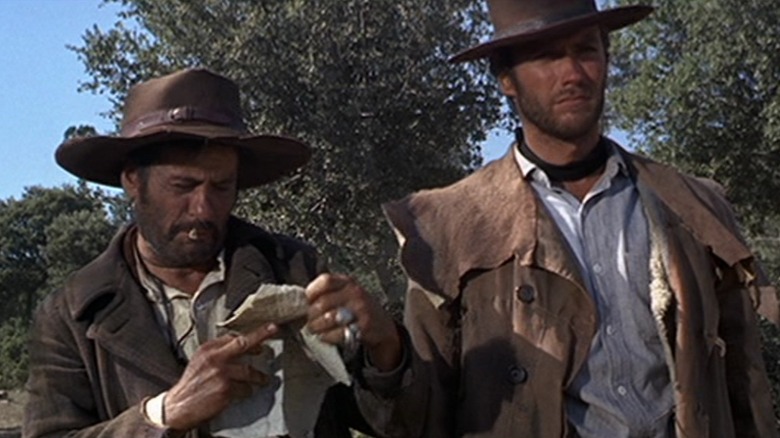
Blondie's intro sequence in "The Good, the Bad, and the Ugly" features him and Tuco pulling a scam together. Tuco is wanted for a bounty of $2,000 (later $3,000). So, Blondie brings Tuco in for the reward, then when Tuco is set to hang, Blondie shoots the rope from a distance, Tuco escapes, and they split the money. Rinse and repeat.
When they first meet, Blondie rescues Tuco from three bounty hunters,which then smash cuts to Blondie bringing in a captive Tuco himself into a small town. It's an amusing edit which doubles by deceiving you about both men's intentions. This scene was filmed not in Spain, but in Rome, Italy, specifically at the Cinecittà Studios where the set for the Western town Tuco (and Eli Wallach) almost died in via hanging by horse was staged.
Cinecittà Studios remains in operation today and has been described as the largest film studio in all of Europe. Despite the studios' illustrious contributions to the art of cinema, it has a dark history. The studio was founded and built in 1937 by Benito Mussolini, the fascist dictator of Italy, who wanted to spur the Italian film industry. Under Mussolini, the studio's slogan was "Cinema is the most powerful weapon," reflecting how Mussolini and his fascist allies in Germany broke new ground in cinema as a propaganda tool.
A Tuco scene in The Good, the Bad, and the Ugly was shot in Mexico
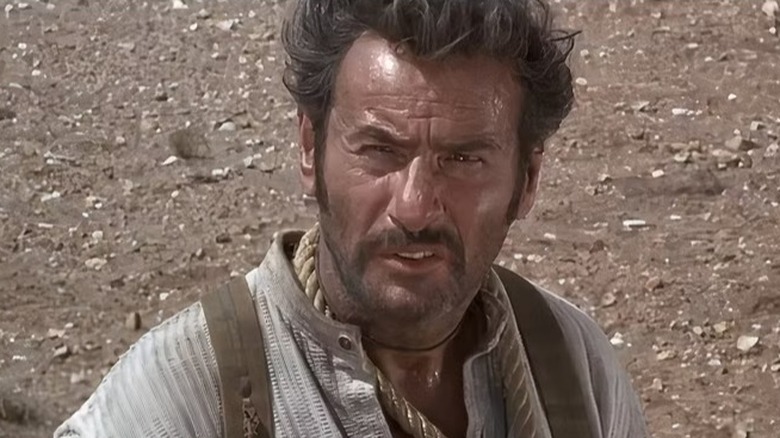
Again, "The Good, the Bad, and the Ugly" may have been filmed mostly in Spain, but it is set on the U.S.-Mexico border. One important scene was reportedly filmed in Mexico itself, offering some extra authenticity rather than the approximation thereof found in European deserts and plains.
Over halfway through the movie, Tuco has a chance meeting with his brother, Pablo (Luigi Pistilli). Unlike his criminal and fugitive brother, Pablo is a priest, who resents Tuco for the choices he's made and abandoning their family; both of the Ramirez brothers see the other one as weak for the path they choose to live on. The scenes offer some important depth for Tuco, who is mostly a self-important, comical bully.
Tuco and Pablo's reunion is said to have been filmed in Durango City, Mexico, specifically at the historical site Plaza de los Fundadores. In English, that name translates to "The Founder's Square," because the public square is built at the site of the city's founding.
The climax of The Good, the Bad, and the Ugly unfolds at Sad Hill Cemetery
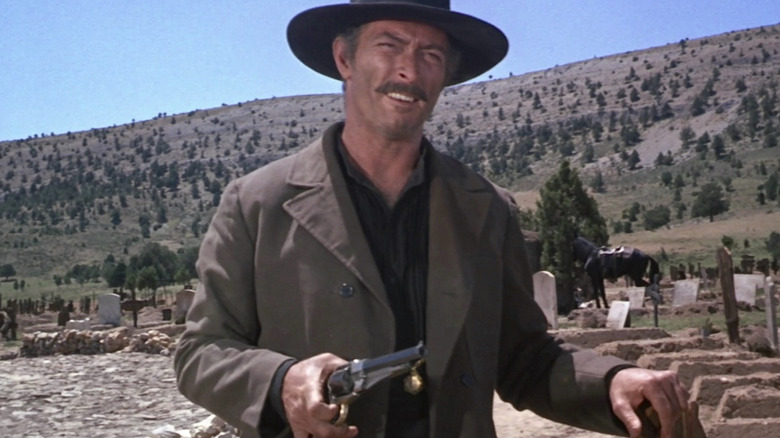
"The Good, the Bad, and the Ugly" concludes at Sad Hill Cemetery, where the treasured gold is located. Blondie, Angel Eyes, and Tuco face each other down in a Mexican standoff and not everyone walks away. This location is why Blondie and Tuco work together even though they both have plenty of reason to kill the other; for most of the movie, only Tuco knows the name of the cemetery, and only Blondie knows the specific grave in which the treasure is buried. (The prize in the aforementioned gunfight is a rock which supposedly has the name of the correct grave written on it.)
You might notice that the real location shares the name with "Sad Hill Cemetery" from the movie. That's because the area isn't a real cemetery, it was purposefully built for the movie. Designed by production designer/architect Carlo Simi, Sad Hill Cemetery has a distinctive circular shape, with numerous ring-shaped rows of grave markers stretching outward from the center. The Spanish army lent help to the monumental construction effort; the faux-cemetery reportedly had around 5,000 grave markers.
Sad Hill Cemetery was constructed in the Mirandilla valley, located in the Burgos province of Spain. In 2015, the cemetery was reconstructed and now stands as a tourist attraction; this effort was the subject of a 2017 documentary, "Sad Hill Unearthed." For this particular part of "The Good, the Bad, and the Ugly," fiction became fact.