

Strange New Worlds Season 4 Just Rewrote Star Trek's Rules For Time Travel
Warning: Spoilers to follow for the "Star Trek: Strange New Worlds" Season 4 premiere, "Valles Marineris."
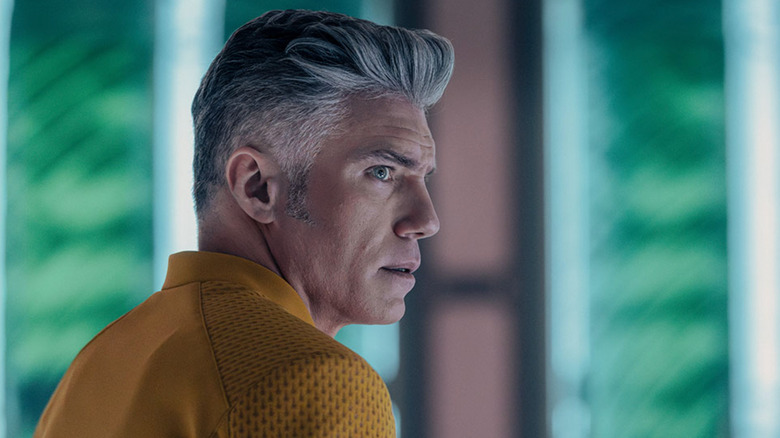
"Don't overthink it." Late in the Season 4 premiere of "Strange New Worlds," Anson Mount's Captain Christopher Pike wryly hangs a lampshade on a quintessential fact of life in the "Star Trek" universe. This is a franchise that deals with aliens, cosmic phenomena, alternate universes, and, oh yeah, time travel. Sure, some of these topics are given an impressive amount of thought (like the question behind why seemingly every extraterrestrial species looks as humanoid as we do, as answered in the classic "The Next Generation" episode "The Chase"). But, sometimes, fans are much better served by suspending a certain amount of disbelief and just going with it.
So, it should come as little surprise that "Star Trek" is up to its usual tricks once again. "Strange New Worlds" has delved into some seriously heady territory before, but nothing compares to an hour that begins like an old cowboy Western and ends with a "Jurassic Park"-like money shot of dinosaurs roaming Earth 65 million years ago. It's just another day in the five-year mission of the USS Enterprise, this time adding a pinch of time travel to the mix. Thanks to an interstellar squall, our crew is sent careening into the Sol system at a time when dinosaurs ruled the Earth.
In and of itself, this wouldn't be such a notable twist on the "Trek" formula. But, once Pike puts some cues together and realizes that his infringement on Earth's past is actually meant to happen, we're thrown for a loop. In a series where time travel is restricted out of fear of changing the past (and, thus, the future), "Strange New Worlds" posits the exact opposite ... and rewrites the rules in the process.
Strange New World Season 4's approach to time travel, explained
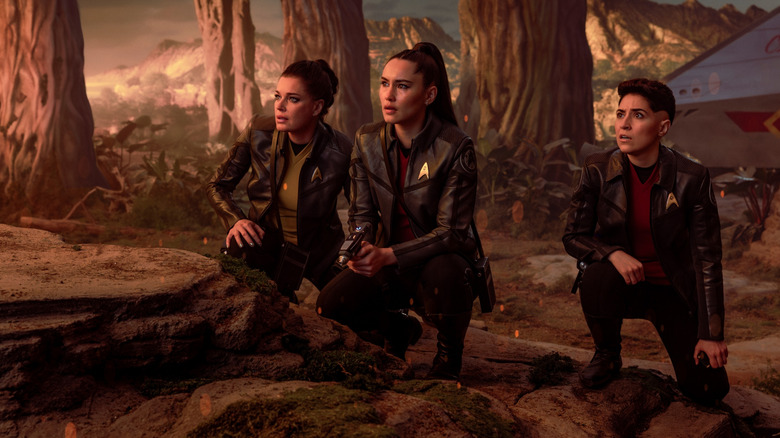
"Doctor Who" is typically known as the standard-bearer for time-wimey hijinks in science fiction, but "Star Trek" might be making a play for the time travel crown. When the real meat of the story in "Valles Marineris" begins, the characters stranded on what they now realize is ancient Earth are instructed not to interfere with any natural lifeforms they come across. It's not necessarily a result of the Prime Directive as it applies to pre-warp societies, mind you, but because of the ripple effects their actions may have on the future. For Una Chin-Riley (Rebecca Romijn), La'an Noonien-Singh (Christina Chong), and Erica Ortegas (Melissa Navia), killing a T-rex in their path might very well affect the evolution of humanity eons later.
If they only knew. When a previously-unknown group of Martians attack the damaged Enterprise, Captain Pike soon realizes their arrival in the past is actually what always happened. In a somewhat head-scratching example of a causal paradox, the Martians abscond with a key piece of Starfleet tech, use it to detonate and destroy the home world of a rival insectoid race known as the Dol'Drm (a planet that doesn't exist in our present-day solar system), and cause the extinction of the dinosaurs in the process.
Phew, got all that? Well, that's exactly the whirlwind of information Pike has to process in seconds when he orders his crew to stand down and allow an entire planet to be destroyed. In effect, he comes to understand that what happened here always happened. Nothing he or his shipmates did when they first arrived could change the past, because they already did so. Confused? Yeah, so are we. But is this some canon-breaking development ... or simply "Star Trek" being "Star Trek"?
Did Strange New Worlds make a major change to time travel in the Star Trek universe?
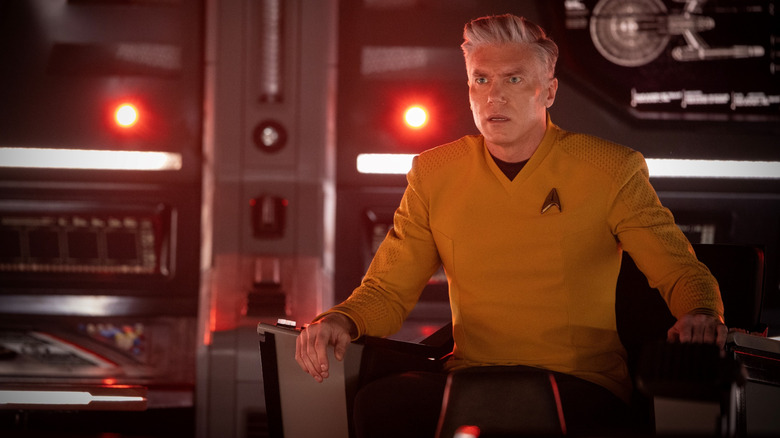
Ever since splitting off from "Discovery" and teeing up the beginnings of "The Original Series," "Strange New Worlds" has mostly resided in its own standalone corner of the universe. Captain Pike and his crew go on countless missions (the Season 4 premiere draws attention to this, leaning hard into the idea of the show's characters experiencing burnout after a whopping 15-straight assignments in deep space), but their journeys typically don't make a huge, franchise-shaking splash. Is that about to change?
Fittingly, the answer isn't as straightforward as you'd think. It's been established time and again that "Trek" characters have the ability to change the past and alter the future, but that's hardly a good thing. The dangers of such actions have been equally emphasized, to the point that "Voyager" introduced the idea of the Temporal Prime Directive to add a fourth-dimensional wrinkle to the mix. While shows like "Lost" firmly came down on one side of the time travel debate, famously stating that "Whatever happened, happened," "Star Trek" has typically had its cake and ate it, too. Yes, despite seemingly confirming that the past and future are mutable, the franchise has argued otherwise several times. The "Next Generation" episode "Time's Arrow," for instance, creates a similar time-loop paradox involving the head of Data (Brent Spiner). Movies like "The Voyage Home" and "First Contact" similarly play fast and loose with the notion of past actions changing future outcomes. The examples go on and on.
So, what's the verdict? Essentially, the needs of the plot always outweigh the needs of the nerds. "Trek" has always abided by whatever works best for the most dramatic story in the moment. "Strange New Worlds" simply keeps that tradition alive.