

X-Men '97 Season 2 Delivers The Origin For One Of Marvel's Strongest Villains
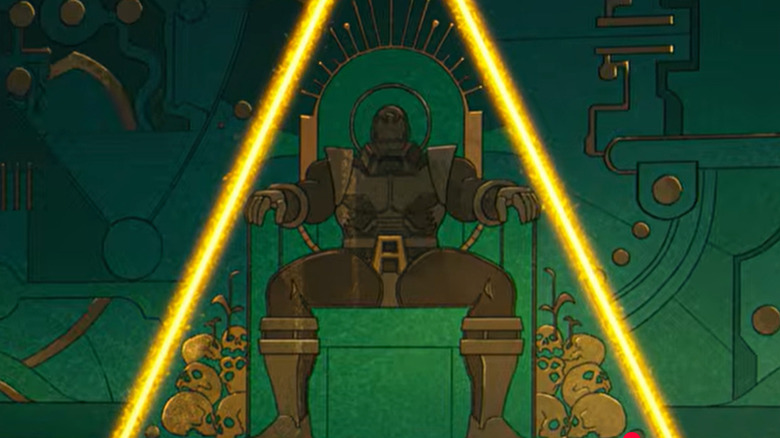
This article contains spoilers for "X-Men '97" Season 2, Episodes 3-4, "Rise of Apocalypse Parts I-II."
"X-Men '97" Season 1 ended with half of the team stranded in Egypt circa 3000 BC. There, they met a gray-skinned mutant named En Sabah Nur (Adetokumboh M'Cormack), who they recognized as a young version of Apocalypse (Ross Marquand). A cyborg with the mutant ability to control his molecular structure, Apocalypse can shapeshift, grow into a giant, make his limbs into weapons, and much more. He's the apex of human evolution and wishes to cull those he deems weak.
Marvel fans know that Apocalypse, one of the first mutants, traces his roots to Egypt. In 1996 (the height of '90s X-Mania), the comic "The Rise of Apocalypse" by Terry Kavanagh and Adam Pollina chronicled his early days. However, that comic arrived when the classic "X-Men: The Animated Series" was completing its run.
When I attended the premiere of "X-Men '97" Season 2 at the Tribeca Film Festival to review the season, Larry Houston, director of "X-Men" and an executive producer on "X-Men '97," explained:
"I think ['X-Men '97' has] the advantage that we didn't have in the '90s because when we did the Apocalypse stories, all of that backstory didn't really exist. So we had to dance around exactly his origin."
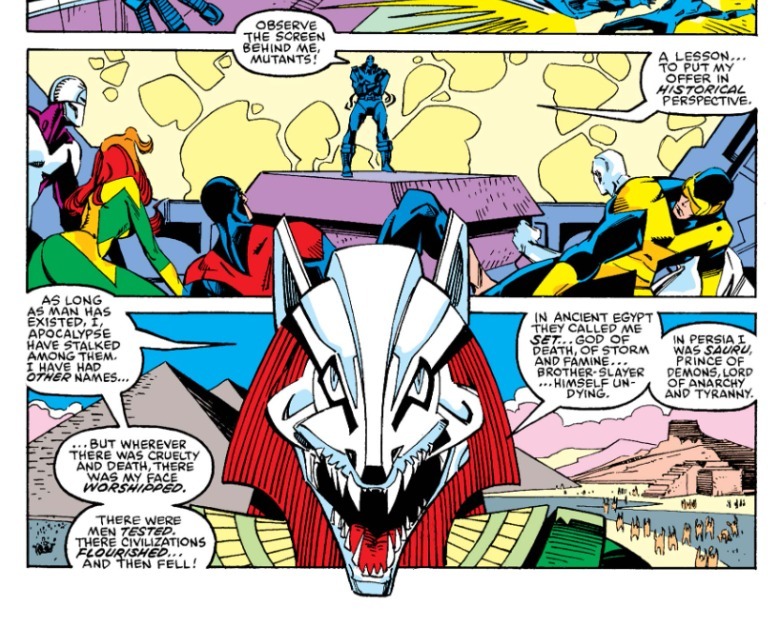
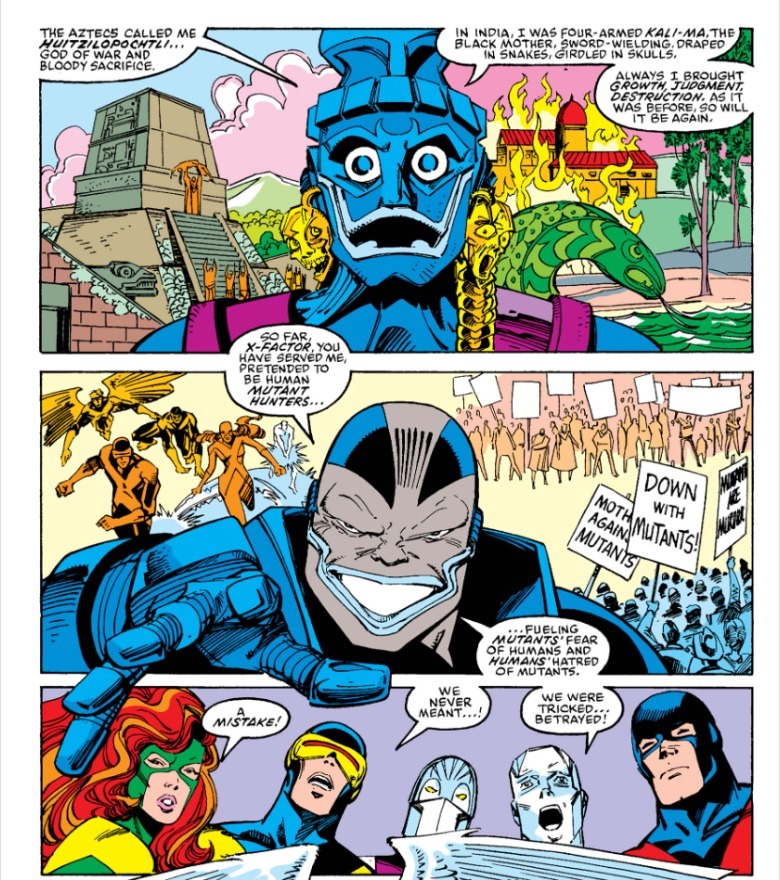
Apocalypse's 1980s appearances during "X-Factor" by Louise & Walt Simonson established he was an ancient mutant, but his exact beginnings remained mysterious.
 Marvel Comics
 Marvel Comics
"X-Men: The Animated Series" likewise portrayed Apocalypse as immortal. In his debut episode, "The Cure," he muses: "I know more of this world than you can even dream. That is why I must destroy it!" Only now does "X-Men '97" reveal the animated Apocalypse's full origin.
Apocalypse's rise on X-Men '97 is full of fire and blood
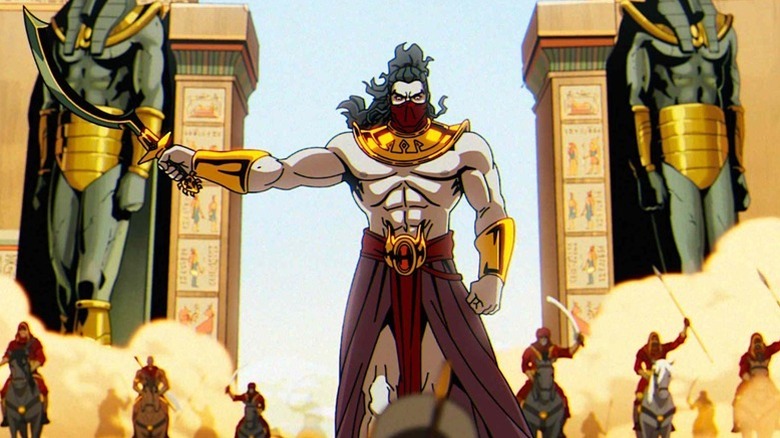
Ancient Egypt is often called a "cradle of civilization," i.e. where humankind reached its earliest heights. So too did mutantkind, via En Sabah Nur, sprout there.
Apocalypse's backstory in "X-Men '97" — shown when Professor X (Ross Marquand) reads his mind —broadly adapts the comic story. As an infant, his mother abandoned him to die due to his gray skin, red eyes, and blue lips. Found by slavers, he was sold into bondage, and became a favored slave due to his great strength. Eventually he escaped and joined the Sandstormer tribe. Their leader, Baal (Michael Dorn), taught Nur to believe in survival of the fittest. When the X-Men arrive in Egypt, the Sandstormers are warring with the pharaoh Rama-Tut (John de Lancie).
Most of the X-Men want to get back home, except Magneto (Matthew Waterson). He becomes a mentor to Nur, trying to teach him to contain his rage. Magneto wants to guide Nur as Professor X has guided him. If the first, most powerful mutant embraces the Professor's dream in a millennium past, then the X-Men might return to a better future where man and mutant live in harmony. But as Nur learns of the X-Men's withheld secrets, his trust breaks.
This two-parter is the most any "X-Men" cartoon has explored how En Sabah Nur became Apocalypse. "X-Men: Evolution" told a mostly faithful but very abbreviated "Rise of Apocalypse" story in its Season 3 finale "Dark Horizon." Then, "Wolverine and the X-Men" was canceled before Apocalypse could take a central role.
This "Rise of Apocalypse" adaptation also surpasses the original. Time travel can overcomplicate a story, but in "X-Men '97," that device makes Apocalypse's rise richer, because Professor X and Magneto's good intentions play a pivotal role in creating the X-Men's greatest foe.
X-Men '97 shows Apocalypse's evil

Rama-Tut is a variant of the time-traveling Kang the Conqueror, so why does he rule over a primitive era? He wants to claim a buried Celestial ship, the one that history says transformed En Sabah Nur into Apocalypse. (This craft, aptly named "Ship," was featured in the "X-Men: The Animated Series" Season 3 episode "Obsession.")
En Sabah Nur and the X-Men set out to find Ship, ostensibly to stop Rama-Tut but also to prevent Nur from becoming Apocalypse. Unfortunately, Ship's halls are decorated in hieroglyphs showing Apocalypse's ascension. Convinced the X-Men were trying to rob him of his destiny, Nur allows Ship to remake him into the armored Apocalypse.
"My destiny is to evolve so that I will never be powerless again," Nur proclaims. They're understandable words from a formerly enslaved person, but Apocalypse intends only to grind others under his heels. The Celestial Eson appears before Nur, tasking him with being "the end of things," the destructive wave that crashes against civilizations so the strongest can thrive through adversity. As Nur accepts this calling, the episode reuses one of Apocalypse's lines from the original "X-Men," which now reads as less a boast and more a vow: "I am the rocks of the eternal shore. Crash against me and be broken!"
"The Rise of Apocalypse" deploys an effective gambit in humanizing En Sabah Nur: He was a hero and liberator once, so perhaps with the X-Men's guidance, he can be an eternal force for good? Nope! Now unencumbered by a TV-Y7 rating, Apocalypse is even more brutal than in the classic series; he vaporizes Magneto before Professor X's eyes, but leaves Charles the way a boot ignores an ant. "X-Men '97" showed Apocalypse was once a man, but proved he's now a monster.
"X-Men '97" is streaming on Disney+.