

Spider-Noir Episode 2's Opening Scene Is A Reference To Some Of The Best Film Noir Dialogue Ever
This post contains spoilers for "Spider-Noir" and "Double Indemnity."
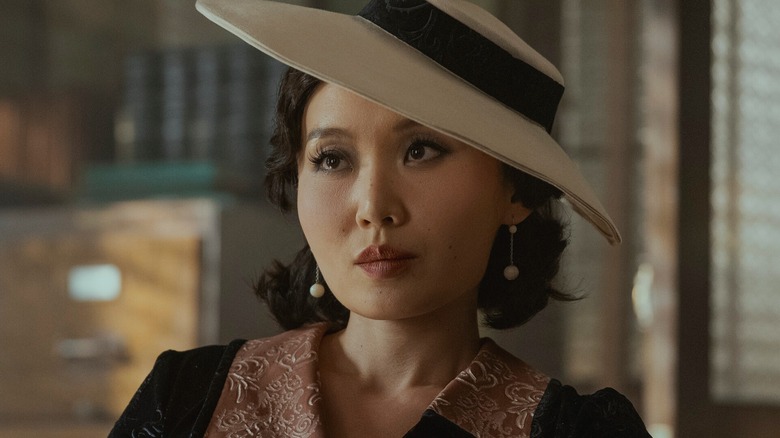
Private investigator Ben Reilly (Nicolas Cage) is really going through it in the initial episodes of "Spider-Noir." Having retired from donning the mask of The Spider years ago, the down-on-his-luck Reilly struggles to make ends meet in a crime-ridden, Depression-era New York City. Irrespective of whether you choose watch "Spider-Noir" in monochrome or color, the series blends the most bankable superhero tropes with key influences that shaped film noir as a genre. Reilly's routine as a private eye inadvertently leads him to Cat Hardy (Li Jun Li), a morally ambiguous nightclub singer who fulfills the femme fatale genre archetype. Reilly and Hardy's conversations are mostly witty and charged, and Episode 2 uses an opening exchange to pay homage to an iconic back-and-forth from Billy Wilder's genre classic, "Double Indemnity."
Episode 1 ended with Reilly using his powers while defending himself against Flint Marko (Jack Huston), Hardy's bodyguard who has sand-related powers. The next day, Hardy arrives at Reilly's office and reports Marko missing, urging Reilly to investigate instead of prying for answers. The two engage in banter that hinges on playful "what-if" retorts, such as when Reilly answers Hardy's "Do you think I'm withholding from you, Mr. Reilly?" with "What if I said I did?" and so on.
This "Double Indemnity" reference echoes the unforgettable "I wonder if you wonder" scene between Walter Neff (Fred MacMurray) and Phyllis Dietrichson (Barbara Stanwyck) during their first encounter in the film. Apart from cementing incredible chemistry between the two, the scene also highlights the poetry inherent in a such a rapid-fire exchange. This first meeting is also recontextualized against Dietrichson's true intentions (which are revealed later), adding yet another layer to this memorable conversation.
Spider-Noir leans towards the cynicism found in the writings of Raymond Chandler
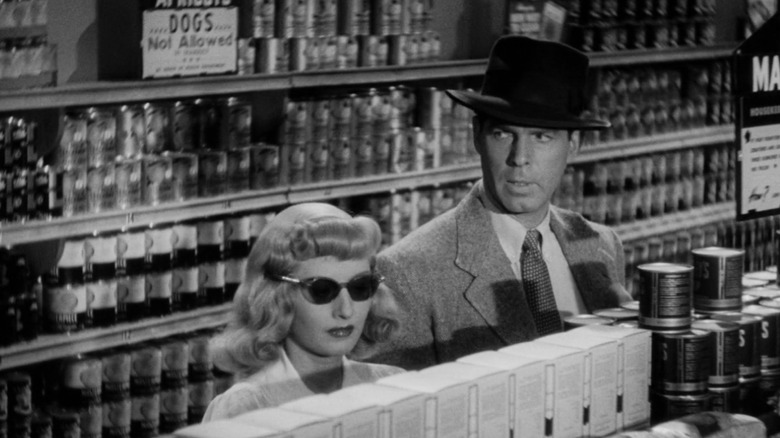
Raymond Chandler's influence on hardboiled detective fiction is immense. Chandler's body of work (which includes "The Big Sleep" and "The Lady in the Lake") embraces a cynical worldview with a side of romanticism and humor, some of which was poured into the screenplay for "Double Indemnity," which he wrote alongside Wilder. Neff and Dietrichson's first meeting is breezy and flirtatious at first glance, with the sharp dialogue relying on double-entendre and subtext to lay the foundation for their relationship.
The cynicism kicks in once we learn that Dietrichson's affections were calculated all along, and that she intends to eliminate Neff to tie up loose ends. Although Dietrichson's motivations are quite complicated, this reveal leads to irreparable distrust between the lovers, who had started off as partners in crime.
Although the context for the Episode 2 opener in "Spider-Noir" is completely different, the similar back-and-forth reinforces the influences of Chandler's writing on a series that indulges in existential malaise. There's humor mixed in here, for sure, as Cage's Ben Reilly is, in the actor's own words, "70 percent [Humphrey] Bogart, and 30 percent Bugs Bunny" (via Esquire). Reilly is an embittered and disillusioned man whose optimism died when he abandoned The Spider moniker after tragedy struck. Despite his desire to steer clear of trouble, Reilly cannot resist an alluring mystery or the opportunity to work for a femme fatale who has close connections to an underworld conspiracy. He yearns to be hopeful again, but everybody has something to hide (and gain) in this seedy corner of the city.
Reilly and Hardy's conversation is hardly the only noir reference, as "Spider-Noir" repeatedly calls back to the genre's legacy within a superhero framework. That fusion creates some fun idiosyncrasies in the inventive new series, which is streaming now on Prime Video.