

Netflix's Emily In Paris To End With Season 6, And I Will Dance On Its Grave

Our long international nightmare is finally over. "Emily in Paris" is officially ending.
According to a report in Variety, Darren Starr's international "comedy" is set to finish out its run on Netflix after the sixth season, which is in production now, wraps up. "Making 'Emily in Paris' with this extraordinary cast and crew has been the trip of a lifetime," Star said in a statement he provided to the outlet.
"As we embark on the final season, I am so grateful to Netflix, Paramount, and, most importantly, the fans who have taken this incredible journey with us," Star continued. "We can't wait to share this last chapter with you. Thank you for letting us be a part of your lives, inspiring your dreams of travel and your love of Paris. We will always have 'Emily in Paris!'"
So why am I rejoicing? Why am I ready to pour some fine French champagne and do a pirouette on this dumb show's grave? I am, without question, the foremost "Emily in Paris" hater at /Film or, perhaps, anywhere in the entire world. This worthless, mirthless, empty show should have ended after its first episode or, perhaps, never even made it to air. Instead, in the fall of 2020, as Paris itself buckled under the weight of a global pandemic, the world was introduced to Lily Collins' titular Emily Cooper, a demon dressed head to toe in Chanel. I lived in Paris when this premiered, actually, and vividly remember laying down on my floor and letting out a primal scream over how the show managed to get everything, and I mean everything, wrong. Still, this awful show had even bigger problems. Here's exactly why "Emily in Paris" was such a blight, and why I'm celebrating its demise. Salut!
Why was Emily in Paris one of the worst television shows of all time?

For the uninitiated (also known as the "lucky ones" who never watched this horrid show), "Emily in Paris" centers around Emily Cooper, an advertising executive who gets to move to Paris for no good reason (namely, her pregnant boss doesn't want to give birth in a country that offers universal healthcare?) and is put up in a too-large chambre de bonne in the French capital's wealthy 5th arrondissement. From there, Emily starts working at a French marketing firm and spends all of her time forcing everybody to speak English, chastising them for not working hard enough — the French are, uniformly, much better about work-life balance than Americans — and is just generally a human wrecking ball. Emily is loud, pushy, and annoying, and at no point does she recalibrate any of her abhorrent behavior to assimilate into French culture.
Instead, this extremely fictional version of Paris — a Paris where people get visas as if by magic and never step in dog poop, even though the city is covered in it — adapts to Emily. Everyone speaks English to accommodate her, every work gaffe is dealt with and fixed, and every personal problem Emily creates is brushed off, even when she's doing frankly deranged stuff like getting involved in the relationship between her chef neighbor Gabriel (Lucas Bravo) and Camille (Camille Razat).
I know all of this sounds relatively harmless. There's a lot of evil stuff going on in the world; can't people just enjoy a silly little escapist show like "Emily in Paris?" Honestly, no — because I think this show is actually deeply sinister for a handful of reasons.
Emily in Paris was a stain upon humanity and I'm thrilled to watch it die
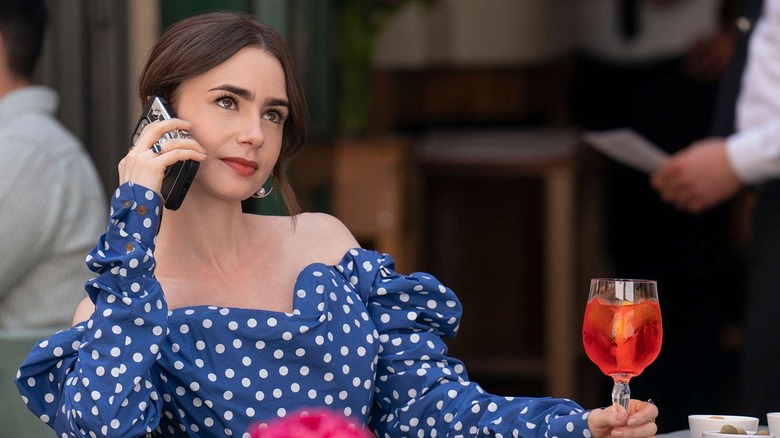
First of all, let's get something vital out of the way: the only reason that "Emily in Paris" survived for as long as it did despite dismal reviews and declining interest is that the show itself is an ad. With a few exceptions, the brands that Emily and her various marketing firms represent are real, including McDonald's, skincare line Augustinus Bader, luxury jewelry and crystal brand Baccarat, and even Air France — the last of which gets a bunch of free PR when Emily visits a over-the-top Air France lounge at Paris' Charles de Gaulle airport. Because the show was able to "organically" weave brands into its narrative, it stopped being a "television show" pretty quickly and just became a straight-up advertisement for why you should go and get a Big Mac.
Beyond that, "Emily in Paris" is a show about how Americans know best and can show other cultures how to properly live their lives. That was a bad message from the very beginning, and it's aged like a piece of Camembert you forgot about in the back of your fridge. The fact that, for six seasons, there was a TV show trying to prove that being a workaholic and loud lunatic was the correct way to live, is honestly gross. "Emily in Paris" isn't just a poorly made TV show with no sense of narrative structure or stakes. "Emily in Paris" is, at its very essence, sort of evil, and it's something you should avoid watching at all costs.
In French, you only say "adieu" if you plan to never see that person again. It literally means "to God," and it's pretty rude. Anyway, adieu, "Emily in Paris." See you in hell.