

The Best Moment In Mortal Kombat II Is A Stephen King Joke (Yes, Really)
This article contains light spoilers for "Mortal Kombat II."
After it became clear that 2021's "Mortal Kombat" was not to everyone's taste, returning director Simon McQuoid and new screenwriter Jeremy Slater decided to lock in and make the sequel as chock full of appeal as possible. Sure, there are oodles of fan service littered throughout "Mortal Kombat II," from the expected, like a character saying "Fight!" to the more unexpected, like the cameo appearance of the game's co-creator, Ed Boon. Yet there's also heaps of just plain likable stuff for all audiences, everything from fun (and gory!) fight sequences to a cheeky sense of humor. That last element is particularly important, as the film's humor laughs with rather than at the admittedly outrageous proceedings.
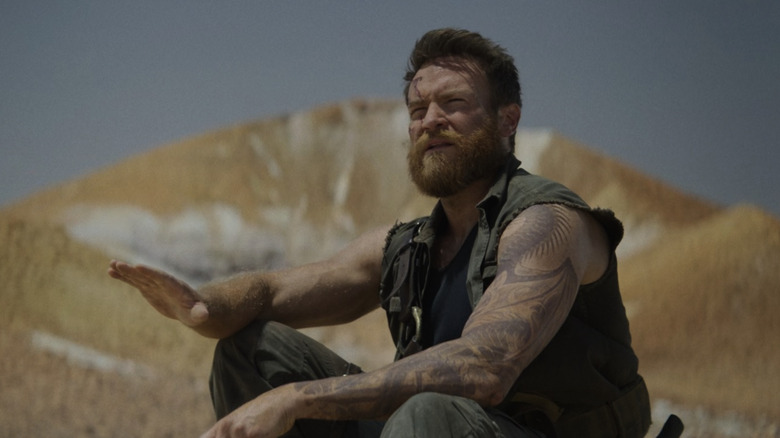
As with the previous film, the largest source of humor comes from the character of Kano, played again by Josh Lawson. On paper, Kano's appearance may come as a surprise, given how he was violently dispatched via garden gnome toward the end of "Mortal Kombat." It turns out that the sorcerer Quan Chi (Damon Herriman) has the ability to reanimate the dead, which usually turns them into a revenant bound to the will of Quan Chi and his master, Shao Kahn (Martyn Ford). Yet, thanks to his unbeatable willpower, Kano is unchanged and is quickly back to his prickly, unpredictable self. This means Lawson is once again unleashed on the film as a master quipster, and the actor delivers a bevy of great one-liners. However, the crown jewel of these comes when he flippantly refers to the ominous Quan Chi as "Pennywise," the evil extraterrestrial clown demon from Stephen King's "It." The moment proves that, of all the special moves used in the film, Kano's wit may be the most cutting.
Josh Lawson had license to 'rough up the edges' of the film
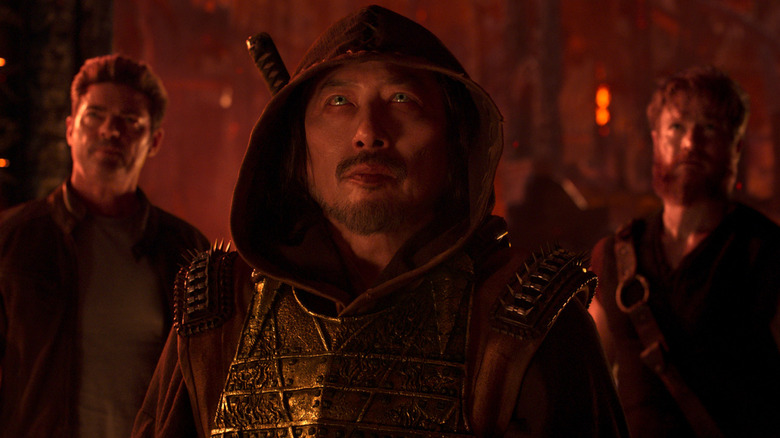
The moment when Kano calls Quan Chi "Pennywise" illustrates how "Mortal Kombat II" can establish its own emotional stakes while keeping things grounded in a relatable, charming way. In other words, a film like this needs characters and moments that take everything very seriously, but it also needs to feel like modern-day audiences can still relate to it. Josh Lawson understands that, inherently, he (along with Karl Urban as Johnny Cage) got the most license from director Simon McQuoid to improvise and play with the script. As Lawson told me during a recent interview, the trick to good improv is all about picking the right moments:
"Not saying you want to go riff on every line. You wouldn't need to because the script is solid. Right? You definitely do it scripted a few times. Then Simon goes, 'We got time. Let's play.' Even one or two of those [ad libs] in a scene, it just helps rough up the edges a bit. I think it makes the characters feel a little looser, a little bit less predictable."
Lawson is completely correct in understanding the value of taking the edge off a film like "Mortal Kombat II," lest it collapse under the weight of so much lore or expectation. The "Pennywise" quip is so good not just because of Lawson's delivery and timing, but also because the reference is the smartest one. He could've called the ashen white Quan Chi something like "Skeletor." Yet "Pennywise" both satisfies the pop culture reference while name-checking a character who's generally very intimidating, unlike Skeletor. It just proves that Kano, who has a laser eye, is all about precision.
"Mortal Kombat II" is in theaters everywhere.