

Mortal Kombat II Review: A (Mostly) Flawless Victory For Video Game And Martial-Arts Fans
What makes a good cinematic adaptation of a video game? It's a question we've been asking since at least 1993's "Super Mario Bros.," and we're not likely to have a solid answer to it anytime soon. For proof, look no further than the reaction to the trailer for Zach Cregger's "Resident Evil," which has begun the fight all over again. In this corner, weighing in at "The Super Mario Galaxy Movie," we have the Purists. These are the fans who demand a video game movie should look like a 1:1 translation of the game, and that its story and characters follow suit. In the other corner, weighing in at "Sonic the Hedgehog," we have the Radicalists. These folks want to see games adapted into a unique cinematic experience, where a film will retain enough of the spirit of the source material but not be slavishly devoted to it.
Into this bloody, no-holds-barred tournament enters a new, surprising contender: "Mortal Kombat II." The previous live-action "Mortal Kombat" movie from 2021 generally fell into a "Radicalist" bubble, yet it turned the games' story of an eternal fighting tournament for control of the universe's realms into something a little too far afield. Still, it garnered enough goodwill thanks to its charmingly plucky tone and impressive kombat (er, combat) scenes. Now, director Simon McQuoid and cast have returned for round 2, this time bringing much more of the recent games' lore and aesthetic with them while keeping the strong focus on the fight sequences and an earnest take on the material. The result is a platonic ideal of a "Mortal Kombat" movie, and while it may not be a new benchmark in video game adaptations, it proves that there is a middle ground where both fans and noobs alike can be satisfied.
Mortal Kombat II smoothly weaves in an actual fighting tournament with character stories
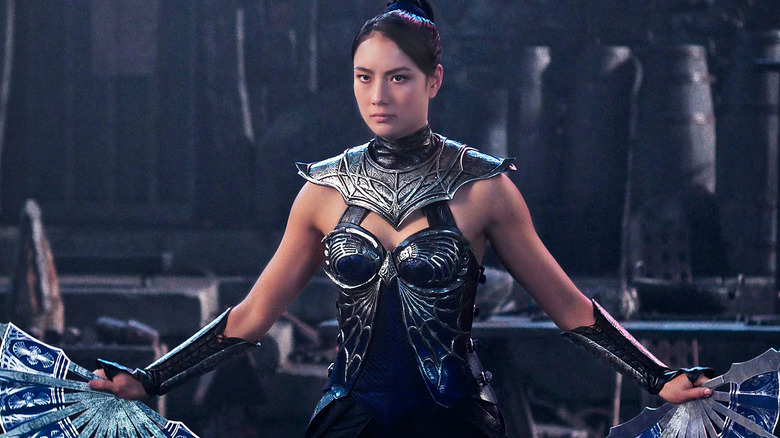
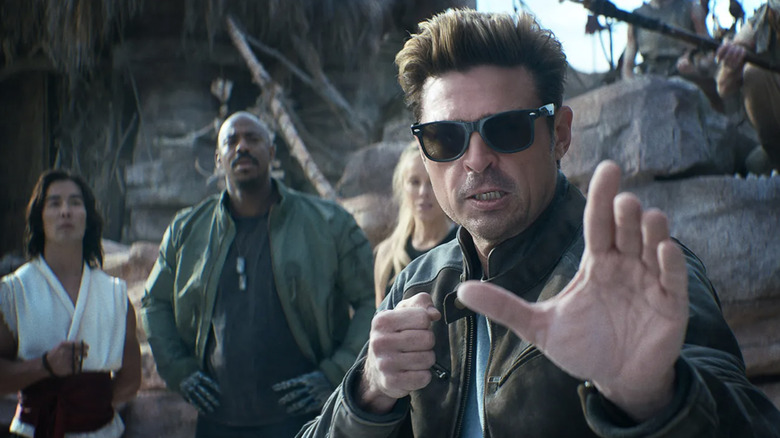
Screenwriter Jeremy Slater addresses the most major complaint about "Mortal Kombat" 2021 early in "Mortal Kombat II," which gets right into tournament mode after a prologue featuring one of the film's new protagonists, Kitana (Adeline Rudolph). Following the "unofficial" fight shenanigans of the first movie, here, the chosen champions of Earthrealm (who no longer bear the video game's dragon logo as a birthmark-style tattoo) are properly part of the titular tournament against the fighters of Outworld, led by the power-hungry Shao Kahn (Martyn Ford). (Shang Tsung, the villain of the first movie played by Chin Han, is relegated to a scheming subordinate in this film.) In addition to fighting for Earthrealm's freedom, the champions also have to contend with Kahn's side scheme to use a MacGuffin amulet to turn himself immortal. They also have a new, somewhat reluctant fighter added to their roster: Johnny Cage (Karl Urban), a washed-up '90s action movie star who needs to get his mojo back.
Where "Mortal Kombat" 2021 seemed overly concerned with avoiding a traditional fighting tournament structure, "Mortal Kombat II" embraces it without missing a step. Slater and Simon McQuoid inherently understand that the concept doesn't preclude character or story. After all, the "Mortal Kombat" game was heavily influenced by martial-arts films such as "Enter the Dragon" and "Bloodsport," and while those movies weren't exactly character studies, they didn't need to choose one aspect over the other. Nor did they spend too much time over-explaining the rules and lore, something that "Mortal Kombat II" sort of adheres to. For every expositional statement about the magic amulet, the film gets to the combat smoothly by having characters glow for a second when they're chosen and then teleported to an arena. Simple as that!
Great fights make up for uneven environments in Mortal Kombat II
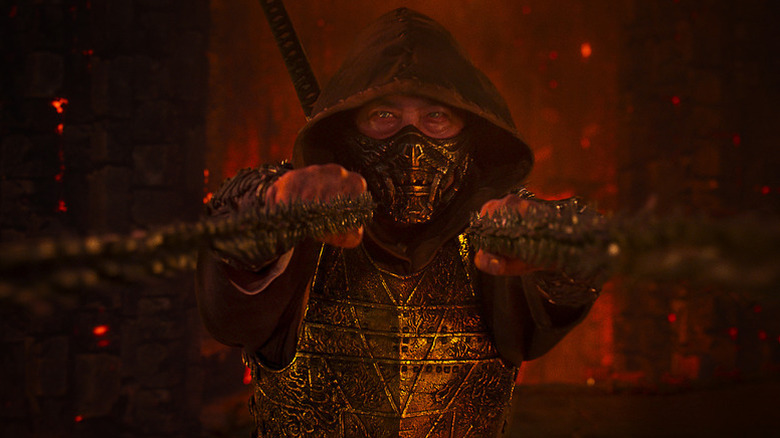
One of the highlights of the previous "Mortal Kombat" film involved seeing martial-arts legends Hiroyuki Sanada (who returns here as Scorpion) and Joe Taslim (who also returns as ... let's just call him Bi-Han for now) strut their stuff, making that movie the first "Mortal Kombat" film to feel like more than just a video game adaptation. Simon McQuoid doubles down on that quality, providing what feels like more fight sequences than the first film. Even better, he and Jeremy Slater have given each fight an emotional component, so rather than just action for action's sake, each sequence feels emotionally charged, proving that McQuoid has learned that the best fight films use combat in a similar fashion to the way musicals use songs. Stunt coordinators Kyle Gardiner and Jade Amantea deliver some impressively imaginative fights, moves which, like a great wuxia film, work with the characters' supernatural abilities rather than just handing over large swathes of scenes to the visual effects team.
Which is good, because that visual effects team is a little overworked in creating all the various environments the characters battle in. While the aspect of each pair of opponents being zipped magically to places that look lifted straight from the video game does allow the movie to feel like the most faithful "Mortal Kombat" yet, it does start to get a little superfluous. To be sure, it would derail the movie and the action if the characters were to explain where they're being transported to and why each time, but some environments — such as a platform floating in a swirling void where Liu Kang (Ludi Lin) and Kung Lao (Max Huang) fight — are so unusual, even almost too fake-looking, that they're nearly distracting. Fortunately, we're not given much time to think about such things.
The cast may be overstuffed, but Mortal Kombat II doesn't pull its punches
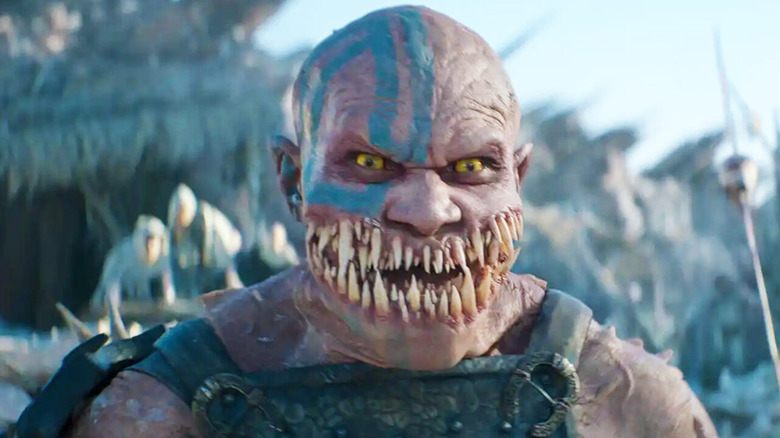
Anyone with a passing knowledge of "Mortal Kombat" (or fighting video games in general) knows that the selection screens are filled to the brim with characters. As a result, "Mortal Kombat II" has no shortage of colorful faces, and it probably won't surprise anyone to learn that not all of these characters get meaningful screen time. Fortunately, the film avoids the "Super Mario Galaxy" flaw of lapsing into neuron activation mode, nor does it suffer from "Deadpool and Wolverine" cameo-itis. Yes, there are a handful of characters who seem to wander in and out of the movie only when they're needed, and folks unfamiliar with the franchise will be occasionally confused as to why the fanboy horde is braying over something. By and large, though, "Mortal Kombat II" levels the playing field for die-hards and newcomers, and even characters who weren't exactly fan favorites, like the non-video game character Cole (Lewis Tan), are treated fairly. (However, some of the returning characters from the first movie make the series' transition out of a more grounded mythology feel too pronounced.)
What's most winning about "Mortal Kombat II" is how uncalloused it is. It feels almost perverse to say that the movie adapted from a video game who's entire point was to see which gory kill you could perform on another fighter is earnestly heartfelt, but it's true. The film really does seem to care about the story more than the perfunctory "here's some cool stuff" IP cynicism we seem to get too much of these days. That attitude, in turn, makes elements like the role reversals between Good and Evil and the brutal demises of hero characters hit that much harder.
Mortal Kombat II is a peanut butter and chocolate mix of a film
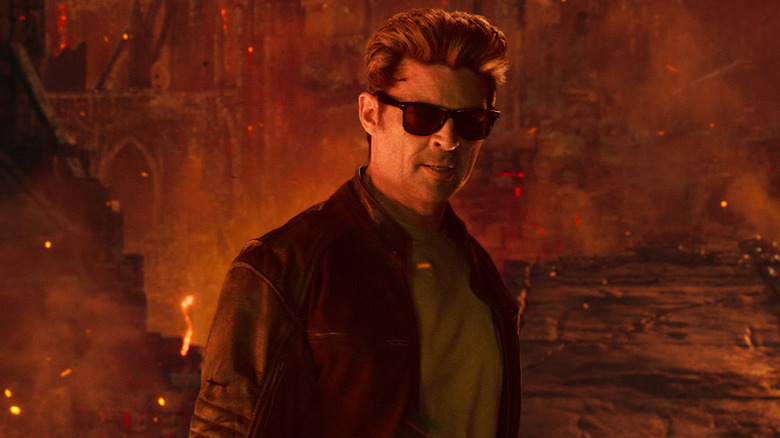
So many big budget IP films these days, especially those designated as a Summer Movie (which "Mortal Kombat II" found itself upgraded to unexpectedly, being pushed back/forward from an initial October 2025 release), find themselves stuck trying to be all things to all people. Of course, no movie can be that (nor should they be), but "Mortal Kombat II" makes such a challenge feel attainable. It's a movie that feels like it's having its cake and eating it, too. It does something like letting improvised quips from Urban and Josh Lawson as Kano run rampant without diluting its earnestness, then does itself one better by turning that duo into an unlikely odd couple. It brings back characters in a way that doesn't feel extraneous (even if they totally are), and throws in new characters late in the runtime without making you roll your eyes from exhaustion. While not every little thing in the film works, it's honestly a little astonishing how much of it does.
There is a "peanut butter and chocolate" scenario going on with "Mortal Kombat II." It's simultaneously a video game adaptation and a martial-arts film, an ode to past-their-prime action stars and a gritty fairy tale of a warrior princess, a no-nonsense action movie and a frivolous romp. It's easily one of the biggest surprises of this year. While it doesn't yet settle the debate about where video game movies will go from here, it proves the subgenre is evolving. Video game movies, especially "Mortal Kombat" movies, don't have to be radical reinventions, nor do they need to be relegated to fan service slop. They can be more.
/Film Rating: 8 out of 10
"Mortal Kombat II" opens in theaters on May 8, 2026.