

The Drama Review: Zendaya And Robert Pattinson Shine In This Uncomfortable Dramedy
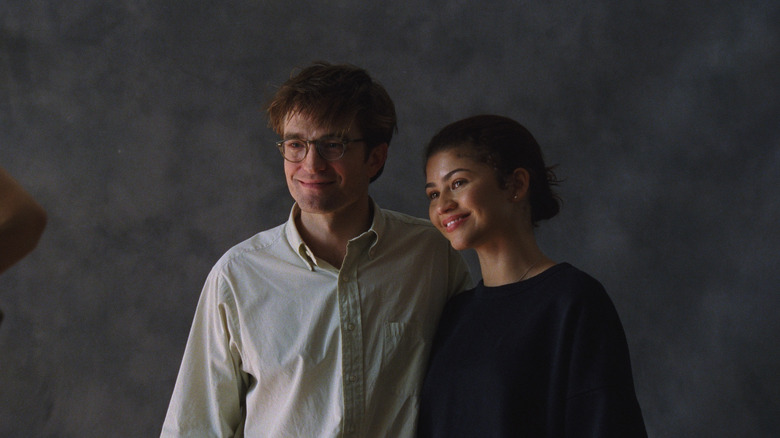
Even though "cancel culture" may not be a real thing anymore, there's no doubt that moral fortitude has become currency in our highly front-facing, always-online social landscape. Just as folks have learned that performatively being a good person (whether or not they actually are) pays dividends, they've also realized that it's just as easy for a mere opinion of theirs, let alone an actual action, to sink their moral clout. Additionally, romantic relationships have been a perennial source of tiny disagreements growing to cataclysmic proportions, long before the social media age. Most people, particularly newlyweds, tend to overlook their partner's flaws. "The Drama" strikes right at the worst possible Venn Diagram intersection of all these topics. What if, just before your wedding, you discovered a horrific secret about your partner's past, something that doesn't just reflect badly on them but could easily make you look bad if you choose to remain with them, too?
It's this thorny topic that writer/director Kristoffer Borgli delves into with his fourth feature, and when it comes to delivering on the promise of its title, the film doesn't disappoint. Borgli has fostered an auteurist reputation for himself as a provocateur, and his movies like "Sick of Myself," "Dream Scenario," and now "The Drama" feel like they have more in common with Danish rascals like Lars Von Trier and Nicolas Winding Refn than Borgli's Norwegian contemporaries. Or perhaps Borgli is looking more toward the Swedes; "The Drama" features the prominent placement of a poster for 1969's "The Passion of Anna," and Borgli's film plays like Ingmar Bergman by way of Albert Brooks. In any case, "The Drama" is a cinematic Trojan horse: it's a breezy farce that feels uncomfortably ominous, and it's also a star-studded romance movie which could set off a discourse bomb.
Borgli ingeniously lets The Drama dig its own moral hole
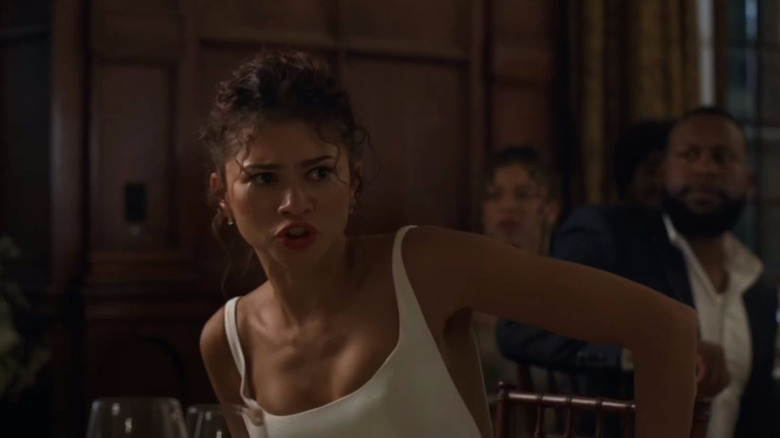
"The Drama" begins weaving its web of thorns right from the opening moments, when museum curator Charlie (Robert Pattinson) meets literary editor Emma (Zendaya) in a cafe in Boston. Kristoffer Borgli immediately starts introducing a feeling of doubt into what initially seems like a rom-com meet cute: we realize that we're seeing the meeting as part of a flashback narrated by Charlie and Emma to their respective friend groups on the eve of the couple's impending marriage, and not only does each person have a different version of the tale (a la Akira Kurosawa's "Rashomon"), but even the facts of their meeting could be interpreted multiple ways. Was Charlie pretending to have read the book Emma was reading charmingly inspired, or manipulatively creepy? Was Emma offering to start their entire encounter over after not hearing Charlie speak to her generous, or does it show her to be too willing to sweep the past under the rug?
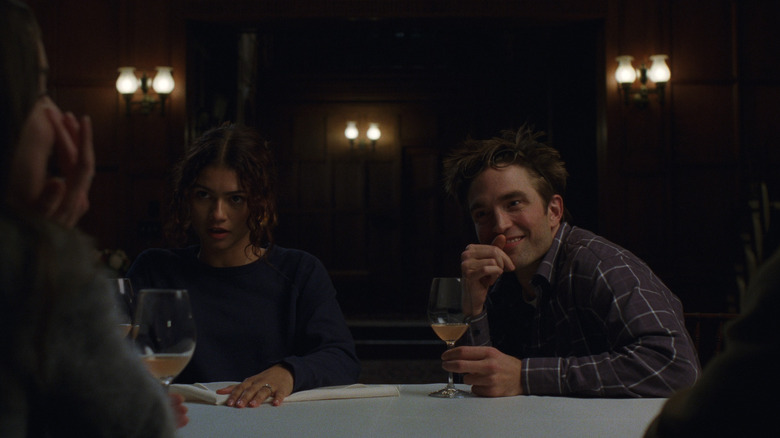
From there, Borgli builds to an early scene where the couple and their friends, Mike (Mamoudou Athie) and Rachel (Alana Haim) play a drinking game where each confesses the worst thing they've ever done. Borgli orchestrates this scene ingeniously, giving all the characters secrets which could potentially offend someone, leading to Emma dropping a bombshell on the table. I won't reveal what that revelation is here, suffice to say that Borgli has concocted a deliciously discomfiting scenario. Emma's transgression is not so egregious as to stop the marriage (and thus the film) in its tracks, but it is troubling enough to derail it. The movie then becomes an unraveling: of Charlie and Emma's relationship with each other, with their friends, and of the truth, something with which Borgli continually teases the audience in an insidious fashion.
Zendaya and Robert Pattinson play to their respective strengths
Obviously Borgli is attempting to give the film a very specific and particular tone. As such, Robert Pattinson and Zendaya are perfectly cast, with each getting to play to their strengths. Zendaya has built up a resume of roles in which moral ambiguity is a major feature, whether it's the drug-brained Rue in "Euphoria" or the manipulative Tashi in "Challengers." That ambiguity serves Emma well, as it allows her to be the intelligent, yearning, loving young woman she is with a hint of unknowability beneath the surface, a quality which grows the more we and Charlie learn about her. Pattinson, meanwhile, has become infamous for playing weird little freaky guys, from a very emo Bruce Wayne in "The Batman" to the titular schizophrenic clone of "Mickey 17." At first, Charlie seems like a change of pace for him, the character appearing to be buttoned up and dull. After Emma's revelation, however, Pattinson begins pulling at Charlie's threads so hard that he becomes hilariously unhinged, a transformation that Borgli is all too happy to chronicle.
The rest of "The Drama" ensemble is more than up to the task of following the leads' footsteps, too. Mamoudou Athie and Alana Haim make for a delectable mirror image couple to Charlie and Emma, and this may be Haim's best performance yet, perhaps besting even "Licorice Pizza." Hailey Benton Gates continues to demonstrate why she's a perfect A24 poster girl, easily making her role as Pattinson's co-worker hilarious and memorable. Elsewhere, Daniel Pemberton brings his off-kilter inventiveness to the score, while cinematographer Arseni Khachaturian keeps his frame stable enough to allow the characters to flail about, while also making the intrusion of the occasional disturbing cutaway feel that much more jarring.
Is The Drama a lazy satire or a subversive plea for empathy?
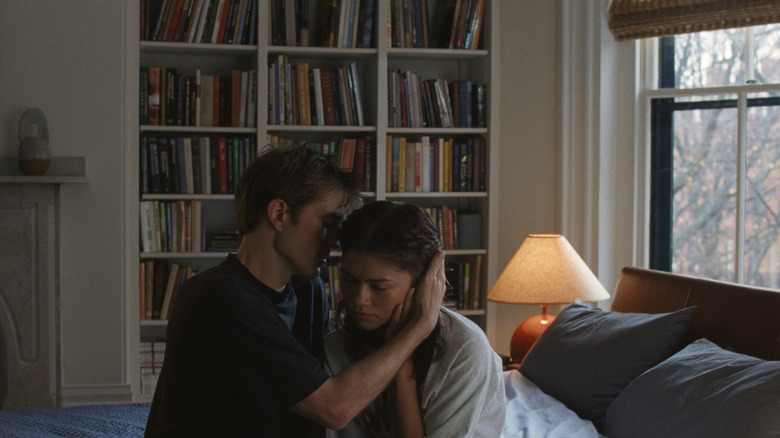
For all of its provocation, however, "The Drama" is in actuality a highly subtle film. On the one hand, this is Kristoffer Borgli knowing that he's making a movie for an era in which it's enough for the subject matter to start the wildfires of discourse on and offline by itself. On the other hand, "The Drama" feels surprisingly reserved; despite the involvement of producer Ari Aster, Borgli's movie doesn't go to the satiric or provocative lengths of Aster's "Eddington." And despite some disturbing fantasy images and an unsettlingly no-nonsense treatment of the flashbacks to Emma's past, the actual on-screen incidents seen in "The Drama" wouldn't be out of place in the average prime-time sitcom.
That's because it feels like Borgli's true aim with the movie isn't satire per se. Sure, "The Drama" sends up the pretentiousness of upper middle class sociability as well as the performativeness of expensive weddings, but Borgli is careful to not pass moral judgement one way or another. The point of this seems to be Borgli making a plea for empathy. Having to reckon with the transgressions of our loved ones is a phenomenon we all deal with at some point, as we equivocate things we learn about our friends and family as well as ourselves. The ultimate point of discomfit in the film may end up being one entirely unintended by the filmmaker, as an essay Borgli wrote years ago about his relationship with a teenager has resurfaced on the eve of the movie's release. Did Borgli make "The Drama" as a confession, or a search for understanding of himself and his own checkered past? The answer, as is usually the case with uneasy questions, is up to you.
/Film Rating: 8 out of 10
"The Drama" opens in theaters on April 3, 2026.