

Project Hail Mary Is The Perfect Next Chapter In Cinema's Greatest Modern Sci-Fi Trend
This article contains spoilers for "Interstellar," "Arrival," "The Martian," and "Project Hail Mary."
Does the human race have a future, and if so, what does that future look like? These are the big questions that so many of us have found ourselves asking over the past couple of decades. To be sure, life has always been beset by various tragedies, atrocities, and obstacles — everyone lives in "interesting times," to quote the apocryphal expression. It's just that these times seem a bit more interesting than before, especially when it comes to issues like humanity's penchant for destroying itself and our foolhardiness when it comes to killing the planet we live on. Given our ability to "doomscroll,' i.e. inundate ourselves on a daily basis with the most toxic news and content possible, optimism and hope for the future are in particularly dire straits right now.
Can art, and science-fiction films in particular, save us from this doom spiral? Even though sci-fi is a broad and particularly malleable genre (and there are numerous examples of bleak, cynical, dystopian sci-fi), a large portion of the genre has always existed to highlight humanity's ambition and reach. After all, two of the most influential works of sci-fi film and television — "2001: A Space Odyssey" and "Star Trek" — were massive influences on real-life achievements in science, tech, and space exploration. They spotlight human ingenuity, curiosity, and wonder as much as they critique human fallibility, offering us a beacon to follow into a better future. Several recent sci-fi films like "Interstellar," "Arrival," and "The Martian" have carried this torch into the 21st century. The most recent chapter in this vein, "Project Hail Mary," perfectly continues the trend.
Project Hail Mary reassures us that no problem is unsolvable

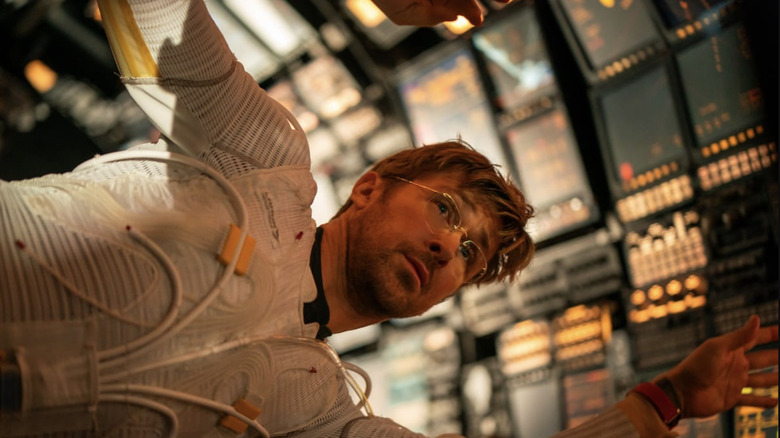
In "Project Hail Mary," the stakes aren't merely high — they're apocalyptic. Not only is our sun dying, but it's surrounded by a large cluster of stars that are also dying. There's one star in the cluster which seems to be unaffected, however, and humanity's Hail Mary pass is building a ship to travel 11 light years away. Three humans will take the one-way trip, hoping they can discover a fix that they'll then send back to Earth on probes. However, Dr. Ryland Grace (Ryan Gosling) awakes to find the rest of the crew have died in transit, while he's got huge gaps in his memory. "Project Hail Mary" is not an apocalyptic tragedy, though; it's an underdog "beat the odds" tale. There's a good reason why the alien creature whom Grace happens to meet and gain friendship and assistance from is dubbed "Rocky."
The fashion in which Grace and Rocky work their way through each problem as it comes to them isn't mere plot contrivance. It's the main event of the film, demonstrating how humanity has the ability to find its way out of a pickle. Or, as Matt Damon's Dr. Mark Watney says in "The Martian," to "science the s–t out of this." From stakes as small as saving one man's life, to first contact with extraterrestrials as a gateway to world peace ("Arrival"), to a future generation of humanity helping itself escape a dying Earth in the past ("Interstellar"), it's no accident that all these films have a strong parental element to them. A part of growing up is realizing that no problem is unsolvable, and that you can be responsible for yourself as well as for others. These movies present the ideal version of that principle.
The sci-fi trend that Project Hail Mary belongs to is not one of toxic optimism

While "Project Hail Mary" and this trend in sci-fi highlights positivity, they are not films buoyed by toxic optimism. Each of these stories includes an element of self-sacrifice, with the implication being that difficult problems cannot be solved without hardship, loss, or more. "Interstellar" sees Cooper (Matthew McConaughey) give up his relationship with his children so that he can ensure their future as well as the rest of humanity's. "Arrival" says that humanity can achieve peace with itself and with other species at the cost of knowing the future, even if that future includes unavoidable loss, as with Louise (Amy Adams) and her daughter. "The Martian" sees several astronauts, NASA, and the CNSA sacrifice significant time and resources in order to save Watney.
Initially, "Project Hail Mary" doesn't seem to belong to this theme of self-sacrifice, especially after it's revealed that he refused to go on the mission and is only there by force. Yet the film is a story of overcoming loneliness and finding something (and/or someone) to live for. In the end, Grace willingly gives up his trip back to Earth in order to save Rocky. Thus, Grace ends up building a new life on an alien planet.
This is the latent messaging these films are delivering when it comes to facing down all our potential futures: we can have a brighter tomorrow, and we can solve a lot of the problems that could cause irreparable harm to us, but the solutions aren't going to be easy or comfortable. What's most important is that all hope is not lost, and help is out there if we need it. Will Steven Spielberg's upcoming "Disclosure Day" continue this trend? We'll see what the future holds.