

How Scientifically Accurate Is Ryan Gosling's Project Hail Mary?
Warning: This article contains spoilers for "Project Hail Mary."
These days, every popular author has that "thing" they're most famous for, especially when it comes to any film or television adaptations of their work. Colleen Hoover is going to craft the most melodramatic romance imaginable (and the box office will thank her for it). George R.R. Martin? He's the guy you go to for incredible world-building details, clever subversions of the fantasy genre, and the adrenaline-fueled thrills of eventually outpacing the source material because he's still (allegedly) writing them. As for science fiction fans, "The Martian" and "Project Hail Mary" writer Andy Weir has firmly established himself as the leading voice in "hard sci-fi" — someone who strives for a remarkable amount of scientific accuracy at the core of his stories.
With directors Phil Lord and Chris Miller's definitive cinematic take on "Project Hail Mary" finally rocketing into theaters, moviegoers experiencing this for the very first time may be wondering whether we have another "Interstellar" on our hands. Thanks to some impressive attention to detail, Christopher Nolan's sci-fi film accurately redefined our conception of what black holes look like (so to speak, that is, since space nerds know we can't actually "see" black holes with our puny human eyes) before scientists even confirmed this for themselves. Could Lord, Miller, and "Project Hail Mary" screenwriter Drew Goddard pull off something similar?
The answer is ... kind of, yeah! "Project Hail Mary" throws some seriously heady concepts at mainstream audiences, from aliens to dying stars to Einstein's theory of relativity. Neither Weir nor the filmmakers are averse to bending the laws of physics (sometimes literally) for the purposes of a more entertaining narrative. But, incredibly enough, there's still quite a lot of truth to be found in "Project Hail Mary."
Could the Hail Mary spaceship actually travel that far?
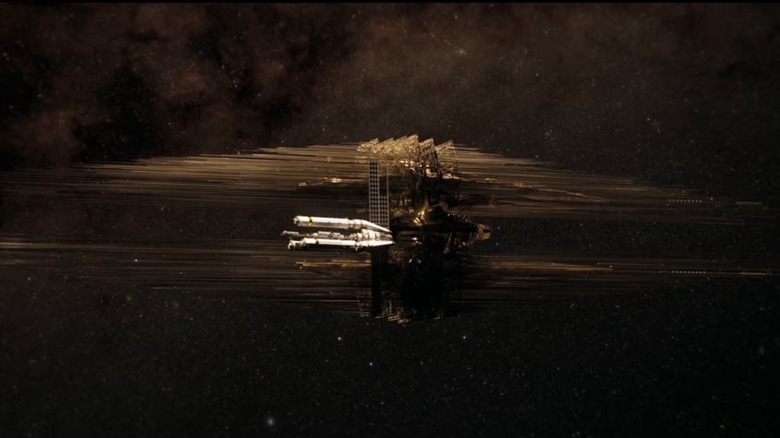
Let's just say that Andy Weir was probably the right guy for this job, having grown up with a physicist and an engineer as parents. (Weir himself was a software programmer and engineer from a very young age.) That scientific background came in handy when he first wrote "The Martian" in 2011, paying special attention to the facts behind orbital mechanics, interplanetary communication, and, of course, poop potatoes. What "Project Hail Mary" lacks in slingshot maneuvers and Martian tornadoes, however, it more than makes up for with its focus on the particulars of interstellar travel.
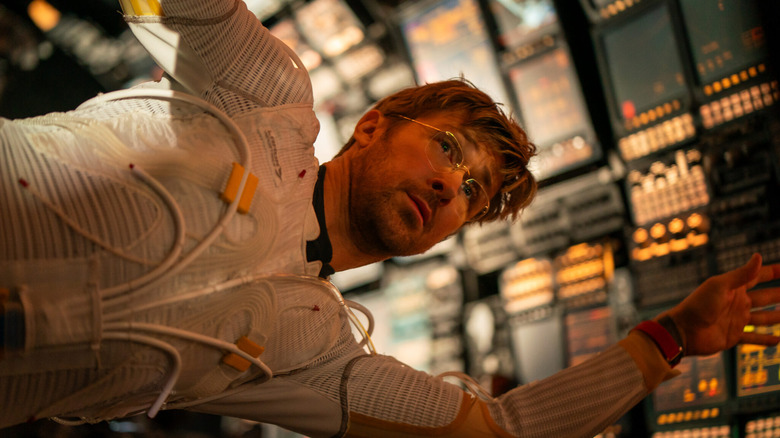
Take the Hail Mary spacecraft, for example. When we first meet Ryan Gosling's amateur astronaut Ryland Grace, he's already well into his journey to the Tau Ceti star system, roughly 12 light-years from Earth. Because of the unfathomable distances and timescales at play, even for this relatively nearby stellar "neighbor," Grace and the other astronauts on this mission are put into comas and fed intravenously — a much more scientifically accurate approach than the usual cryogenics explanation in most other sci-fi tales. Why doesn't Grace age by over a decade, then? Relativity, baby! The closer you accelerate to the speed of light, the less you feel the effects of time.
What about pesky problems like radiation exposure and fuel reserves? Luckily, the fictional "astrophage" — the microscopic little critters consuming the sun — are Weir's get-out-of-jail-free card. They provide convenient radiation shielding for the ship and act as the spaceship's fuel source. We don't currently have the means to travel that fast with our primitive rocket propellant. But theoretically? Mass-conversion fuel (a fancy term for storing huge amounts of energy in a tiny amount of mass) like astrophage would be the key to unlocking interstellar travel.
Is it possible aliens really look like ... that?
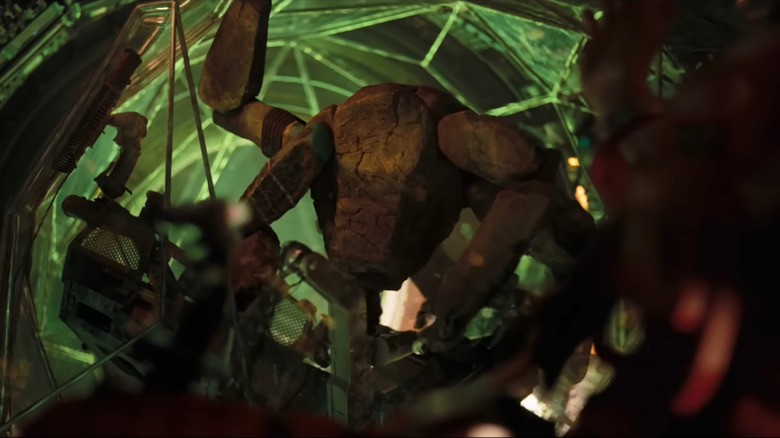
Amaze, amaze, amaze! Not only is that our favorite alien Rocky's (voiced by James Ortiz) favorite turn of phrase, but it'd also be our collective reaction to the news that life does, in fact, exist in other parts of our vast universe. Scientists have made significant progress in this department, pinpointing numerous planetary bodies (some of which reside in our own solar system) that are potentially habitable to life as we know it ... but we're not quite there yet.
Much of that has to do with, well, our understanding of life as we know it. On Earth, nothing can survive without good ol' fashioned H₂O — or water, for those who failed Science 101. In "Project Hail Mary," Ryland Grace makes a case for life that isn't based in liquid water and seems to be proven right when astrophage is first discovered living on or near the surface of the sun. Of course, further study proves they're almost completely made of water, but this only highlights one accepted notion in scientific circles: Not all life needs to look or function the way we do.
The existence and appearance of Rocky is the most emphatic example of this, requiring an environment completely incompatible with that of Earth. Weir recently addressed his thought process for Rocky with the New York Times, saying, "I didn't set out for Rocky to be as alien as possible. What I did was not have any restrictions on my speculative evolution of what this alien is like." That allowed him to imagine an alien with a rocky exterior, an ammonia-rich atmosphere, and almost zero overlap with human biology (like eyes).
If life exists, however, it'll most likely resemble astrophage: single-celled organisms, rather than sentient beings.
Is the sun actually dying?
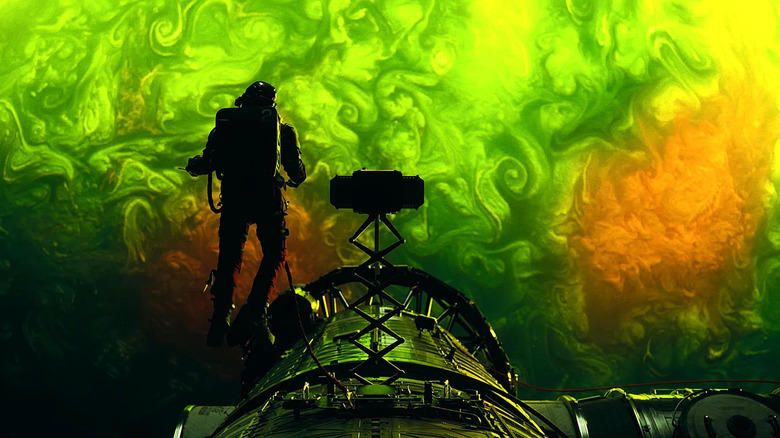
I don't mean to alarm anybody, but the answer to this question is an emphatic yes. The sun will inevitably die ... but only billions and billions of years from now. Like anything else in the known universe (outside of Marvel movies and Oscars discourse, at least), our sun has a set expiration date. Luckily for us all, we'll be dead long before we even get close to that. Sol, the agreed-upon name for that yellow ball of fire you may have noticed whenever you look up at the daytime sky, is a relatively youthful star in the grand scheme of things. A spry 4.5 billion years young, our sun isn't even halfway through its estimated lifecycle. It's projected to take another 5 billion years before it consumes its internal fuel source and runs out of energy, which will be bad news for anyone still hanging around our solar system by then.
For "Project Hail Mary," Andy Weir decided to speed things up a bit and introduce a mold-like infection of astrophage. These organisms feed on the sun's energy and hasten its demise, cutting off vast quantities of light and heat to our planet and spelling disaster for all of life on Earth. While loosely based on actual lifeforms like spores or algae, this concept as depicted is completely fictitious with zero basis in scientific observations and fact. You can't blame Weir for spicing things up, however, especially since he takes a very clever approach to which stars the astrophages infect, what it takes to solve their threat, and how they got there in the first place.
That brings us to our next and last point.
Why are Rocky's species and humans located so close together?
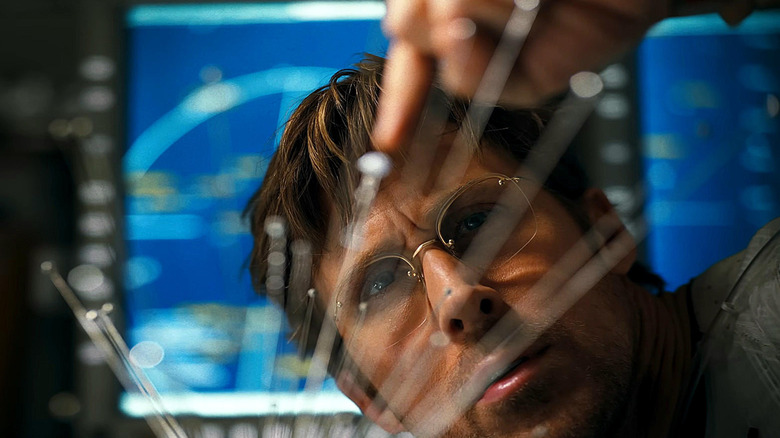
Now we've arrived at the nerdiest question of all. For those of us who spend WAY too much time thinking about such things, it's a known fact that the odds of humans actually encountering another space-faring civilization from elsewhere in the universe are infinitesimally small — regardless of what Steven Spielberg may claim about aliens. So, given how unimaginably vast and old this universe is, the ridiculously low probability of two intelligent species evolving and developing spaceflight at basically the exact same time, and the simple logistics of meeting up at precisely the right time and place ... how the heck does a human like Ryland Grace and an Eridian like Rocky (who originates from the star system of Eridani) end up bumping into each other so quickly?
That's all in the rather nifty conceit of "Project Hail Mary." Our sun isn't the only star dealing with the astrophage problem, as it turns out. Every star in our immediate stellar neighborhood also shows signs of infection; all of them, that is, but one. The Tau Ceti system stands out as the one place immune to astrophage, so it makes sense that any aliens in the immediate vicinity would send their top explorers to go check it out. It's an inspired solution to a topic broached by the similarly scientifically-inclined Netflix series "3 Body Problem," which also wrestles with the question of why we've yet to discover any evidence indicating the existence of extraterrestrials (known as the Fermi Paradox).
The book goes even further, ending with Rocky and Ryland discussing the possibility of life being more common than they think. If they're anything like Eridians, it's a comforting thought.
"Project Hail Mary" is now playing in theaters.