

Warner Bros. Wanted A Crucial Plotline Cut From V For Vendetta, But The Director Said No [Exclusive]
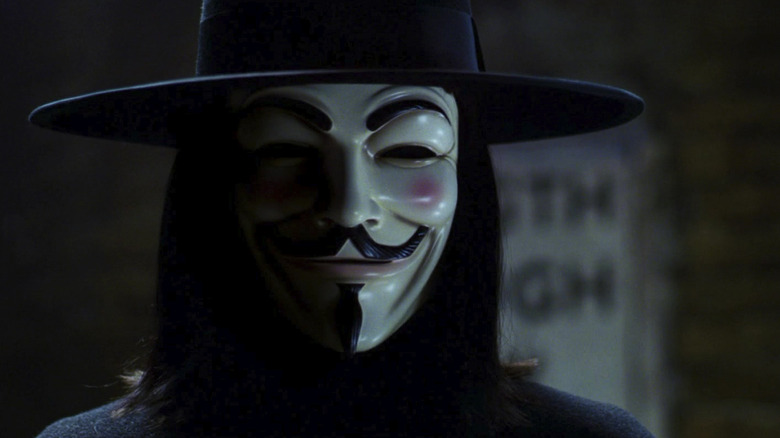
You can probably count on one hand the number of big-budget Hollywood movies that engage in an earnest "freedom fighter or terrorist?" conversation with a protagonist who occupies that morally murky role. 2006's "V For Vendetta" is among the few examples that meet that criteria, and to celebrate the film's 20th anniversary, I asked director James McTeigue if he experienced any pushback from Warner Bros. about the film's provocative imagery, which includes blowing up government buildings and assassinating politicians. Surprisingly, the studio didn't blink at the Parliament building (the Palace of Westminster) exploding; instead, someone asked McTeigue to remove what is arguably the lynchpin of the entire movie.
"Really, I only had one meeting with the studio about [removing any subject matter] and that was, 'Can you take the Valerie sequence out of the movie?' That's the lesbian relationship that the movie star has," McTeigue explained.
If it's been a while since you've seen the film, "the Valerie sequence" happens after Evey (Natalie Portman) is kidnapped and has her head shaved. In a hole in her cell wall, she discovers a roll of toilet paper with scribblings on it from Valerie (Natasha Wightman), a prisoner who was a movie star before Chancellor Sutler (the late, great John Hurt) took power and reshaped the UK under his control. The film flashes back to detail Valerie's life story: her bucolic upbringing, discovering she's a lesbian, being rejected by her parents, her burgeoning acting career, falling in love with a woman named Ruth, and finally, she and Ruth being kidnapped by their fascist government and sent to a concentration camp because of their sexual orientation. Before Valerie is killed, she writes her autobiography on whatever she has available, and that scroll eventually makes its way to Evey and inspires her to keep going.
The Valerie subplot is essential to V For Vendetta
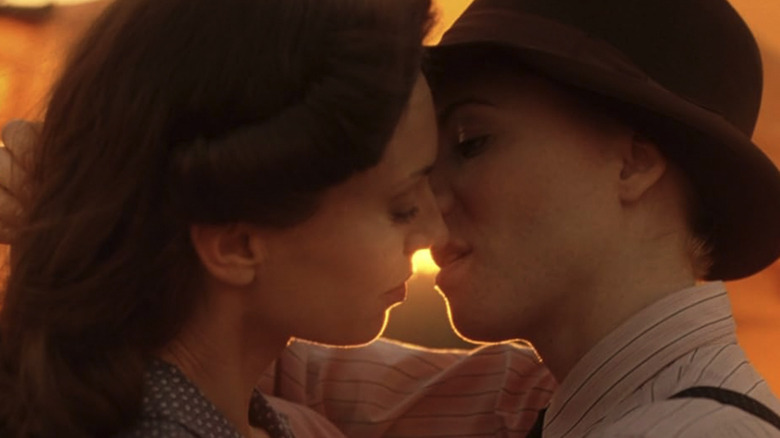
This isn't the only time Warner Bros. notes almost ruined a great movie, but this request is especially egregious. Thankfully, James McTeigue stood his ground:
"You can't take that out. It's the thing that transforms Evey. That whole story that she gets on the rolls of toilet paper through the hole in the wall, it's the crucible of the movie, right? I said, 'No.' They went, 'Okay.' That was it. Kudos to them, and then they really got behind releasing it, too."
20 years later, I understand why McTeigue gives "kudos" to WB for allowing him to retain that aspect of the movie . But the fact an executive ever asked to have it removed in the first place proves that executive did not actually understand this story. Reading about Valerie's life is the thing that gives Evey hope in a hopeless place and makes her feel connected during her greatest time of isolation. Ultimately, it gives her the confidence to hold the line and do what's right, even in the face of certain death. If Valerie can retain her humanity in such horrific circumstances, Evey can, too. We all can.
An underrated aspect of Valerie's message is that it ends with her telling the reader that she loves them, regardless of the fact that she'll never meet them. That concept — loving your neighbors — is antithetical to the fear-mongering Sutler and his goons, and we see it in action when the citizens of London take to the streets wearing V masks to enact change.
Without Valerie's story, Evey's journey is incomplete, and the movie simply does not work.
To hear my full conversation with McTeigue about "V For Vendetta," listen to this Wednesday's episode of the /Film Weekly podcast.