

Marshals: The Zone Of Death's Real-Life Inspiration Explained
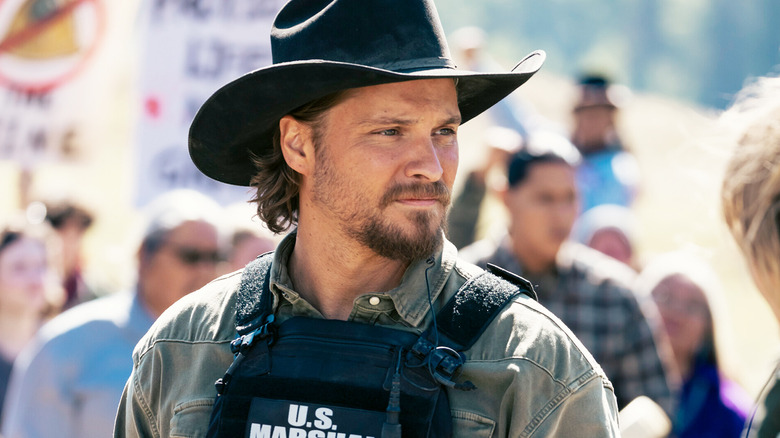
"Marshals" episode 2 sees Luke Grimes' Kayce Dutton and his U.S. Marshals intercept a drug deal between two gangs in an area known as the Zone of Death. This is an actual place in the Idaho portion of Yellowstone National Park where it's been suggested a person could get away with murder.
"Marshals" is already killing off characters in awful ways, taking a page out of the "Yellowstone" playbook in the process. On the mothership series, the Dutton family wasn't just perpetually mired in interpersonal drama, they also liked killing people and disposing of their bodies at a secluded location. In "Yellowstone," the Train Station was a rocky outcrop that overlooked a canyon. But it wasn't just the fact that this particular landform proved convenient for dumping bodies. The Train Station was located in an area of land which Lloyd Pierce (Forrie J. Smith) describes as having "no people, no law enforcement, no judge and jury of your peers, and no one living within a hundred miles." All of which meant that even if one of the Duttons' victims were discovered, the family would still likely get away with murder.
Coming as it did from Taylor Sheridan, "Yellowstone" was often a ridiculous show and the Train Station seemed like just another absurd aspect of the series. But such a place does actually exist. To be specific, the lawless, isolated land described by Lloyd exists as a place called the Zone of Death, a 50-square-mile area within the Idaho section of Yellowstone National Park where one could technically get away with murder (but not really). It forms a big part of "Marshals" episode 2, which seemingly confirms that the Train Station was within its bounds. So, here's everything you need to know about the real-life Zone of Death.
It's technically impossible to prosecute a crime committed in the Zone of Death
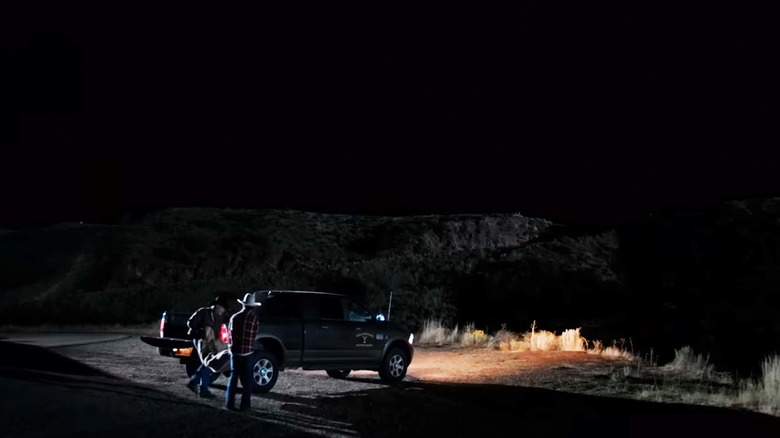
"Yellowstone" wasn't always the most accurate show, but the "Zone of Death" is a real term used to refer to a 50-square-mile area in the Idaho section of Yellowstone National Park. It was discovered by Michigan State University law professor Brian C. Kalt as part of his research for an essay about the Sixth Amendment to the U.S. Constitution.
After discovering the Zone of Death, however, Kalt wrote a different essay in 2005. Entitled "The Perfect Crime," the paper explains how Congress originally put the District of Wyoming in charge of Yellowstone National Park, even though the park itself overflowed into parts of Montana and Idaho. Crimes committed anywhere in Yellowstone National Park — even the Idaho and Montana sections — are therefore tried in Cheyenne, Wyoming.
This creates a problem when it comes to the Idaho land, however. Should someone commit a crime in the 50-square-mile Idaho section of the park, under the Sixth Amendment they would be entitled to a jury made up of members from both the state and district in which that crime was committed. That means that the jury would have to include members who were both from Idaho (the state where the crime was committed) and from Wyoming (the district). The only place where someone could technically be from both Wyoming and Idaho is in the Zone of Death, and guess what: nobody lives there.
This loophole essentially means that a jury could not be formed for any crime committed in the Zone of Death, making prosecution impossible. Since Kalt's discovery, there have been attempts to close the loophole, but thus far Congress hasn't turned over the Idaho section of Yellowstone to Idaho itself. The Zone of Death persists.
Could you actually get away with murder in the Zone of Death?
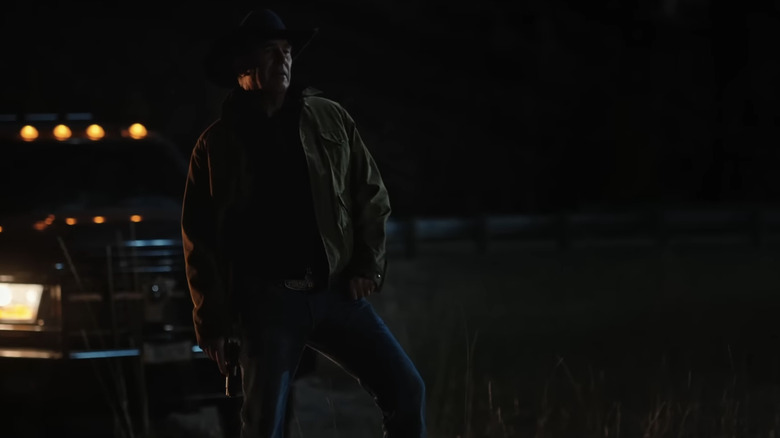
In 2016 Brian C. Kalt spoke to Vox about the Zone of Death. "The loophole looms, waiting for a murderer to exploit it," he said. "I feel like I've done what I can to prevent this; the blood will be on the government's hands." But could someone really get away with murder in the Zone of Death? This is one of those questions that "Yellowstone" failed to address and which "Marshals" also leaves hanging. In reality, no murderer is likely to walk free.
Were a murder to take place within the Zone of Death, a judge would likely allow for a jury to be created in another way. What's more, even if the defendant wasn't tried for murder he or she could still be tried for associated crimes, such as conspiracy to commit a crime. Prosecutors could also request a change of venue — though this is typically used when jury members from the local district are unlikely to remain unbiased. There would also be a lot of scrutiny over the word "district" in the Sixth Amendment and the courts would likely agree on an expansive definition that would allow a jury to be called from other areas.
This is all hypothetical since no murder has actually taken place in the area (unless you count the terrible things the Duttons have done). In 2005 a man named Michael Belderrain did shoot an elk in the Montana section of the Yellowstone National Park, and tried to use Kalt's article as part of his defense. However, his argument was dismissed and he took a plea deal. Had he appealed the decision it could have led to an interesting real-world test for the Zone of Death loophole, which remains in place today.