

The World's First Robot Movie Was Just Discovered (& It Goes Back To 1897)
We may receive a commission on purchases made from links.
Film students will happily bend your ear about the career and influence of Georges Méliès. As has been repeated in film schools and cinematheques the world over, Méliès discovered film when he attended an exhibition held by the Lumière Brothers back in 1895, where they were showing off their brand new motion picture camera. Méliès immediately went out looking for a motion picture camera of his own. He began shooting his own movies, discovering the wonders of editing, outsize sets, weird costumes, and marvelous fantasy storytelling. His movies were always very short, with some of them lasting less than 60 seconds, but they were all shot with a very clear enthusiasm for the brand-new medium.
Most people might know Méliès from his 1902 film "A Trip to the Moon," one of the most famous movies in history. The short saw a group of scientists taking a rocket to the moon and meeting the weird Mooninites that lived there. Méliès seemed to feel that cinema was very similar to performing magic tricks. Méliès is one of the pillars of the cinematic medium.
There is so much more history to tell about George Méliès, but that is best reserved for a more extended medium. The vital part of the story is that many of his films were lost, their celluloid melted down and recycled. Only about 300 of his 500 films survived. His story was told in Martin Scorsese's "Hugo."
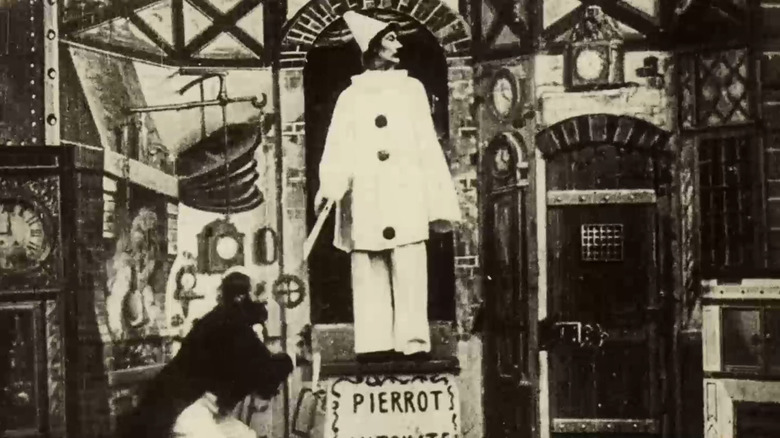
According to a new update from the Library of Congress, one of Méliès' films has been rediscovered, however. "Gugusse and the Automaton" was recently dropped off at the Library. It may be the earliest depiction of a robot on film.
George Méliès' 1897 film Gugusse and the Automaton may feature film's first robot
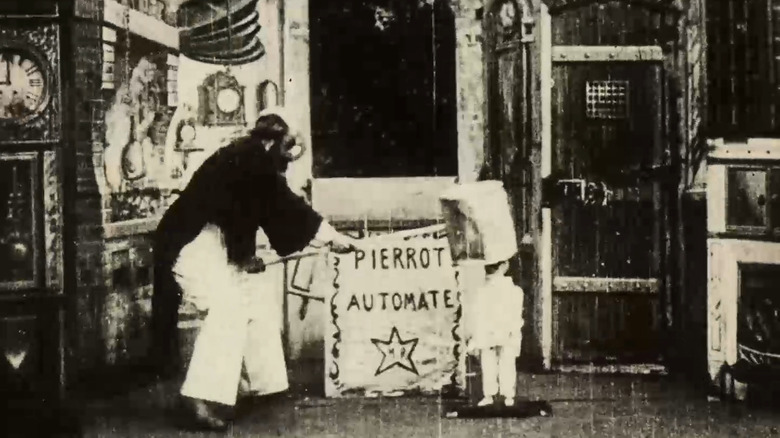
It should be noted that the term "robot" wasn't even coined until the publication of Karel Čapek's 1920 play "R.U.R.," which, in the play, stands for "Rossum's Universal Robots." Prior to that, however, there were plenty of human-shaped automatons that were being constructed as far back as Ancient Greece. As entertainment, automata were included in the acts of stage magician Jean-Eugène Robert-Houdin (the magician from whom Ehrich Weiss took his stage name, "Harry Houdini"). Because Georges Méliès was also a magician, he likely had seen Robert-Houdin's automata and was familiar with them as a form of entertainment.
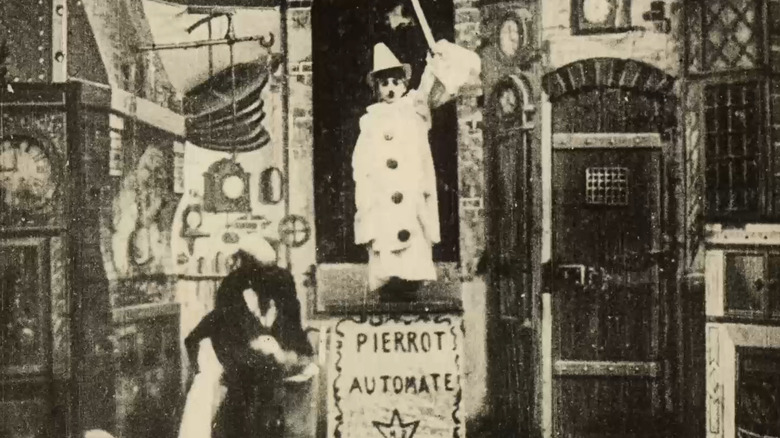
Méliès' newly discovered film, which can be seen on the Library of Congress website, features a character named Gugusse who turns a crank on a large box, causing a robotic automaton (played by a human actor) to begin moving. The automaton transforms from a boy into a taller adult. Gugussed pulls the automaton down from the box, extracts a large comedic mallet, and mashes it over the head. With each thwack, the automaton shrinks, becoming a child again. He goes a few thwacks too far, however, and causes it to shrink into a small statue, and finally into nothing.
Méliès loved to use editing to cause a magical effect. The transforming automaton mutates from one actor to another in the blink of an eye. He was riffing on a magician's use of automata in their stage acts, and posited, with film's magical qualities, what would happen if an automaton act didn't work out well. What if you, as a magician, made it grow by mistake? The humor and wit of Georges Méliès are undeniable.
How the film was discovered
The discovery of "Gugusse and the Automaton" is described on the Library of Congress website, and a video from the Library's nitrate film vault was posted on its Instagram account. The film was donated by one Bill McFarland, a citizen of Grand Rapids, Michigan, who drove a box of old prints to the Library's branch in Virginia. It seems that McFarlane's great-grandfather, William Delisle Frisbee, was a schoolteacher and farmer who moonlit as a stage magician and entertainer. Frisbee would, in the years before World War I, sell tickets to tech shows where he would dazzle audiences with his film projector and his equally novel phonograph. It seems that Méliès' movie has made its way into Frisbee's collection.
When the Librarians opened up McFarland's box, the reels were aged and stuck together. Readers should also recall that nitrate film stock is incredibly fragile and incredibly, incredibly flammable; one can light nitrate film on fire and throw it into a swimming pool, and it will continue to burn. The Library, in a very careful and controlled fashion, examined the print and found that "Gugusse" was a copy of a copy. But it was the first time anyone had likely seen the film in over a century.
And, because it depicted an automaton, it may be a significant artifact in the history of science fiction. We have now taken a glimpse at cinema's first proper robot. Méliès was always drawn to sci-fi and fantasy, so if anyone was going to depict a robot on film, it was going to be him. The first robot, as modern audiences might describe it, appeared in the 1919 serial "The Master Mystery."
It may be time for /Film to update our list of the 25 best movie robots.