

Two Classic Star Trek: Voyager Episodes Give Starfleet Academy Episode 8 Its Emotional Backbone
Attention, students: This article contains spoilers for episode 8 of "Star Trek: Starfleet Academy."
If "Starfleet Academy" is trying to go back through every era of "Star Trek" and deliver a pitch-perfect homage to the franchise each time, we're here for it. Only weeks after treating us to a "Deep Space Nine" power hour with an episode entirely about the mystery of Avery Brooks' Benjamin Sisko, the series has once again delved into the past to make franchise history feel shockingly relevant again in the present. (Um, make that hundreds of years in the future for all the timeline nerds out there, actually.)
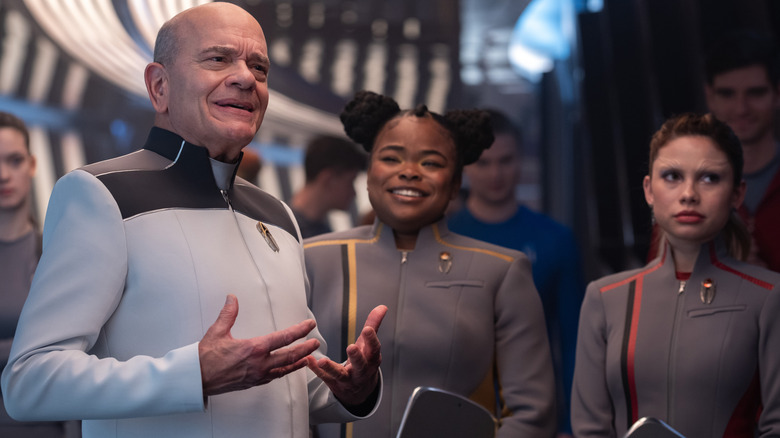
The star of the show this time around is Robert Picardo's Doctor, the Emergency Medical Hologram who first appeared throughout "Voyager." Our ageless, opera-loving grump has mostly served a comedic role as one of the faculty members of Starfleet Academy, but episode 8 (titled "The Life of the Stars") finally saw fit to add some serious gravitas and make him the unexpected centerpiece of a thoroughly emotional episode. It begins by dealing with some leftovers from the events of episode 6, "Come, Let's Away." The trauma inflicted by the villainous Furies still lingers with the students, manifesting as both mental and physical (or, in this case, holographic) scars. Kerrice Brooks' Sam is glitching out, and the Doctor and Chancellor Nahla Ake (Holly Hunter) decide that only an impromptu visit to her photonic homeworld of Kasq can save her life.
What follows is a deep-dive into Sam's psyche and an exploration of the Doctor's surprising insecurities involving a student who looks up to him as a mentor ... and even a father figure. This triggers a painful journey of introspection for him. For us, this calls back to two of the best episodes in all of "Voyager."
Starfleet Academy pays homage to two of Voyager's best episodes: Real Life and Blink of an Eye
As soon as episode 8 of "Starfleet Academy" opened with the Doctor's voiceover recording a personal log, musing on the countless sunrises he's seen over his 900 years of life and the cruel passing of that "beast" known as time, we should've realized what we were in for throughout the rest of the hour. The crisis regarding Sam's glitches, discovered to be an overload in her internal processors, gives him and Ake a not-so-convenient excuse to reckon with his refusal to get close with Sam and give her the encouragement she so clearly needs. But when her Kasq creators (voiced by Chiwetel Ejiofor) solemnly conclude that nothing can be done for her, the Doctor finally breaks down and weeps, tearfully explaining exactly why he held her at arm's distance all this time.
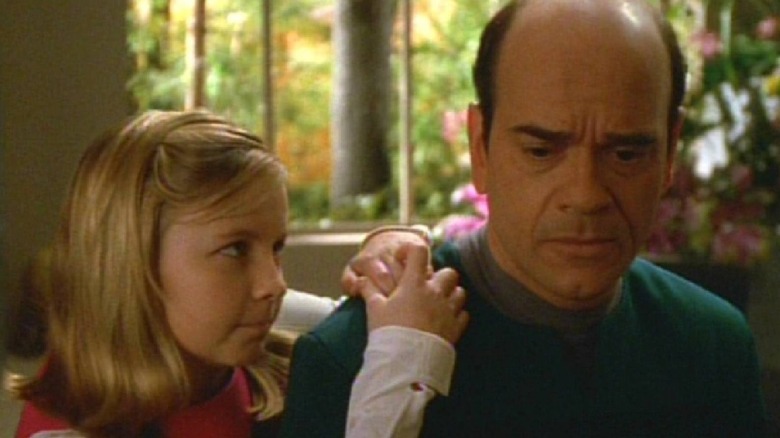
It all has to do with the life he lived aboard the USS Voyager and the painful losses he endured. In "Real Time," the Doctor creates a holodeck program to give himself (under the name "Kenneth") a holo-family in order to understand his human crewmates better. After a crucial tweak to the algorithmic code adds a dose of hard-hitting reality to his self-serving fantasy, the Doctor learns all about the highs and lows of having a partner and children. When an accident renders his daughter Belle (Lindsey Haun) with an untreatable life-threatening condition, he must grapple with the grief of losing a child. "Blink of an Eye" puts a similar spin on this concept, bringing the USS Voyager into contact with extraterrestrials who experience time very differently. In 18 minutes, the Doctor lives a full life on the alien planet — which includes having a son of his own.
Starfleet Academy cleverly makes the Doctor's experiences in Voyager an important part of his and Sam's arcs
If you thought Patrick Stewart's Jean-Luc Picard was the only "Trek" character to experience entire lifetimes through wibbly-wobbly, timey-wimey stuff, think again. Every Trek fan knows the classic "The Next Generation" episode titled "The Inner Light," when Picard was granted a glimpse into a full, alternate life lived among an alien civilization on the precipice of having its entire existence forgotten. But "Voyager" pulled off a similar trick with the Doctor on two notable occasions. To its credit, "Starfleet Academy" takes both of these episodes and folds them into an emotionally-charged arc centuries later for the Doctor ... and for Sam, as well.
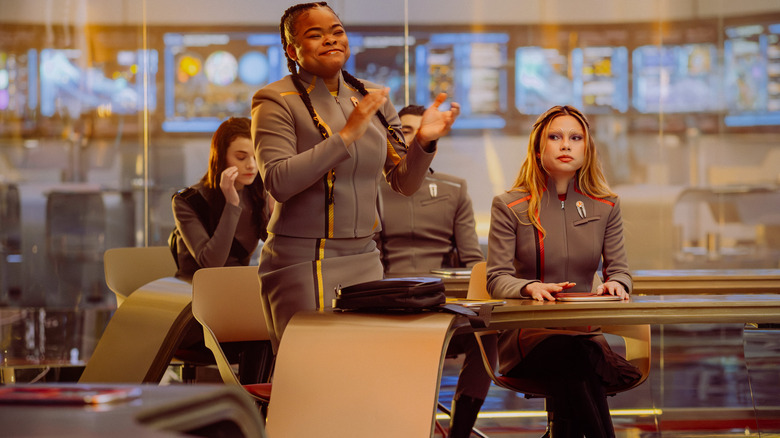
While it's not surprising that "Starfleet Academy" avoids killing off a peppy and wholesome character like Sam so early, the clever twist is that her recovery is contingent on giving her the childhood memories she never had. Obviously, the reluctant Doctor is their best (and only) option for a parental figure, and thus begins one of the show's most moving sequences. We glimpse the two sharing all kinds of loving moments together, from infancy to adolescence. By the end of this montage, which dovetails nicely with Sam's fellow students back at the Academy learning to heal and bond together through the power of art and theatre, Sam is finally made whole again and the Doctor appears to have healed from his own residual trauma.
For a show that has endured its own undeserved flak through review-bombing, "Starfleet Academy" finds the perfect solution to overcoming obstacles. For those who recognize the (mostly unrealized) potential of "Voyager," episodes like this go a long way towards redeeming that flawed series, too. New episodes of "Starfleet Academy" stream on Paramount+ every Thursday.