

Star Trek: Starfleet Academy Answers The Question Everyone Has About Robert Picardo's Doctor
Spoilers for "Star Trek: Starfleet Academy" episode 8 to follow.
Robert Picardo lucked out with his "Star Trek: Voyager" role as The Doctor, a holographic intelligence designed to assist medical officers; on the stranded starship Voyager, the Doctor had to step up for a full-time job. Since the Doctor is one of many mass-produced holograms, Picardo has been able to easily return in other "Star Trek" productions. He even got himself a role in the film "Star Trek: First Contact" by asking why the Enterprise wouldn't have an emergency medical hologram (EMH) like Voyager.
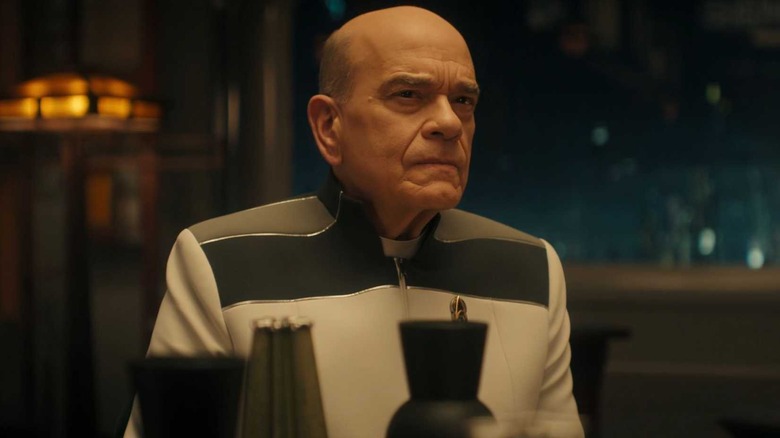
More recently, Picardo joined the cast of "Star Trek: Starfleet Academy," which is set in the 32nd century, more than 800 years after "Voyager." But the Doctor is still around, having added some wrinkles and grey hair to his generated appearance to convey some aging. This allows "Starfleet Academy" to account for Picardo looking older than when he played the Doctor on "Voyager."
Everyone the Doctor knew on Voyager, the first friends and family he ever had, is long dead. The centuries have also left him many opportunities to form new connections, only to see them fade away to time, too. The obvious question about the Doctor is, well, is he okay?
He's not. "The only thing that allows me to bear my infinity is not having to love anyone," the Doctor says in the latest "Starfleet Academy" episode, "The Life of the Stars." Absent any external danger, the Doctor's lifespan may end up being as long as a star's. However, he's not alone; Starfleet Academy Chancellor Nahla Ake (Holly Hunter) is a near-immortal Lanthanite, so she's familiar with losing loved ones like the Doctor has. So, with some encouragement from Nahla, the Doctor accepts the photonic SAM (Kerrice Brooks) as a surrogate daughter.
In Star Trek: Starfleet Academy, the Doctor becomes the father SAM needs

SAM is an artificial being similar to the Doctor; she hails from Kasq, a planet of light-based beings who evolved out of holograms, or the Kasqians. SAM, the Series Acclimation Mil, was then created and sent to be the Kasqians' emissary to the world of organics. But in "The Life of the Stars," her program is failing. As such, the Doctor, Nahla, and SAM journey to Kasq to see if her makers can repair her.
When describing her fear of dying to the Doctor's stiff upper lip, SAM says one thing she wants to experience is falling in love with someone. "Have you ever been in love?" she asks the Doctor. He doesn't answer directly, but my mind (and probably his) immediately flashed to Seven of Nine (Jeri Ryan), the liberated Borg drone who joined "Voyager" in season 4.
The Doctor had to learn how to be human, so he was the perfect person to teach Seven to be one as well. Starting out, their relationship paralleled that of Professor Higgins and Eliza Doolittle in "My Fair Lady," particularly in the "Voyager" episode "Someone to Watch Over Me." Eventually, the Doctor fell for Seven, although the pair never actually got together on that show (and who knows if they ever did before Seven ultimately passed away).
However, the Doctor and SAM's relationship winds up mirroring a different part of his life on Voyager.
Starfleet Academy builds on the Star Trek: Voyager episode 'Real Life'
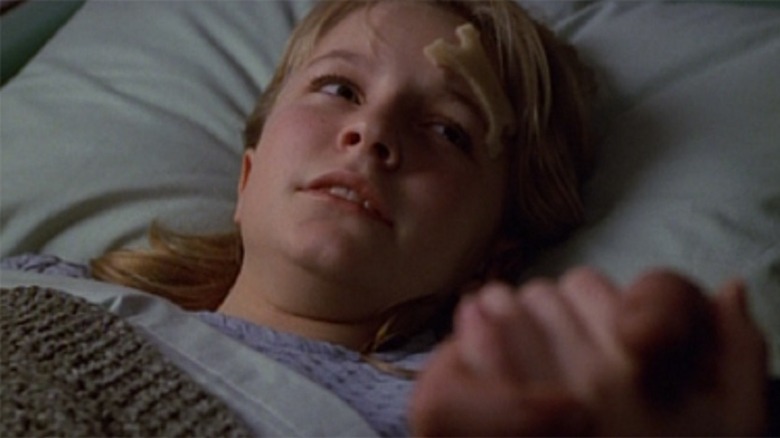
In the "Voyager" season 3 episode "Real Life," the Doctor used Voyager's holodeck to create a simulation where he's a human Starfleet medical officer named Kenneth living on Earth. He even had a wife named Charlene (Wendy Schaal), a son named Jeffrey (Glenn Harris), and a daughter named Belle (Lindsey Haun). The Doctor initially programmed the holodeck to make him a "perfect" family, but his crewmate B'Elanna Torres (Roxann Dawson) suggested he add some dysfunction to get a more accurate experience of being human.
The simulation thus took a tragic turn and Belle suffered a fatal brain injury during a sports accident. Even 800 years after that, the Doctor still speaks of her as his true daughter; Belle was his first major loss and one that weighs the heaviest on him. Tears in his eyes, he confesses to an unconscious SAM (with Nahla in earshot) that she reminded him of Belle, which only made the Doctor keep her at a distance. (Picardo's stirring performance will remind you how he made the Doctor into the breakout character of "Voyager.")
So, when SAM's makers claim she can't be fixed, the Doctor doesn't accept that. He concludes that SAM's neural deterioration is because she wasn't programmed with any pre-existing memories, so her mind couldn't handle the burden of emotions. So, to save her life, SAM is sent to experience 17 years' worth of childhood memories — with the Doctor playing the role of her father. Due to time dilation, moments pass by in the "real world" while the Doctor raises SAM. For photonics like the Doctor, time has little meaning, but he's remembered that it means a lot to other beings.
"Star Trek: Starfleet Academy" is streaming on Paramount+.