

Starfleet Academy Episode 6 Is A Tribute To An Undervalued Corner Of Star Trek Fandom

Mild spoilers for "Star Trek: Starfleet Academy" episode 6 to follow.
In the sixth episode of "Star Trek: Starfleet Academy," titled "Come, Let's Away," the cadets are all given an exciting new assignment. They are taken to a derelict Starfleet vessel, the U.S.S. Miyazaki, which has been adrift in space for an extended period. The Miyazaki is used as a training ground for cadets learning about away missions. There, they are split into teams, with one team tasked with reigniting the Miyazaki's computers and the other staying back and offering them support from the U.S.S. Athena. Cadets will then be graded on their performance.
The Miyazaki, it seems, is legendary among the new class of cadets, as it was described in a series of in-universe comic books called "Tales from the Frontier." This comic book, beloved especially by the Vulcan cadet B'Avi (Alexander Eling), told the (fictional) stories of the crew of the U.S.S. Miyazaki back when they were still active. B'Avi's own militant instructor, a man about a decade his senior, also cops to having read "Tales from the Frontier" when he was a boy, adding that he especially admired the Miyazaki's captain, Captain Chi.
Caleb (Sandro Rosta) chimes in to lambaste the comics, saying they were mere Federation propaganda. Later on in the episode, however, when the Miyazaki is beset by creatures, B'Avi finds his comics fandom to be useful; his knowledge of "Tales from the Frontier" gives him inside knowledge on the way the Miyazaki works.
This a definite nod to fans. As deep-cut Trekkies can tell you, "Star Trek" comics have been a long-standing facet of the franchise's fandom. These comics are often dismissed as non-canonical piddling about by comic writers, but such comments deny the thought, artistry, and imagination that go into making them.
The weird, wild world of Star Trek comic books
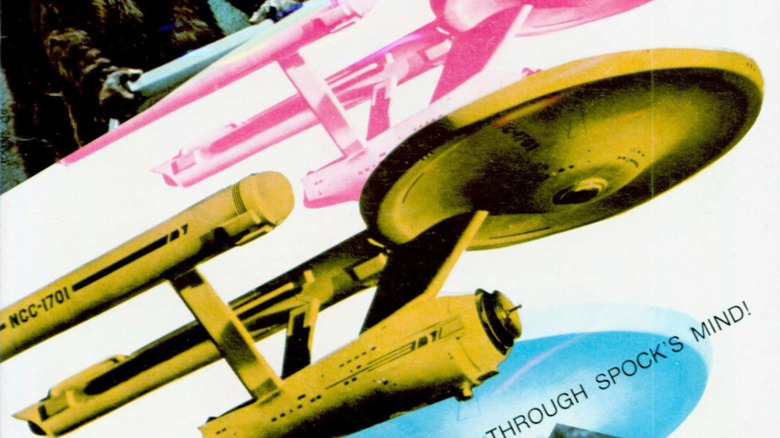
"Star Trek" comics are, in fact, almost as old as the franchise itself. A company called Gold Key Comics first began printing them as early as July 1967 (i.e. between the first and second seasons of "The Original Series"), and they mostly featured all-original stories. According to the Curt Danhauser website compiled in 1999, Gold Key's "Star Trek" comics lasted for an impressive 61 issues. The comics made good use of visuals taken directly from the show, but they also introduced new ships, uniforms, and other ancillary details before their initial run ended in 1979.
Some fans might even know about the "Star Trek" newspaper comics that were printed in England and the U.S. from 1969 to 1973 and 1979 to 1983. These comic strips may just represent some of the most obscure "Star Trek" ancillary material (along with those bizarre "Star Trek" audio adventures that were released on vinyl).
In 1979, Marvel secured the rights to "Star Trek" and released a comic book adaptation of "Star Trek: The Motion Picture." Marvel didn't work on "Star Trek" for long, though, and passed the rights to DC in 1984, allowing the company to oversee the stories on-and-off through to 1996. Concurrently, Malibu Comics published a comic based on "Star Trek: Deep Space Nine," a series that was swallowed up when Marvel Comics purchased Malibu in 1994. Marvel also ran a few comics based on "Star Trek: Voyager," but that didn't last long. DC then reacquired the rights and put out a few "Star Trek" titles under its WildStorm label in 2001. That, too, didn't last long.
(Coincidentally, one of the best writers to ever work on the "Star Trek" franchise, Peter David, was also a Marvel Comics legend.)
Star Trek and IDW Comics have a long history
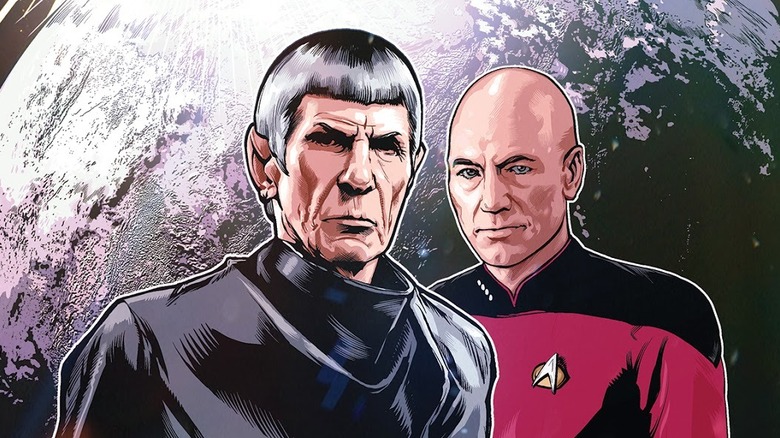
Since 2006, IDW Publishing has handled the publication of "Star Trek" comics, overseeing titles that span all of "Star Trek" history. IDW's partnership with "Star Trek" has lasted into the present, and it has even put out titles based on newer shows like "Star Trek: Strange New Worlds" and "Star Trek: Lower Decks." One can see the scads and scads of new "Star Trek" comics on the IDW website.
"Star Trek" comics, like "Star Trek" novels, spring from the canonical, on-screen shows and movies, but they often spin out into original stories. They don't (necessarily) take place in a parallel universe, yet they also aren't considered strictly canonical. Rather, they inhabit a fandom-friendly headspace where stories about the likes of Captains Kirk, Picard, Sisko, and so on can be explored without interfering with any of the "Star Trek" TV shows or movies. And, because they allow for any kind of visuals, the comics are great for time travel stories, crossovers, and other "what if" scenarios that fans will dig. Heck, there have even been comics where "Star Trek" characters meet the X-Men.
"Star Trek" comics have many loyal fans, and the fact that "Starfleet Academy" featured its own in-universe comics is a little tip of the hat to that crowd. "Tales from the Frontier" isn't just a cute little in-universe explanation as to how ideas of the Federation persisted throughout the dark days of the Burn, it's also a way of acknowledging that "Star Trek" comics, while not necessarily "true stories," are still paid close attention by many, many Trekkies. In "Starfleet Academy," comics are important to B'Avi. In the real world, comics are important to many people.
"Starfleet Academy" is streaming on Paramount+.