

Star Trek: Starfleet Academy's Shocking New Status Quo For Klingons, Explained By The Showrunners [Exclusive]
This article contains spoilers for "Star Trek: Starfleet Academy" episode 4, "Vox in Excelso."
"We are Klingons, Worf. We don't embrace other cultures, we conquer them!" proclaimed General Martok (J.G. Hertzler) in "Star Trek: Deep Space Nine." The Klingons are one of the oldest "Star Trek" alien races. While they've flip-flopped between friend or foe to humanity, they're generally portrayed as imperialists and warriors. But "Star Trek: Starfleet Academy" revealed a grim future for the Klingons.
By the 32nd century, the Klingon homeworld Qo'noS has been destroyed; apparently, conspiracy theories suggest that the Klingons themselves blew it up. "Star Trek VI: The Undiscovered Country" showed the Federation and Klingons made peace in the late 23rd century after Qo'noS's moon Praxis exploded due to over-mining. To save their planet from the effects, the Klingons had to call in the Federation's aid. (Though not without difficulties, as "The Undiscovered Country" shows how once-young idealists can become reactionary.)
Apparently, the Klingons' efforts only bought Qo'noS another millennium or so. Without a homeworld, the Klingon Empire has collapsed and there are apparently only eight feudal houses left. It's even said the Klingon race and culture could be heading towards extinction, a far cry from the people who once dominated the galaxy's Alpha Quadrant.
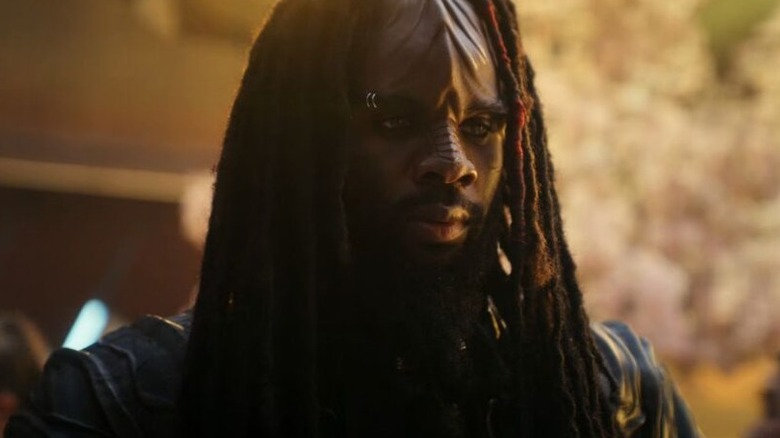
The latest episode of "Starfleet Academy" focuses primarily on the one Klingon cadet, Jay-Den Kraag (played by Karime Diané), and flashbacks of Jay-Den's nomadic upbringing are sprinkled throughout. /Film's Jacob Hall spoke with co-showrunners Alex Kurtzman and Noga Landau about this change to the Klingon status quo. Landau said:
"We've only ever known the Klingons as being this powerful race with an empire, with a home planet, and the idea of who you become when you lose that seed of power and you become a diaspora was really compelling to us."
The Klingon diaspora draws parallels between Star Trek and real history
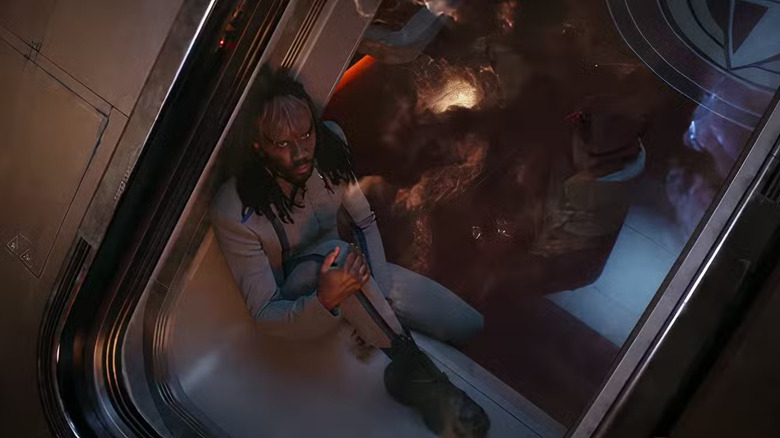
In place of the extinguished Klingon Empire, there is now a Klingon diaspora. This word, coming from the Greek word meaning "to scatter," describes people who have left their original homeland.
A real-world example is the Jewish diaspora, or the historical scattering of Jewish people into different communities. There's also the Irish diaspora, which includes American descendants of Irish immigrants who fled brutal British rule back in Ireland (history "Star Trek" has alluded to before). Speaking from personal experience in the Irish diaspora, it's easy to feel a melancholic longing to connect with your native culture from a distance. Many Irish Americans have historically supported Irish Republicanism even though they didn't have to face the real consequences of the struggle (which stories like the FX mini-series "Say Nothing" document).
Jay-Den faces a cultural conundrum of his own because he's not a natural Klingon warrior. He's at Starfleet Academy learning to be a medic, and this episode shows that even public speaking makes him sweat. Is he betraying his endangered people and family by not being a "true" Klingon? He realizes in "Vox in Excelso" that only a Klingon can decide what a "true" Klingon is.
Speaking to /Film, Kurtzman explained that "Starfleet Academy" seeks to build plots out from character. A story about Jay-Den struggling with his identity was a strong vehicle to tell a story about Klingon society:
"What happens if where [Jay-Den's] coming from is very fractured and he's dealing with the pressure of his family and what the expectations are about who he was supposed to be, and what happens when a character who doesn't fully understand their connection to being Klingon in the diaspora actually comes full face with it?"
How Starfleet Academy saves the Klingon diaspora

"Star Trek: Starfleet Academy" has introduced a few half-blooded Klingons; Lura Thok (Gina Yashere) is half-Klingon and half-Jem'Hadar, while the pirate Nus Brakka (Paul Giamatti) is half-Klingon and half-Tellarite. Knowing Klingons are now a nomadic species with a seriously lowered population adds new context to them marrying with other species.
That said, the Klingons aren't alone. The 2009 "Star Trek" film revealed that, in the late 24th century, the Romulans lost their homeworld Romulus when their sun went supernova. "Star Trek: Picard" picked up from this and showed a fractured Romulan people. The thing is, though, the Romulans' true homeworld wasn't Romulus — it was Vulcan. By the 32nd century, as "Starfleet Academy" shows, the Vulcans and Romulans have finally reunified into a single people, with Vulcan renamed Ni'Var.
The Klingons, too, find new hope at the episode's end. Starfleet has located a planet similar enough to Qo'noS, called Faan Alpha, that the Klingons can inhabit. But the Klingons won't take charity, not even from friends. As Jay-Den literally finds his voice in debate, he realizes, "battle exists in as many forms as there are warriors." Thus, Starfleet gets the idea to stage a "battle" for Faan Alpha, allowing the Klingons to "conquer" the planet.
As Kurtzman told /Film, "[This] gives us somewhere beautiful to go from here because now the Klingons get to rebuild, and that's super exciting." Landau added that they "love the Klingons so much and we really wanted to do them justice in telling this new chapter of their story."
Some "Star Trek" stories have definitely handled the Klingons better than others, but "Starfleet Academy" is off to a promising start.
"Star Trek: Starfleet Academy" is streaming on Paramount+, with new episodes premiering on Thursdays.