

An Oral History Of One Battle After Another's Best Scene, From The People Who Helped Make It [Exclusive]
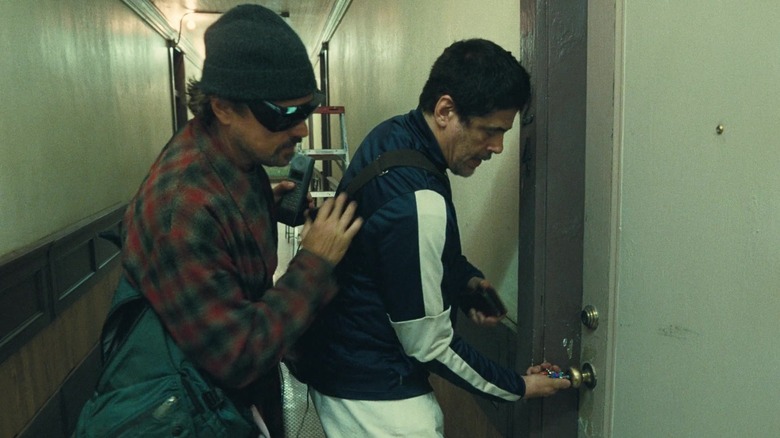
Paul Thomas Anderson's "One Battle After Another" is the director's most ambitious film yet, a fiercely political action-comedy that many people believe is the best movie of 2025. Its full-tilt pacing blasts you through the story, whipping from memorable moments to incredible setpieces, including an early heist-gone-wrong and that amazing car chase at the end. Arguably the most impressive setpiece comes about an hour and ten minutes in, when burned-out former revolutionary Bob Ferguson (Leonardo DiCaprio), who is trying to find his missing daughter, Willa (Chase Infiniti), visits Willa's martial arts instructor, Sensei Sergio St. Carlos (Benicio Del Toro) for help. This is an oral history of that incredible scene.
The extended setpiece features several of the premiere movie moments of the year. Jonny Greenwood's nerve-jangling, off-kilter score amplifies the tension as Colonel Steven J. Lockjaw (Sean Penn, playing the best villain of 2025) slowly closes in on his prey. The stakes have been clearly established, and this scene, which takes place almost in real time, contains elements that are thrilling, beautiful, terrifying, hilarious, and touching. In honor of the film's physical media release (it's available now on 4K, Blu-ray, and DVD), I'm happy to present an oral history of this scene, as told by some of the crew members who helped make it happen.
Crafting Sensei's dojo
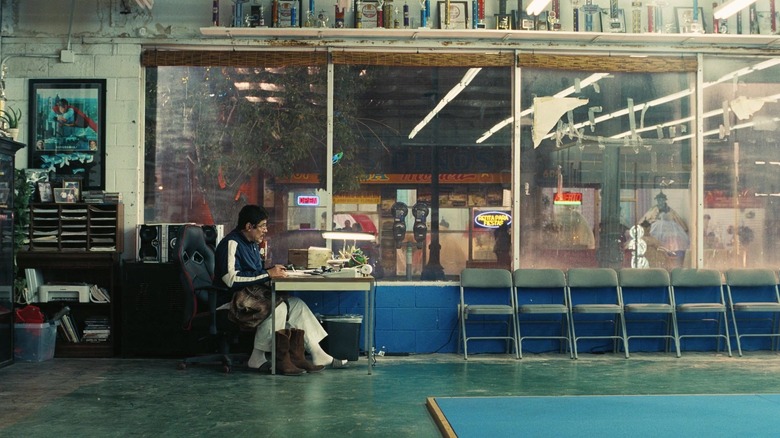
A frantic Bob learns Lockjaw is searching for him and Willa, so he visits Sensei at the dojo for help.
Michael Bauman (cinematographer): That was an abandoned storefront that they completely decorated and turned into the dojo.
Florencia Martin (production designer): The sequence was scripted that Bob meets Sensei and they go to Sensei's apartment, which is all interconnected with his family that leads to his bachelor pad. So we had that foundation. We went scouting for the film for over two years throughout California, and landed in El Paso and walked into the perfumery store, which became the anchor of all of Sensei's story. So we arrived to the perfume shop. We're in a city that doesn't get normal filming, so everyone was very welcoming, very curious to what we were doing. And we explained the story and said, "Can we poke around this building?" And they said, "Absolutely." So you go up the stairs that led to this interesting passageway to the building next door, which was completely gutted on the second floor and had one trap door that led to the bag shop below. So that was the genesis — which is funny because it's called Perfumery Genesis — of how we created that labyrinth that starts at the dojo, which we recreated in an empty storefront two blocks down as Sensei's dojo.
Michael Bauman (cinematographer): [Benicio] came in at a certain point in the film, we had already shot for half the movie. He came in and he's working with what his character is and exploring different directions of it. So we always had that place to go back to. Paul would be like, "I think we're going to take another bite at how the cops come by and they exit the place and Bob comes to the door and bangs on the door and all that." So you could just go back and turn the lights on and we could experiment with either different blocking or different dialogue. I was always appreciative of it, because it always gave us the chance to build on what we had already done and give it some extra juice just to make it a little bit better.
Florencia Martin (production designer): It was a very deeply collaborative process between the actors, Paul, and myself and our set decorator, because once Benicio landed in El Paso and walked through the sets, his inspiration also started brewing. So we got to the dojo and he's like, "Well, I would call my family to let them know what's happening." That is a small example of the incredible way that we worked on this film.
Michael Bauman (cinematographer): I think one of the things [that evolved in that scene] was turning the lights off when he was exiting. The original thing wasn't really going to be that kind of an exit, and then it was like, "Bob, get off the tataki," and all that. That was the two of them just riffing around. And then when he's like, "Okay, Bob, ocean waves, ocean waves" and all that, they play it in silhouette and they're being lit by a light that we had across the street down the block that's just coming through the windows. The whole ethos was just embracing the chaotic, improvisational moments that could happen, and you had to be comfortable with the uncomfortable. As a cinematographer, you're like, "Okay, well, we've got to really get this light right and give them [what they need]," but the beauty of it is by this point in the story, you knew who the hell Bob was. And because everyone's very familiar with Benicio, it didn't take long [to recognize] Sensei's character, everybody knows it. So then you can start really playing with silhouette and things like that.
Andy Jurgensen (editor): [Paul Thomas Anderson] loves to do long takes like that. Does it sometimes put you in a corner and you're like, "Okay, well, there's only one way to do this?" Yes, it does, of course. But what's so nice about long takes like that is that it allows the viewer, the audience, to look around and just see what's happening. There's even shots in the dojo where we're holding on Sensei when he's at his desk and Bob is crawling around or whatever, and we're seeing stuff happening outside, we're getting to see the posters on the wall.
Florencia Martin (production designer): I had an image of a bachelor pad where a man had a glass cabinet with all of his collectible figurines. And Sensei mentions Batman and these superheroes, and we were like, "Oh yeah, he would totally have a collection of superhero memorabilia." And then I stumbled upon that — it's a "Superman" poster in Japanese, and it was perfect [for] his dojo fascination, just a really good mark of character. And he's our low-key Superman superhero in this, so it just felt like a really good fit.
Andy Jurgensen (editor): It's just enjoyable to watch, and you're still watching the performance, too. It kind of is like you're watching two actors on a stage or something like that.
Florencia Martin (production designer): We came across [the tiger imagery] in the dojo we were going to film in Eureka [California]. [The owner] very graciously allowed us the rights to use his logo, if you will, for his business. It's a tiger head wearing a dojo master's [gi]. And the second we saw that, we're like, "Wow, that's it." I think Paul sent a photo to Benicio just like, "This is you." Life is better than fiction in that moment. So that became the main poster in his dojo.
Lockjaw stirs up trouble
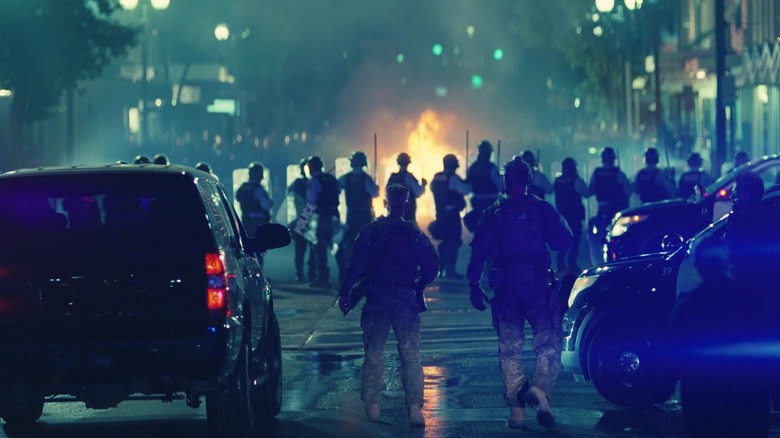
Meanwhile, a protest is brewing in the streets of the fictional Baktan Cross. Lockjaw has concocted a pretext for his forces to be in the city, and after shutting down a local restaurant and arresting innocent employees, the people of this community rally to stand against the overstepping militarized police. Lockjaw quietly sends in an agitator dressed as a protestor to provide a spark that gives his soldiers an excuse to fire tear gas at the crowd.
Andy Jurgensen (editor): It really was just keeping the momentum up the entire time. We were always trying to figure out where we were going to be doing the crosscutting between all the different characters. There's obviously Bob and Sensei, and then there's the [protest] that's happening. Then there's the soldiers trying to find Bob or trying to find Sensei, trying to get in.
Florencia Martin (production designer): We studied a lot of footage of the way people quickly react to things and how banal it can be sometimes. It starts with Bob running across that bridge with the redwoods behind him. And there's some activity happening at a taco stand and how people just take their phones out and start to congregate and how this can escalate so quickly. That was the progression of that action, where you see that first activity and then you start to feel it behind Sensei when he's at the dojo. So the glass window was really important to us, police sirens coming through, and adding to the tension of that scene of the fear that Bob has for his daughter, and all that unrest that's happening.
Michael Bauman (cinematographer): The unsung hero of the whole [protest sequence] is the sound design. I just want to shout out to that, and the score that Jonny [Greenwood] did, because those are two things that just add so many tension elements to it. But I think for that particular sequence, Flo and I had walked through and talked about practicals, talked about where light sources would come from, how to integrate as much as possible so we could just be shooting it. We'd light some buildings, we'd bring in movie lights for that, we'd do a few things, but also talking to the special effects, because they were going to have a car on fire, burning, which is awesome. As soon as you get that, that means you get smoke, you get cool lighting going on. There's a lot of things that add to the visual "wow" real quick.
Andy Jurgensen (editor): I think the way they shot [the protest] was interesting because it was, especially when we're looking at Lockjaw, there's moments where it's almost zoomed in, so you see, out of focus, soldiers and fire and things like that. It focuses on him, but you realize that there's this activity around him. I think the biggest thing was just getting the sound right there, because we had the chance from production, we had some good stuff, but it had to be augmented. And it wasn't just like the yelling and the fire sounds, but it was also all the, just the rustling of the soldiers, with all of their body gear and the armor and all that kind of stuff. Those were the layers of things we were adding to that to get that feeling.
Florencia Martin (production designer): Back to how accommodating El Paso was, because their downtown is basically a shuttered preservation of historic buildings, there's no longer any commerce really there. So for me, it's a dream, because you're not hiding a Starbucks or fast food restaurant. It's just a clean canvas. And throughout the film, we wanted everything to be practical in 360 [degrees]. So we did all of the lighting and camera with Anthony, our set decorator. So that was really fun to restore these streets and storefronts and what they would look like at night. And then El Paso was an incredible accommodating city because basically they gave us complete lockdown for these four city blocks in a circle. So all the driving sequences and then those scenes, we were able to completely lock down and close down and create fire and atmosphere. So it's the most blessed way to work.
Michael Bauman (cinematographer): You've got the cops on one end and the people on one end and [Lockjaw sends] in the guy they planted in there to throw the [molotov cocktail] — "Send in Eddie Van Halen" — and we had this long dolly track that just went down the whole block. A lot of these [background actors] were local talent that hadn't acted before, but they were certainly getting fired up on this. We could just go down the line and just photograph them and just catch all that raw energy. There was no wrong in it. People are dark, light, whatever. The energy of it was so overpowering. And then we did the one shot where we looked down the way and the car actually exploded. Something heated up in the car and it blew up. Not blew up massively, but it had some sort of thing going off, and that's in the film. Justin and the gaffer put some lights way down at the end of the street so you could see the silhouettes and the shadows of the people as they're in the smoke, as they're getting all mad and you're pulling back, and there's the whole line of cops and all that stuff. It was really just — that, coupled with the sound design and that energy, your mind just puts it all together in a really unique way.
Andy Jurgensen (editor): There's a balance. You don't want it to look too small, but I feel like if we had made such a big deal about the protest, then you're losing the story, which is more about Bob and Sensei, so we didn't want to overstay our welcome in the protest. That's just one element of what's happening right now. There's this whole other thing with Bob and trying to find his daughter. That's what we're really focused on, so it just was just one element of it.
Michael Bauman (cinematographer): One of my favorite shots in the film is that one where the skateboarders come up next to [Bob and Sensei] in the car and he's like, "What's up?" They say, "It's World War III out there, man." And then [Sensei]'s like, "All right, meet me at Genesis," and they drive and you get the shot of all the skateboarders panning with them as they all go around the corner. It's silhouettes and texture, and that was the whole key to the thing.
The kids are all right
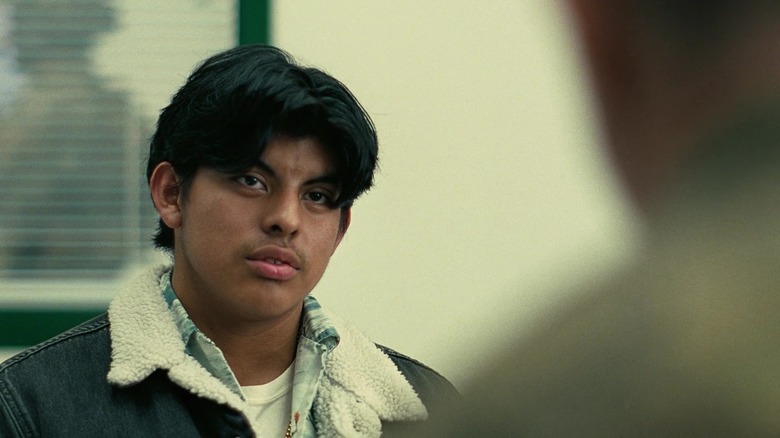
While all this is happening, the film cuts across town to Willa's high school, where her friends are being interrogated by an imposing figure from Lockjaw's squad who's trying to find Willa.
Andy Jurgensen (editor): The interrogations, they weren't really scripted, so I think the kids were thrown in with Danvers [the interrogator character] and didn't really ... I think Paul maybe gave them a prompt or something. "Okay, you cannot say anything. Willow doesn't have a phone. Just say what you would say as your character." A lot of fun stuff came out of that, just different reactions of the various teenagers. So it was really going through the footage and finding the good, funny moments. It started out longer and I remember we just started trimming it down and down and down and it got to be distilled to the version it is. But the line when [Danvers] says to Bluto, he's like, "Do I look like your dad?" And [Bluto's] like, "Kind of," that just came from when they shot it, just improv. It got a laugh in dailies. So we're like, "Okay, that's going to be in the movie." We had to get that one in there.
A journey through Sensei's family's perfume shop
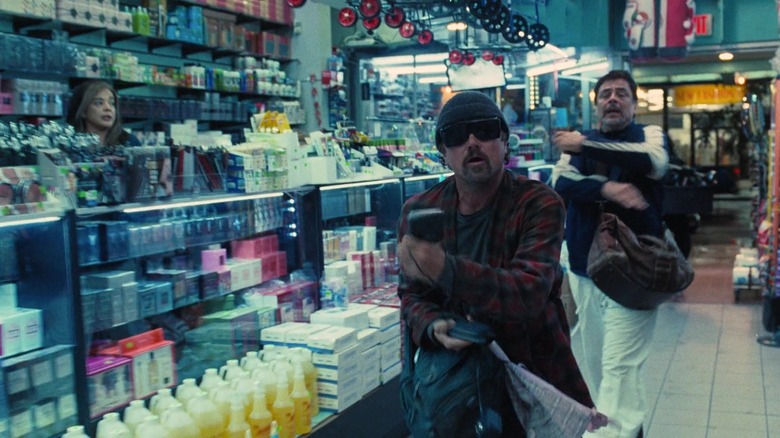
The calm, cool community leader takes Bob to Sensei's family's perfume store, through what Sensei refers to as "a little Latino Harriet Tubman situation" happening in his building, and finally into his apartment, introducing an agitated Bob to various family members while Bob bounces around like a pinball as he searches for a phone charger.
Florencia Martin (production designer): By the time we got to the perfume shop, we strongly felt that that was [Sensei's] family's store and his apartment would just be right above, because it's a bit of a front. Then we cast the actual people that worked in that store as his family. So Benicio goes in and he's like, "Maricela, you're working the cash register. You're closing up the shop," and starts orchestrating all these people in the natural way that they worked, because we got there at closing time, so we started seeing the way they pulled things off the sidewalk and closed the gates. So [it was] this very beautiful, energetic way of working.
Andy Jurgensen (editor): What was so great is that we were able to have this camera that's moving through the hallways, moving into the apartment, moving outside, and you really feel a sense of the space. They did an incredible job, and it luckily was able to translate to the final product. [...] Especially upstairs, I mean, there are shots that are going down the hallway into the entire apartment, down to the other side of the room, and then it's moving outside to the hallway. It just makes you just understand the geography and you just feel the energy and everything. That section was really ... I don't want to say it was easy to put together, but things fell into place. It was more just like moving stuff around just because we had so much good material.
Michael Bauman (cinematographer): So much of the film was about the energy and just having the camera going and moving and always in motion and the roughness of that. You start with that baseline of the language. And then one of the things was Sensei's apartment, for example, when [Bob] really interacts with Sensei, that was all a very interesting build that was done on the second floor of a building in El Paso. The main reason we were there is because we could see out the window for that one part where [Bob] goes to the window and the curtains fall down and he's looking down below. It was being able to tie in that world. Flo, the production designer, she and her art director, Andrew Cahn, it was a totally empty space and they constructed all the set within that, and the only thing that existed was the trap door.
Florencia Martin (production designer): As far as the set design, we worked by taking all of the visuals of what we had scouted. So we were in immigrant houses in El Paso that represented really what these families were like, and we recreated that from the ground up on the second floor of this loft. And the best part was being able to say, "Okay, here's the perfume shop, you go upstairs, this is where the sanctuary is," [and that area] where Sensei keeps the immigrants, that actually is a sanctuary for people crossing the border. They allowed us to use all of the supplies that they offer everyone as help when they come, and all of the artwork was created by the children of people. And it's really unbelievable to be able to work that way, because what they're depicting is America, family, this idea of a new beginning. [...] The people of El Paso were extremely accommodating and extremely open to the story that we were telling. And so all of the majority of the set dressing and the props are locally from El Paso and donated, as well as the church, because we wanted to really be accurate and really be sensitive to what we were depicting.
Michael Bauman (cinematographer): Did [Flo] tell you they had to assemble [Sensei's apartment set] in L.A. and ship it out? It was interesting because there was a historic building, and really the best way to get in there is to pull the windows. You remove the window and you can [bring the set in through them]. But they didn't know if they could [legally remove the windows]. So Andrew had to, from Flo's rough design with how she'd designed it, figure out a way how to build [Sensei's apartment set in pieces]. He ended up sending two guys to Home Depot, and they built a four-foot-by-nine-foot panel. He had them walk it up the stairs and figure if they could actually get it in there in case they weren't able to pull the windows. He knew he could never build anything bigger [for Sensei's apartment set] than four-foot-by-nine-foot. So he and Flo designed the whole thing and they built it on a stage in L.A. so we could look at it, and then they took it all down, shipped it out to Texas, and then assembled it on the location.
Florencia Martin (production designer): The fact that we got to infuse all the sets with this type of mirroring of what we were seeing was just a really amazing way to design a contemporary film. And then the satisfying part of this long hallway that Sensei gets to, walks through all of his family. Each set was really beautifully detailed by Anthony Carlino, our set decorator, and his team, telling the story of each family. Like, one's [the] grandparents, the next one are the bachelor cousins, the next one is his sister with the baby, and you get to Sensei's [space]. Throughout the film, you meet these people and their stories continue on beyond what's happening in that scene. So it's really great because working with Benicio, he's like, "Okay, I'm going to take money to the church. So I keep my envelope here and I have my boots always in this corner." And we were thinking with Anthony, he probably gets home after a long day, listens to music, has his meditation area, because a lot of that was based off of Northern California, which is where the story takes place, even though we filmed it in El Paso.
Sensei's apartment and the Comrade Josh phone call
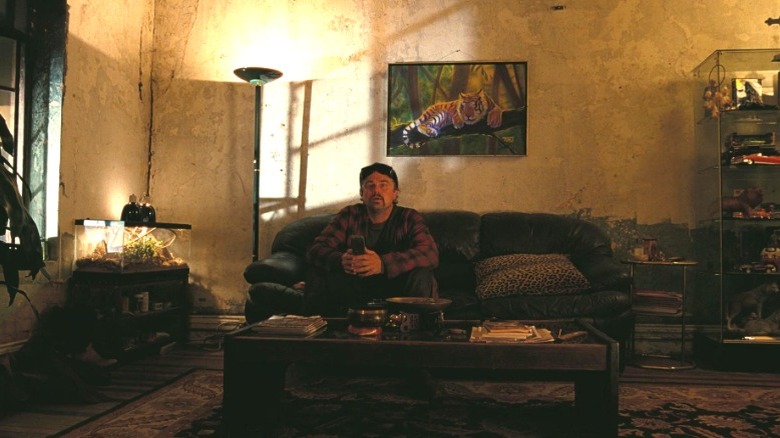
During a hilarious phone call with a revolutionary go-between named "Comrade Josh," Bob learns the coordinates of a safe house where Willa is being held.
Florencia Martin (production designer): I set [the tiger imagery] as the background of his cell phone, and then Anthony, our set decorator, ran with it with a motif and actually got a commissioned artwork from a local artist that's hanging on the wall behind Leo when he's doing his [phone call]. So I think it just represents that the tiger inside of us that Sensei would want to also project onto his students as his motif. But we had a lot of fun infusing — the whole film for me is about building these characters and all their backstories.
Andy Jurgensen (editor): We watched dailies during the shoot communally, so we had our favorite takes [of the phone call], I think just from what the script supervisor had circled from when Paul was there on the set. And I remember we just watched some of just the raw dailies of Leo, and there were two takes that just were the best. He loved them, they got really good laughs in the room, and so we stuck to these two. And we usually don't do two cameras, but we actually did have a front angle and like a side angle of Bob for a lot of that stuff so we could cut between if we needed to. And then [Comrade] Josh on the other end of the phone was there live, so that helped the performance. It wasn't just like reading against some other actor or like script supervisor or something, so we were able to use that recording as well from Josh [in post] to use and play back and forth.
Michael Bauman (cinematographer): The other thing that was really interesting about that set is that Anthony Carlino, the set decorator, he decorated the whole thing, because he and I and Flo would have a lot of conversations about integrating lighting in the space, but he decorated it off of Facebook Marketplace and stuff that's local to the area. We'd just be like, "Hey, let's get some crappy practicals here," and he'd be like, "Yeah, here's 10 crappy practicals I have that I just bought for five bucks down the street." It allowed that kind of chaotic energy to go through the whole thing. It allowed us to move the camera all the way through and shoot in every room we could, which is pretty cool.
Andy Jurgensen (editor): That was a section where you want to find lengths of time that you can stay on Leo and squeeze as much humor out of [a moment] before you have to cut, instead of cutting to all these different angles or cutting to different takes, [where] it just feels manipulated. You don't want to be cutting to the front and the side and the front and the side and all these things, because it just feels there's too much cutting. So you have to stay with the front angle for a little while. I remember we threw in that when Sensei goes in the bathroom, [Leo's] like, "What time is it?" and [Benicio] says, "8:15." And we were like, "Okay, I hope that gets a laugh." And it got a laugh in one of our screenings. Like, "Okay, that was good." You're just trying things.
Florencia Martin (production designer): It's just magnificent to be able to build characters in this way, build on location and have a whole playground at your fingertips.
Andy Jurgensen (editor): Then there was a point in which we decided, "Okay, we're going to move to the side angle when Benicio sits down with the gun and is doing all of his stuff." That was what was fun, too: We were able to use all the fun stuff that Benicio was doing in silence on the other side of the room as ways to manipulate the timing to make things play better.
Florencia Martin (production designer): The greatest kickoff from there is the labyrinth that we were able to actually physically create in those four blocks in El Paso because Sensei goes down the trap door through the bag store, and Bob goes through the water closet to the flower shop, which is actually a block down, comes up that roof, jumps to another roof that was two blocks down, then they jumped to another roof and land through a tree that we actually had in real life that our stunt men jumped over.
A shocking tumble from the roof
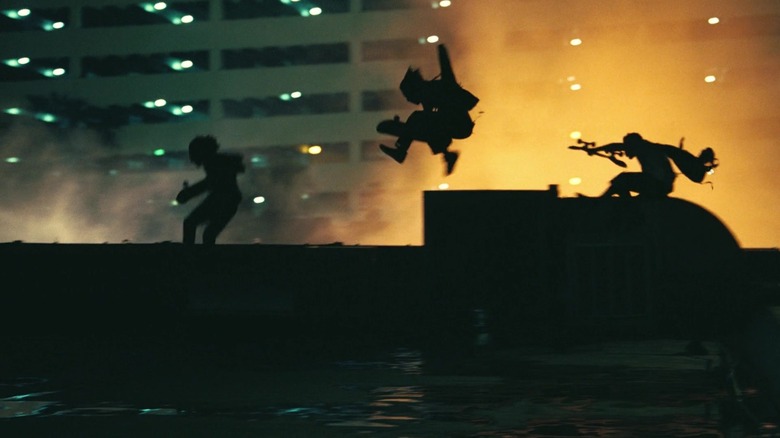
With Lockjaw's forces closing in, Bob and Sensei split up. Bob follows some young skateboarders to the roof, but instead of leaping from one building to the next, the middle-aged Bob can't keep up with them, so he misses the jump, crashes through a tree, and hits the ground.
Michael Bauman (cinematographer): [Silhouette] was something we also were able to really explore when they run across the rooftop, and they're just running in silhouette, because the skateboarders have their own unique look, Bob obviously has his crazy look, and you just need to see a few beats where you actually have light on their face, and then you can really tell the story of a silhouette and all the chaos that's going on behind them, which is just the madness of the world.
Andy Jurgensen (editor): I was figuring out the best takes where Bob looked like he was struggling the most [on the rooftop]. And one of our assistants, I remember I asked her, I was like, "Can you go through and find any of just the vocalizations that Bob was doing, the [grunt noises] and, 'oh, s***,' random things like that?" Because I knew that would be really funny there just to accent the difference between like what he used to be like and now 15 years later, trying to keep up with these kids.
Florencia Martin (production designer): [Leo] was just doing all of the jumping, and in a very comical way, falling behind as Bob would in his bathroom and sunglasses.
Andy Jurgensen (editor): This movie has a lot of cuts in it compared to Paul's other movies, but Paul doesn't like to cut that much. He wants to stay with performances and he feels like it's more effective to do that, so I'm always trying to hold back and be like, "Okay, so how could I do this scene with like a few less cuts?" Then you're relying on the performances, you're saying, "We're not manipulating this too much." It's finding that like middle ground of, you obviously have to cut sometimes and you want to create energy, but you also want to just find the takes that can play themselves.
Michael Bauman (cinematographer): Leo had a really great stunt double. His name was Levi [Gilbert]. There was a tree that was actually growing there on the location. It was like, "Oh, this is cool. Maybe we can play with this a bit," because we had a couple different concepts for how [Bob] would escape. We looked at some other locations, but it always kept coming back to the tree. There's a thing called a descender rig, which is a stunt rig that hangs off of a crane. Levi was on that and he ran, he did the jump, and then he could fall, and they could slow the rig down really quickly. He could fall [very far at full speed] and then they hit the brakes.
Andy Jurgensen (editor): Basically [the end of the scene] is like three or four shots stitched together, but like the main chunk of it, which is Leo getting up and going around the corner, I think we had like two or three takes that we really liked, but we settled on one. I was there that night when they were shooting, to make sure that they got everything. And we did a few different kind of falls. He can't be like going head-first down, and it was random how it happened because you're jumping and going through branches. The stunt guy was amazing. But it had to be a fall that would still be kind of believable that he could just get up right away, so it was just finding that right plate and then stitching it together with the hero shot for Leo.
Bob gets tased
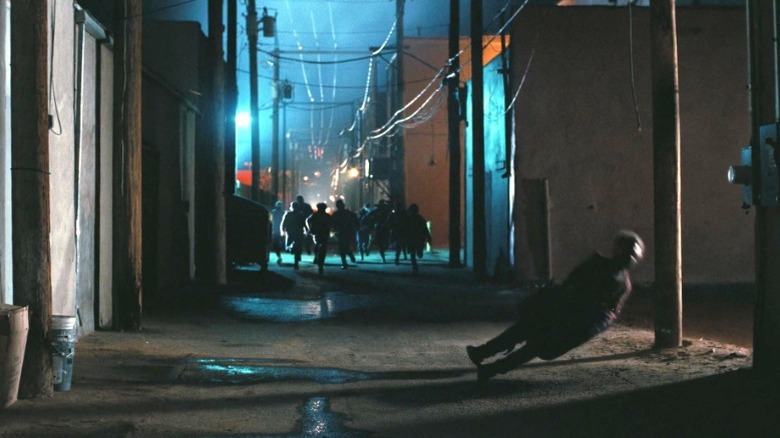
Bob gets up from his fall, but is quickly tased and arrested by the police.
Michael Bauman (cinematographer): Then obviously we remove [the descender rig digitally] and then Leo just got up from there. We kept the camera positioned the same. Leo gets up, runs in, runs towards camera, we have all the chaos going on in the background, he turns. With Leo, we did that run, his turn, and then we had a stunt pad, and he faked getting tased and fell.
Andy Jurgensen (editor): The taser is VFX, so he mimicked getting tased and getting rigid and falling.
Michael Bauman (cinematographer): But we did another version with Levi doing [the taser fall] with no stunt pads so we could get a complete fall. And then they just do a little stitch of the whole thing as the fall's happening and then added the taser lines that hit him. Those were digital that hit him. And then also we'd shot a pass of the cop cars coming through and going down and chasing people down the road and all that kind of stuff.
Andy Jurgensen (editor): Like two days later, I took the raw footage and roughly stitched it together to be like, "Okay, this is going to work, proof of concept, I got it," and then we sent it off to visual effects to start working on it.
Michael Bauman (cinematographer): I wish I could say that it was like, "Oh my god, we had the whole thing storyboarded and it went flawlessly." There was really very little storyboarding, if any, on this movie. It was really more about having Andy, the editor, there, and we'd shot it over a series of nights because we always had other things we had to shoot those during those nights. So Andy could cut stuff together and we could see it and he could comp things and see, "Okay, cool. Yeah, this is going to work. Let's do this and do this and do this."
Florencia Martin (production designer): A lot of what we talked about, too, with our late and great Adam Somner, first AD, was exactly that: How do we continue to build tension and escalate this scene that then ends like a squashed fly with Bob getting tased? And then, like the title of the movie, "One Battle After Another," you're onto the next, Bob in jail, and that was an amazing thing to discover and find because the whole film, we wanted to anchor it in some truth, as well. So developing that with Benicio and Leo and Paul, we went to an actual jail, which they allowed us to film in. Talking to the county police officer, like, "How do you book somebody? Where do they go? How could they get out of this?" Discovering that, oh, he's got "diabetes," so he's going to a hospital. And all of those nurses are real nurses and are so genuine, and they also help you going, "Oh, in reality, there's always an officer posted, but you could go out the back way." So it's just a really amazing way to construct a scene and to work with people that are experts that are always helping you bring that real texture into the story.
Michael Bauman (cinematographer): Every day you'd come into work, and you'd have people who were — you had real cops, you had real folks. You're trying to throw in these whole different chemicals into the pot, into the beaker. To me, there was a moment where I was just standing there and all this was going on, I'm like, "Wow, this is really special." That's one of the reasons you make movies, is you have these experiences where you can put all these things together and just stuff starts to scale and build upon itself. Those are really unique moments that are really cool, and this film was littered with them.
"One Battle After Another" is available now on physical and digital.