

Is Marty Supreme Based On A True Story? Here's The Truth
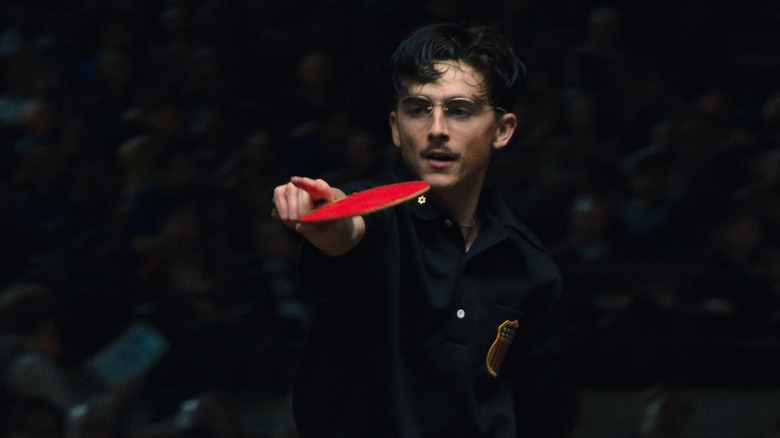
All too often, folks see the phrase "based on a true story" and focus far too much on the "true story" part while skipping over the "based on." It's a problem that's existed practically since the beginning of cinema (if not earlier), and has resulted in everything from "print the legend"-style hagiography to people putting themselves in mortal danger. Yet it's not audiences who bear all the blame for this. To be sure, hundreds of unscrupulous hucksters, ballyhoo men, and advertising firms have only been too eager to sell tickets by using the lure of supposed reality when it comes to films and television. In some cases, this has gone so far as to make the ads feel less like salesmanship and more like a kind of confidence game.
Several films released this holiday season are based on true stories: "The Testament of Ann Lee," "Song Sung Blue," and "Avatar: Fire and Ash" (Okay, yes, I'm joking with that last one). Josh Safdie's "Marty Supreme" doesn't contain a disclaimer about its roots in reality either in its advertising or its credits, and to be sure, many of the film's outrageous elements and setpieces are the work of fiction. Yet while the movie cannot be said to be based on a true story per se, it is indeed based on a real person. In the film, Timothée Chalamet plays Marty Mauser, a New York City hustler who uses every trick he has at his disposal to try and make himself a table tennis world champion. Mauser is based on Martin "Marty" Reisman, an NYC table tennis player and sometime champion. As such, "Marty Supreme" isn't based on a true story per se, but is based on reality.
The real Marty Mauser was Marty Reisman

"Marty Supreme" is set in 1952, and the reason for that is not arbitrary. For one thing, it was during the '50s that the sport of table tennis (aka ping-pong) saw its popularity further expanded beyond its English origins to include Asian countries. As depicted in Safdie's film, this popularity led to these countries competing in official championships more often. The Japanese gold medal winner for 1952 in men's singles, Hiroji Satoh, is likely the inspiration for the character of Endo in the film, played by Koto Kawaguchi, who becomes Marty's professional rival. Additionally, the '50s saw foam be introduced to classic table tennis paddles, which further transformed the game. This development is also mentioned in the movie, albeit in a twisted fashion.
Of course, the primary reason for the film's period setting is that it's loosely based on Marty Reisman's life. While a majority of the incidents in the film are fictional, the spirit of Reisman can be seen in Mauser throughout. Like his cinematic counterpart, Reisman was born into an Ashkenazi Jewish family and was obsessed with table tennis from an early age. He hustled for money at various table tennis clubs and eventually competed in numerous championships, winning a total of 22 titles between 1946 and 2002. During his life, he became such a visible, flamboyant character that he not only did comedy routines for the likes of the Harlem Globetrotters (as seen in the film) and appeared on talk shows, but he also became known for his signature style, as he often wore bright clothing and some type of fedora. So, while neither Mauser's costumes nor the film's viral jackets and other merch resemble Reisman's style, they continue his flair for splashy fashion.
'Marty Supreme' exemplifies Safdie's loose, interpretative approach to reality
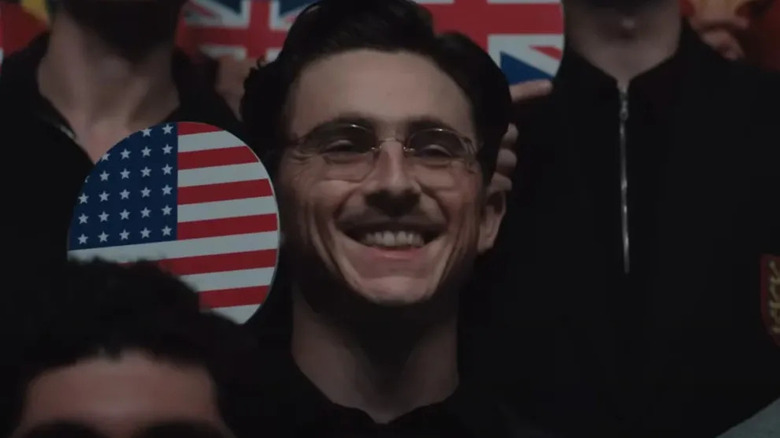
Although "Marty Supreme" and Chalamet's performance undeniably pay homage to Reisman, it would be erroneous to call the film a 1:1 adaptation of the latter's life. In contrast to the numerous other films that are loosely based on true people or events, Safdie and co-writer/co-editor Ronald Bronstein take "Marty Supreme" several steps beyond period verisimilitude. To be sure, the production design (courtesy of Hollywood legend Jack Fisk) and costume design (by Miyako Bellizzi) appear to be accurate to the '50s, as does any diegetic music. Yet Daniel Lopatin's original score is an electronic fantasia, creating a sound that's as 2025 as it is reminiscent of the '70s and '80s scores by the German electronic music group Tangerine Dream. Safdie and music supervisor Gabe Hilfer double down on Lopatin's aural direction, stuffing the film with a gaggle of '80s pop/rock needle drops.
All this is to say that Safdie and "Marty Supreme" are deliberately creating a fictionalized world made up of a blend of various elements, combining the historical and ahistorical. It makes the film a heady experience, which intentionally disassociates the viewer from any feelings of distance created by the period setting or the trappings of the story in general. This way, Safdie can put the audience directly in the same emotional headspace as Marty Mauser, allowing the various chaotic happenings to feel that much more powerful and immediate. As a result, the film is that much more emotionally truthful. While "Marty Supreme" may not be based on a true story, it's indeed based on a real-life person, and so many aspects of Marty Reisman — his hustler nature, his love of table tennis, his foibles, and his small triumphs — are represented in the movie.
"Marty Supreme" is in theaters everywhere.