

Fallout Season 2 References A Popular Location From The Games (And Gives It New Meaning)
This post contains spoilers for the "Fallout" franchise.
Season 1 of "Fallout" makes its central MacGuffin worth our time. While every faction covets the severed head of ex-Enclave scientist Wilzig (Michael Emerson), the key lies in the Cold Fusion tech lodged inside his brain. As energy is an invaluable resource in the Wasteland, Cold Fusion's ability to generate infinite energy provides surface settlements access to electricity for the first time. But it also poses the risk of bloodshed and all-out civil war, as whoever controls Cold Fusion can shape the future of the Wasteland.
Season 2 picks up right after these events (read /Film's review here), with Lucy (Ella Purnell) and the Ghoul (Walton Goggins) traversing the Mojave Wasteland to track down Hank MacLean (Kyle MacLachlan), who revealed himself as an antagonist last season. While Lucy and her mutated travel buddy don't represent any factions, they're both in search of answers connected to Vault-Tec and the role they played in triggering the apocalypse. As the two bicker while traveling, the Ghoul notices a dilapidated building in the desert: the Starlight Drive-In. This is a pretty familiar name for those acquainted with the "Fallout" games, as the Starlight Drive-In is a prominent location in "Fallout 4," and its Appalachia-based namesake is also featured in "Fallout 76." Starlight was most likely an American drive-in chain before the nuclear war, with the Mojave structure being built in what's now known as New Vegas.
This, however, isn't a throwaway franchise reference, as the Starlight Drive-In has always represented rehabilitation and the potential for a better future. In this case, the Ghoul glances at it with longing and regret, which might clue us in on the role he played days before everything went to hell. Let's take a closer look at what it represents.
The Ghoul views the Starlight Drive-In as a nostalgic relic of the old world
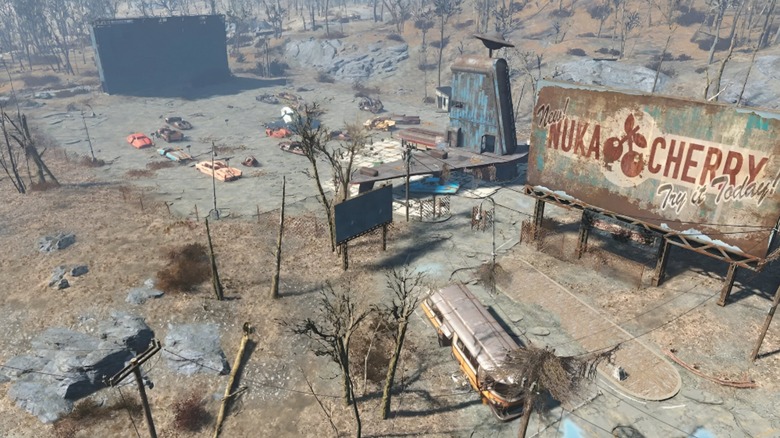
In "Fallout 76," the Starlight Drive-In (situated in the Burning Springs region) is a regular quest area overrun with feral ghouls. The more interesting chain is located in the Commonwealth in "Fallout 4," where players have the option to rehabilitate the area into a settlement. The possibilities are limitless, as its open-space plan allows you to build a massive marketplace with bustling stalls/connected walkways, or turn it into a full-scale factory with armed fortifications. When we first arrive at the Drive-In, some parts of it are radioactive, but this issue can be solved to make the area more habitable.
This hopeful association is somewhat changed from the Ghoul's perspective, as he notices that the theater's final show was one of his own Westerns, "A Man and His Dog 3." His name, Cooper Howard, is also written beneath, reminding him of the person he used to be before his mutation.
Despite his ruthless demeanor, the Ghoul isn't immune to the hope of being reunited with his family, even though it's unlikely that they've survived this long. Given that Vault-Tec employees underwent cryogenesis to survive literal post-war fallout, it isn't far-fetched to assume that his family might still be alive (but he doesn't know that yet). The premiere also flashes back to Cooper actively trying to sabotage Vault-Tec's pre-war schemes, representing a time when all hope was not lost, and the world could still be saved. Starlight Drive-in evokes nostalgia for pre-irradiated America, one where he was Cooper Howard — beloved actor and family man — and not a broken, revenge-driven soul corrupted beyond recognition. While the Wasteland can still be rebuilt, nothing will ever be the same.
The season 2 premiere of "Fallout" is now streaming on Prime Video.