

Absolute Joker Gives The DC Villain A Real Name And Origin - With A Shocking Twist
We may receive a commission on purchases made from links.
Spoilers for "Absolute Batman" #15 follow.
"Absolute Batman" #15 is a Joker origin issue. While those paying attention to the advertising might have pieced together the book's mysteries, writer Scott Snyder and guest artist Jock still weave a terrifying tale.
The Joker has appeared infrequently in "Absolute Batman," but he's the story's main villain. One of the world's wealthiest men, the Joker has funded all the horrors in Gotham that Batman has faced: Black Mask's Party Animals, Mr. Freeze, Ark M, and Bane.
The "Absolute" Joker is a public figure, so unlike the classic Joker, his real name is public knowledge. "Absolute Batman" #15 reveals it: Joseph "Jack" Grimm V, supposed scion of the wealthy Grimm family. Both "Joe" and especially "Jack" are names associated with the Joker; recall his sometimes alias, "Joseph Kerr," and his real name being Jack Napier in the 1989 "Batman" film. "Grimm" is likely a pun, referring to how this Joker never laughs or smiles.
Both "Joe" and Jack" are very generic names too. That reflects that the Joker could be anybody, both in the sense he was an unremarkable "average Joe" before his clown phase and his deluded belief that deep down, everyone is as evil as him. The "Absolute" Joker, though, is far from ordinary: He's been alive since at least the 1880s, and Jack Grimm I-V are not a familial line but a single man posing as such.
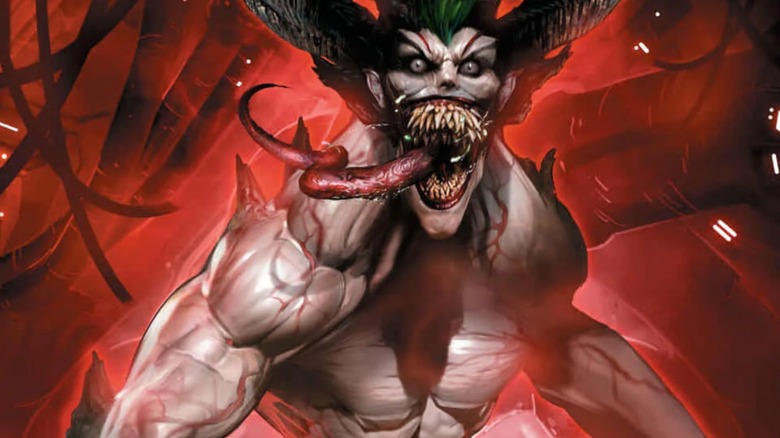
The issue also gives us the first look at the Joker's monster form, teased in previews and covers, and his transformation into it. His spine twists, a green "krack" sound effect contorting around it, as he grows into a 15-foot tall, pale-skinned, green-horned beast with long claws and multiple rows of teeth. From that horrifying maw, we finally hear the "Absolute" Joker laugh.
Absolute Joker has lived over a century as Jack Grimm I-V
Snyder's 2016 arc, "Batman: Endgame," teased that the classic Joker was an immortal, Pennywise-esque clown demon who'd been sowing misery and terror in Gotham City for centuries. That turned out to be the Joker's latest prank on Batman, but the idea must've stuck with Snyder. Now, he's using it to reinvent Joker for "Absolute Batman."
Wisely, though, some mystery is maintained; the Joker's immortality could be "infernal science," or "a dark pact," or both, but we don't know. The issue is framed as Alfred Pennyworth (who, remember, is a British secret agent here) finally telling Bruce Wayne about the Joker. We never get a peek at the Joker's thoughts, so like our heroes, we must try to understand the rogue from his history and actions alone.
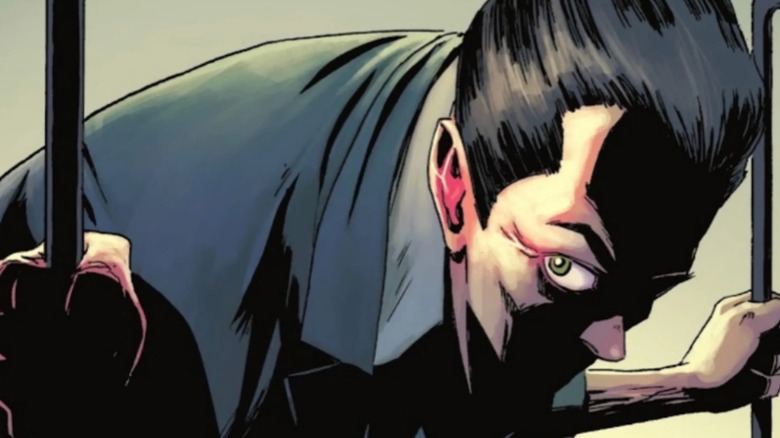
What is that history? In 1888, Jack Grimm was a Gotham City orphan turned street performer who employed newly developed nitrous oxide (laughing gas) to leave crowds bowled over and robbed blind. He used the money from his performing act as the seed of a business empire. Over the decades, he's spread his influence over the globe, making a corporation so powerful it holds all the cards of the world's future.
The issue unfolds in layers: Alfred tells Bruce the public truth that the Grimm family are philanthropist billionaires, then that the Grimms funded all the suffering they supposedly helped alleviate, and then his unbelievable (but true) theory that there is no Grimm family. Jock uses double page spreads throughout the issue, arranged like a collage to show the breadth of the Joker's history as Alfred narrates. The structure echoes the Joker's famous statement in Alan Moore & Brian Bolland's "Batman: The Killing Joke" that "I prefer [my past] to be multiple choice."
Absolute Joker has Bruce Wayne's usual resources
The issue resolves any complaint that the "Absolute" Joker had abandoned the character's clown motif. As a child performer, Grimm dressed in clown makeup, and he built his fortune through investments in the entertainment industry: Vaudeville theatre, Hollywood, television, video games, etc. Alfred suggests that Grimm's affinity for clowns is not because he wants to spread laughter, but because of his sneering contempt for people:
"A clown plays the fool while making a fool of everyone else. [...] Its whole act is a cruel mockery of us, of humanity, as bumbling, stupid."
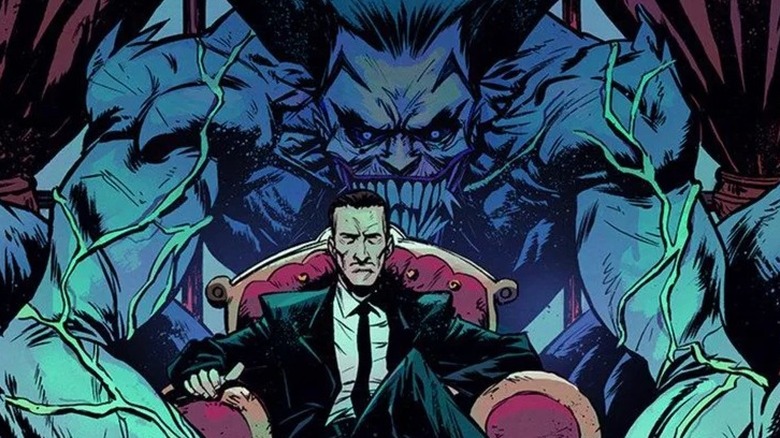
Yet, the story doesn't just bring "Absolute" Joker closer to Joker tradition. This Joker is a lot like classic Bruce Wayne, from his human appearance to his vast wealth. Alfred refers to the young, street-performing Jack Grimm as "the boy in the alley," i.e. like young Bruce Wayne losing his parents in an alley. One of Grimm's pet charity causes is orphanages — but rather than training those troubled orphans as Robins, the Joker drains their blood to keep himself young.
For most of the issue, the Joker is away on one of his private islands, hunting (and devouring) the most dangerous game. He then returns to his Gotham manor, greeted by his Alfred-like butler, and we learn he has a secret cave hidden behind a clock in his manor. As the Joker descends down the stairs, the red light from the cave reflects on the wall in the shape of a clown's smile.
The Joker is a flexible character, like Batman; a good comedian knows when to get new material. "Absolute Batman" has crafted a Joker perfect for the 2020s: a blood-sucking oligarch who wants power to lift him above the humanity he despises.